



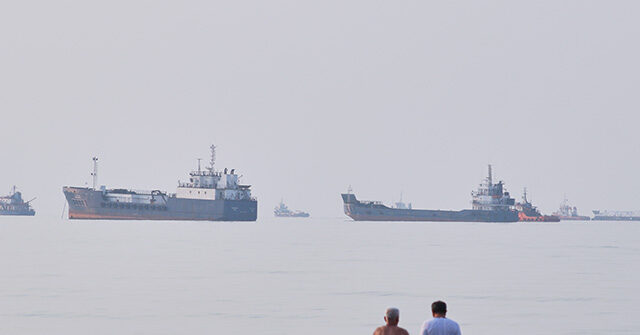
President Donald Trump declared Monday that the U.S. Navy now “controls the Strait 100%” behind an “infallible” American blockade, while leaving the prospect of a major escalation against Iran firmly on the table as Tehran refuses to back down from sweeping demands for ending the standoff.

Asked in the Oval Office when he expected the Strait of Hormuz to reopen, Trump rejected the premise that the strategic waterway remained closed.

“It’s open now,” Trump said. “Look, the only one that has control of the Strait of Hormuz right now is the United States Navy.”

“We have a blockade that’s been infallible. It’s a steel wall,” he continued. “And we let people in that we want to let in, and those people come in. They’ve been coming in, and they’re going out. So it’s actually open now.”

Trump said the United States was preventing vessels from reaching Iran while allowing other traffic to pass, effectively casting Washington — rather than Tehran — as the power now determining access through the strategic waterway.

“We do not let them go into Iran. They’re not admitted into the strait to go to Iran. But it’s open for others,” he said.

The president also said U.S. forces had swept the Strait of Iranian mines, while acknowledging Tehran retains the ability to cause disruptions.

“Now, a little bit complex because they will, on occasion, drop a mine, and we find the mines,” Trump said. “You know, we’ve mine-swept the entire strait.”

“But we control the strait 100%,” he added.

Trump’s declaration comes as Iranian officials insist the opposite: that Hormuz will not fully reopen unless Washington meets Tehran’s far-reaching demands, including ending the U.S. naval blockade, withdrawing American forces from around Iran, lifting sanctions, releasing frozen Iranian assets, and compensating the Islamic Republic for damage inflicted during the war.

The competing claims have transformed control of Hormuz into a central point of leverage in the broader confrontation. Mohammad Bagher Zolghadr, who was serving as secretary of Iran’s Supreme National Security Council when he laid out the six conditions Saturday, declared that Tehran would not yield “whether in war or in negotiations.”

Iranian officials reiterated Monday that separate negotiations with Oman over a temporary shipping route would not result in a full reopening while the American blockade remains in place.

Trump, however, suggested Iran’s leverage was rapidly eroding under the weight of the U.S. military and economic campaign.

“Now, can they make trouble? Yeah, they can make trouble,” Trump said. “But they’re broke. They have no money.”

“You know, Iran is broke, totally broke. And they’re not paying their soldiers,” he added, citing inflation that he said had reached roughly 300 percent.

The president’s remarks came hours after he turned Tehran’s demand for war reparations back against the Islamic Republic, declaring that Iran should instead compensate Americans killed or maimed in attacks and conflicts backed by Tehran, as well as the families of protesters killed by the regime.

“If there’s damages to be paid, I think Iran should pay those damages,” Trump told reporters Monday.

Trump said Iran had spent decades terrorizing the region, pointing in particular to roadside bombs that killed and maimed American troops.

“For 50 years they’ve been the bully of the Middle East,” Trump said. “What they’ve done is terrible. They’ve killed hundreds of thousands of people.”

“They’ve killed people, they’ve wounded and maimed people with the legs and the arms, you know, with the roadside bombs, their bomb,” he continued. “They’re very proud of it. And now they’re paying a price.”

The president earlier expanded his compensation demand beyond Americans and Iranians, writing on Truth Social that Tehran “should be responsible for the damages and death caused to the people of Lebanon, Syria, Yemen, and Gaza” — countries where the Islamic Republic has for years armed and financed terrorist groups and other proxies including Hezbollah, Hamas and the Houthis.

The demand also turns one of Tehran’s own far-reaching conditions back on the regime: Iran has insisted that any settlement permanently end hostilities against its regional proxies and partners in Lebanon, Gaza, Yemen, and Iraq.

Meanwhile, the U.S. blockade continues to tighten. U.S. Central Command said Sunday that more than 20 American warships were supporting operations in the Middle East and that U.S. forces had redirected 55 commercial vessels, disabled two and boarded two others to enforce the blockade as of August 9.

The economic pressure is also mounting. Iran’s official “Misery Index,” combining inflation and unemployment, reportedly reached a record 91.1 percent, while Iranian oil loadings fell to roughly 500,000 barrels per day in July — down more than 66 percent from pre-war levels — according to figures cited by the U.S. Treasury.

Trump signaled Sunday that he was willing to allow that pressure to work, saying Washington was “low-keying it” and was only “semi-negotiating” with Tehran while watching the regime struggle under inflation, sanctions and the blockade.

Yet Trump made equally clear Monday that economic pressure has not removed the military option.

Asked what comes next after previously warning that Iran faced its final opportunity before “decapitation,” Trump offered only a terse response.

“You’ll find out.”

Pressed specifically on whether a “massive escalation” remained on the table, Trump did not rule it out.

“Well, we certainly have that ability if we want to do that,” he said.

“You’ll find out.”

Joshua Klein is a reporter for Breitbart News. Email him at jklein@breitbart.com. Follow him on Twitter @JoshuaKlein.


Read the full article here

Share.
Leave A Reply

Exit mobile version