






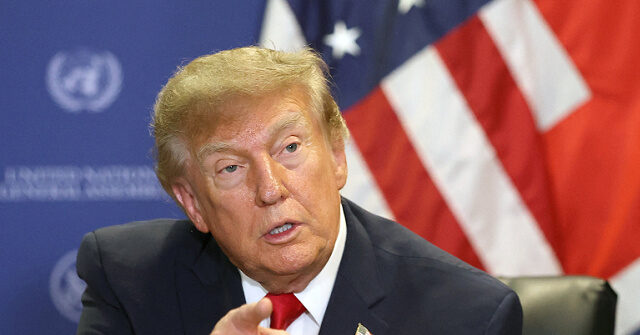
President Donald Trump said a three-hour round of U.S.-Iran negotiations on the sidelines of the U.N. General Assembly “went very well” Tuesday and later told Gulf and other regional leaders there was “a lot of momentum” toward a deal, as Washington and Tehran reopened a negotiating channel for the first time since June.
Trump disclosed the talks while meeting Ukrainian President Volodymyr Zelenskyy in New York, saying U.S. envoy Steve Witkoff and Jared Kushner were involved and that another meeting had already been set for the “very near future.”
“It was a very good meeting,” Trump said. “It was a meeting that lasted for three hours.”
The president said he could not imagine why Tehran would reject an agreement given the alternative now facing the Islamic Republic.
“It’s greatness, potential greatness, or obliteration,” Trump said. “In one case it’s obliteration, and the other alternative is potential greatness. It could be a great country.”

Witkoff, who was alongside Trump as he discussed the talks, initially offered little detail but struck an upbeat tone when pressed by reporters.
“I feel very good right now,” Witkoff said. Asked how he expected to feel Wednesday, he responded: “I think very good.”
Witkoff later clarified how the broader negotiating round had unfolded, saying the talks were conducted through mediators who moved between the U.S. and Iranian delegations throughout the day.
“Today, on the sidelines of the United Nations General Assembly, we engaged in lengthy talks with the Iranian delegation through the mediators, who shuttled between the two sides throughout the day,” Witkoff wrote on X.
“They successfully completed a round of discussions that we hope will prove constructive and promising,” he added. “The mediators will continue their work.”
Iranian state media separately confirmed contact between the two sides, reporting that Foreign Minister Abbas Araghchi met Witkoff and used the encounter to convey Tehran’s terms for reopening the Strait of Hormuz.
According to the Iranian account, those demands included lifting the U.S. naval blockade, releasing frozen Iranian assets and ending the war across what Tehran calls the “resistance fronts.” Iranian state television said Tehran’s “firm positions” were conveyed during the meeting.
The demand to lift the blockade goes directly at one of Washington’s principal sources of pressure on Tehran — and emerged as one of the clearest points of contention in the renewed talks.
The terms reported by Iranian state media were also broader than a proposal described earlier Tuesday by a senior Iranian official, who told Reuters that Tehran could reopen Hormuz to Gulf shipping within seven days if Washington eased military pressure and lifted its blockade on Iranian ports.
The official said Iran had delivered that proposal through mediators the previous week, described the General Assembly as a “golden opportunity” to revive diplomacy and said the delegation in New York had full authority to negotiate.
Trump later described the renewed diplomatic channel in increasingly optimistic terms.
Meeting British Prime Minister Andy Burnham, Trump predicted that Washington and Tehran would ultimately reach an agreement and said communication between the two sides was already developing.
“I think that a settlement is going to be reached,” Trump said. “They want to talk to us. They have been talking to us, even today they’ve been talking to us. And the relationship is developing.”
Trump carried that optimism into a later meeting with Gulf Cooperation Council members and other regional leaders.
“Steve and Jared had a very productive meeting today with mediators of Iran,” Trump said. “I think there’s a lot of momentum for them to make a deal. That’s what we are hearing from everybody.”
But Trump’s upbeat public assessment did not mean the central disagreements had been resolved.
Al Arabiya reported, citing an unnamed U.S. source who attended the talks, that Washington rejected Tehran’s request to lift the blockade and that major differences and obstacles remained between the two sides. The source described the chances of reaching an agreement as limited.
The blockade has become one of Washington’s most powerful economic and military levers against Tehran. U.S. forces have spent months restricting Iranian maritime trade while simultaneously expanding protected commercial traffic through the Strait of Hormuz.
Trump himself pointed to that pressure during his General Assembly address earlier Tuesday, saying U.S. forces had helped move more than one billion barrels of oil through the waterway while calling on countries around the world to join Washington in imposing “complete economic isolation” on Tehran until Iran stops attacking commercial shipping, relinquishes its nuclear ambitions, and ends its support for terrorism.
On Tuesday, Trump used his U.N. address to frame the choice between a negotiated agreement and renewed military action in stark terms.
“I have a big decision to make,” Trump told the General Assembly.
He described that decision as a choice between an agreement that could allow Iran to rebuild into “a far greater country” and renewed military action that he said could “annihilate the Islamic Republic.”
Trump nevertheless said he believes Tehran will ultimately make a deal, possibly after the U.S. midterm elections, while insisting that election politics will not determine his decision.
“What they don’t realize is that I’m not running,” Trump said of Iranian leaders. “I give absolutely no credence and will not give credence to the election when it comes to Iran. It doesn’t even enter my mind. The only thing that does is that Iran will never have a nuclear weapon.”
Preventing Iran from obtaining a nuclear weapon has remained the administration’s central stated condition throughout the conflict and the renewed diplomatic push.
On Tuesday, Secretary of State Marco Rubio said Trump remained willing to engage with Iranian officials if talks offered a path toward resolving the conflict, while making clear that Washington’s nuclear red line had not changed.
“This is a president that will meet with anybody for the most part because he believes that engaging with people is important if you’re going to solve problems,” Rubio said in an interview with NBC News. “It doesn’t mean you’re going to end up agreeing with them, but it’s important.”
Rubio said Washington remained open to engagement while stressing: “Iran can never have a nuclear weapon. They just simply can’t.”
The diplomatic opening came as both sides continued applying military and economic pressure.
Speaking with Gulf and other regional leaders after the negotiations, Trump said Washington was “completely isolating Iran financially” and warned Tehran to act “fast before it’s too late.”
He also repeated his threat to strike the fortified Pickaxe Mountain site if the United States detects renewed activity there, while acknowledging that Washington was “not seeing a lot of activities there” at present.
Iran’s military leadership, meanwhile, dismissed Trump’s U.N. remarks as “merely a tool for domestic propaganda” and warned that Iranian forces remained prepared to carry out “more severe, crushing and unpredictable” strikes if the United States or Israel attacks again.
Even with those threats, the diplomatic channel remains open.
Witkoff said the mediators “will continue their work,” while Trump said another meeting was expected in the “very near future.” Iran, meanwhile, has publicly outlined conditions for reopening the Strait of Hormuz, including lifting the U.S. naval blockade and other economic and military demands.
For now, Washington and Tehran have returned to negotiations without abandoning the military and economic pressure each side is using to try to shape the next phase of the conflict.
Joshua Klein is a reporter for Breitbart News. Email him at jklein@breitbart.com. Follow him on Twitter @JoshuaKlein.
Read the full article here


