


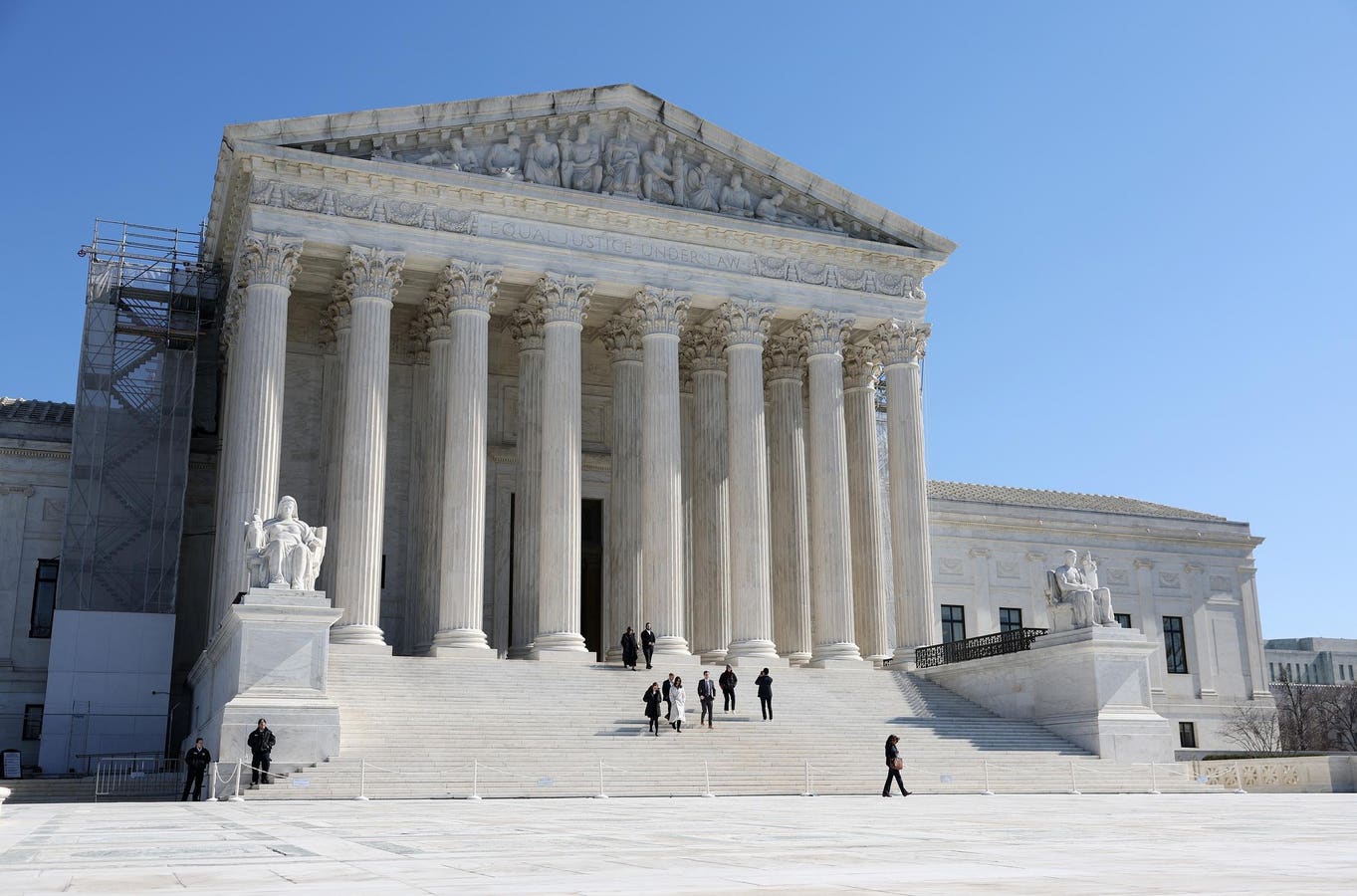
WASHINGTON, DC – FEBRUARY 21: People leave the U.S. Supreme Court. (Photo by Kevin Dietsch/Getty Images)
Getty Images
Does President Trump have unlimited power to unilaterally impose tariffs, and perhaps other taxes, without consent of Congress?
That is the question before the Supreme Court this week. The justices will hear oral arguments in two cases involving President Trump’s broad imposition of tariffs on, well, on the whole world. The decision, which could come within a few months, will have a significant impact on Trump’s expansive use of what he calls emergency presidential power.
I am not a lawyer but, when it comes to taxes, which tariffs are, the Constitution seems clear. Article I, which describes the responsibilities of Congress says, “The Congress shall have Power To lay and collect Taxes, Duties, Imposts and Excises.” By contrast, the words “tax” or “tariff” never appear in Article II, which describes the duties and responsibilities of the president.
And yet…
What The Law Says
Trump is relying on a law called the International Emergency Economic Powers Act of 1977, or IEEPA, which he says grants him unlimited authority to impose tariffs. He’s used that power to: pressure China, Mexico, and Canada to block what Trump claims is the widespread shipping of fentanyl and its components into the US; impose “reciprocal tariffs” on nearly every country in the world, though he has unilaterally exempted certain products; and end what’s known as the de minimum exemption for small shipments of low-cost imports.
Yet, IEEPA never mentions the word “tariff” and, over a half century, the law never has been used by a president to impose import duties.
Under various trade laws, Congress has granted the president limited authority to impose tariffs under very specific circumstances, but only after going through a rigorous review process. That power is not at issue in these cases.
In the words of the small businesses that brought the issue to the Supreme Court in Learning Resources, Inc. v. Trump, “President Trump, through a series of executive orders, has repeatedly bypassed Congress to impose tariffs unilaterally under IEEPA. With the stroke of a pen, he has dramatically changed United States tariff policy while all but admitting that none of the 4,732 sections in Title 19 of the U.S. Code—the title governing customs duties—allows him to do so.”
Trump’s Claim of Power
Trump is asking the High Court to grant him effectively unlimited powers to impose or revise tariffs. In its brief, the Justice Department argued that IEEPA gives Trump authority “to deal with any unusual or extraordinary threat, which has its source in whole or substantial part outside the United States, to the national security, foreign policy, or economy of the United States, if the President declares a national emergency with respect to such threat.”
In other words, anything is a national threat if the president says it is. And once he declares something a national threat, he can impose any tariff he chooses, with no congressional role, notwithstanding the Constitution.
Case in point: Trump increased tariffs on Canada because he was angered by a television ad.
Congress, meanwhile, has been unwilling to reassert its Constitutional tariff authority, effectively giving Trump free rein.
What Is At Stake?
Tariffs are taxes on US businesses and consumers. Trump insists they are taxes on foreign countries, but they are not. They are taxes paid at the US border by US importers. Those firms can either eat those tariffs in the form of lower profits, offset them by cutting other costs, or pass them on to consumers.
Thus, the president is unilaterally and substantially raising taxes on Americans, with lose-lose consequences.
A modest amount of the tax may be paid indirectly by foreign producers in the form of lower prices. But, for the most part, the levies are paid by US companies or consumers who either buy imported goods or US-made products that include components made in foreign countries.
A recent study by Goldman Sachs estimated that through August, US businesses paid 51% of tariff costs and consumers paid 37% of the burden. Only about 5% were paid by foreign exporters and 3% was lost to evasion.
Assuming Trump’s tariffs stick, most economists expect businesses will pass on an increasing share to consumers. Another alternative, which we have begun to see, is firms laying off workers to offset their tariff costs as well as declining demand for consumer goods.
By one estimate, retail prices already have increased by 4.9 percentage points relative to pre-tariff trends. The Tax Policy Center estimates Trump’s tariffs will cost American households about $2,600 on average next year, assuming they remain at current levels.
While the president brags about the massive tax cuts Congress passed in July—most of which extended existing tax law—his tariffs claw back nearly all their value on average.
The Tax Policy Center estimates Trump’s tariff’s would raise taxes by about $2.5 trillion over the next decade, if they remain in place.
The administration insists those dollars are critical to the national fiscal health.
But keep two things in mind: The federal government expects to collect $40 trillion in income taxes through 2035, making the tariffs only about 6% of federal taxes. That estimate also excludes declines in corporate tax revenue from lost foreign sales of US products or the negative effects of the tariffs on the overall US economy.
If the Supreme Court rejects Trump’s expansive claim of presidential tariff authority, the president is likely to use other tools to tax some imports. But these cases give the High Court the opportunity to set some limits on the president’s power to tax.
Read the full article here