




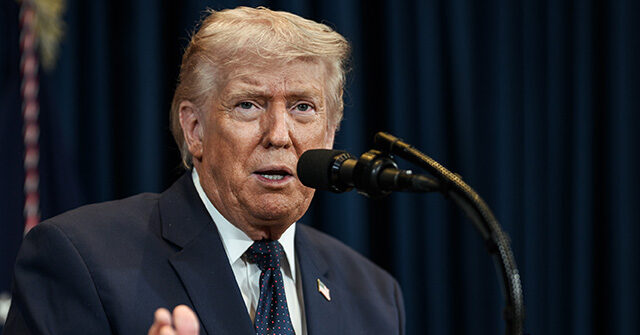
President Donald Trump said Friday that the United States will declare the Strait of Hormuz “U.S. territory” after it finishes defeating Iran, escalating his assertion of American control over the strategic waterway as Tehran vowed that the strait “has been Iranian, is Iranian, and will remain Iranian.”
“After we finish defeating Iran, which is being very badly defeated, pretty soon I’ll be declaring the Hormuz Strait a territory of the United States,” Trump told a crowd during an event in Nassau County, New York.
Trump did not elaborate on how such a declaration would work, but the remark marked his latest and most expansive assertion of U.S. control over the strait after declaring earlier this week that Washington now “owns” the waterway and suggesting the United States may keep it.
“We have the blockade. No ships get through unless we want them to,” Trump said Friday, describing the U.S. naval cordon as “unstoppable” and a “wall of steel.”
“What we are doing is a great service for the world, not only for ourselves, for the world,” he added.
The president expanded on that message in an interview with Fox News ahead of his remarks, declaring that Washington is already exercising effective control over the strait while using the blockade to inflict mounting economic damage on Tehran.
“We totally control, we own, in the true sense, we own the Strait of Hormuz,” Trump said. “We only allow boats to come in if we want them to come in.”
Trump said the blockade is costing Iran “hundreds of millions of dollars every single day,” while pointing to sweeping U.S. sanctions as another front in Washington’s effort to squeeze the regime.
“We’ve got economic sanctions against them like nobody’s ever had before,” he said.
Asked about the possibility that Iran could become more aggressive ahead of the November midterm elections in the belief that political considerations would constrain an American response, Trump issued a stark warning.
“We’re capable of really destroying the whole place. We don’t want to do that,” Trump said. “If they hit, we would hit back 100 times harder.”
The president’s remarks came one day after Treasury Secretary Scott Bessent announced that the administration is preparing another escalation of its “Economic Fury” campaign against Tehran, with new measures expected next week that he said will take Iran’s economic isolation to an unprecedented level.
“Watch this space for more announcements coming next week because we are going to apply measures like have never been seen in the history of economic isolation on a country,” Bessent said Thursday.
The Treasury secretary described the strategy as a “one-two punch,” combining escalating financial pressure with the U.S. blockade of Iranian ports.
“It will be a combination of economic isolation like the world has never seen before, and the continued blockade in the Strait of Hormuz that will keep anything from going in or out of the Iranian ports,” Bessent said.
The blockade itself continued to expand Friday, with U.S. Central Command reporting that American forces have now redirected 62 commercial vessels, disabled three and boarded two to enforce compliance.
Secretary of War Pete Hegseth said Thursday that the U.S. Navy can maintain the blockade “indefinitely,” with American warships rotating through the region as necessary.
The Trump administration has increasingly portrayed the blockade as an open-ended instrument for depriving Tehran of revenue while allowing Washington to control shipping through the region. Energy Secretary Chris Wright said Thursday that between eight million and nine million barrels of oil are continuing to transit Hormuz each day, much of it aboard vessels operating under U.S. escort with their Automatic Identification System (AIS) transponders switched off.
Iran, however, answered Trump’s declaration Friday with competing claims of sovereignty over the waterway and fresh threats to continue its own restrictions on shipping.
“Once and for all, accept the reality: up to this point, you have suffered strategic and heavy defeats; the Strait of Hormuz has been Iranian, is Iranian, and will remain Iranian,” Iranian Deputy Foreign Minister Kazem Gharibabadi wrote on X.
“This strait will only be closed and opened under Iran’s command,” he continued, threatening that Tehran would maintain its blockade until the United States accepts what he called its “strategic defeat” and abandons its “fanciful delusions.”
The exchange comes as efforts to revive negotiations between Washington and Tehran remain uncertain. Iranian Foreign Minister Abbas Araqchi said Friday that Qatar and Pakistan continue to exchange messages with Tehran but insisted that no decision has been made to resume negotiations with the United States.
The contacts “do not mean negotiations,” Araqchi said, while disputing claims that the 60-day framework established under the Islamabad memorandum requires an extension and maintaining that previous diplomatic channels are no longer effective.
Trump, meanwhile, made clear Friday that preventing Iran from obtaining a nuclear weapon remains the overriding justification for the campaign, acknowledging that Americans may temporarily face somewhat higher gasoline prices as Washington maintains pressure on Tehran.
“For you to pay a tiny little bit more for your gasoline, just remember you’re doing it so that a very evil country cannot have — a country, really, it’s the number one state sponsor of terror in the world — we don’t want to have them have a nuclear weapon,” Trump said.
“We cannot let Iran have a nuclear weapon,” he added.
Trump also defended his decision to use American military power against Tehran, saying he has employed the military “a little bit more than I wanted to, frankly, but that’s okay.”
“If we didn’t hit them, you would’ve had a nuclear weapon,” Trump said of the earlier U.S. strikes on Iran. “It would have been a very sad day for this country and the entire world.”
For his part, Trump portrayed the escalating Iranian threats and competing claims over Hormuz as coming from a regime already being badly weakened by the U.S. campaign.
“Nobody has any idea how successful we are,” Trump said. “You know who knows how well we are doing? Iran.”
Joshua Klein is a reporter for Breitbart News. Email him at jklein@breitbart.com. Follow him on Twitter @JoshuaKlein.
Read the full article here


