


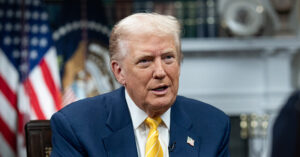
President Donald Trump said Sunday the United States is “low keying” its approach to Iran, signaling he is prepared for now to let mounting economic pressure squeeze Tehran rather than launch another major military offensive.

“We are low keying it,” Trump said in a brief phone interview with Axios. “We are only semi-negotiating with them. We are just watching Iran with its huge inflation and the fact they have no money.”

Trump said Iran is “in very bad shape” economically and lacks the money to pay its troops, pointing to the U.S. naval blockade as further intensifying the regime’s economic crisis.

At the same time, the president noted that oil prices have fallen to just above $75 a barrel, reducing the conflict’s economic impact on American consumers as Washington waits to see whether Tehran will bend.

“It will work out. It always works out. It’s like a chess game,” Trump told the outlet.

The comments mark a notably measured posture from Trump just one week after he was considering a return to major combat operations against Iran. Axios reported that the president ultimately decided against another major escalation for now, with one U.S. official arguing that active fighting allows the Iranian regime to avoid confronting the consequences of the war, including widespread infrastructure damage and a deepening economic crisis.

Without active warfare, the official said, Tehran is instead forced to confront a grim economic reality for which it has few apparent solutions.

Trump’s approach comes as his administration increasingly focuses on restoring traffic through the Strait of Hormuz while maintaining military and economic pressure on Tehran.

The Wall Street Journal reported Sunday that Trump has privately floated to senior aides the possibility of declaring victory in the conflict even without securing a new nuclear agreement if Iran’s nuclear program remains contained and the Strait of Hormuz fully reopens.

Trump has told senior officials he believes Tehran is unlikely to be able to revive its nuclear program during his presidency following the destruction of its three primary nuclear sites and that U.S. intelligence would detect an effort to rebuild the facilities or covertly develop a nuclear weapon, according to the Journal. He also reportedly believes the threat of renewed American strikes would serve as an enduring deterrent.

The outlet quoted a White House official as saying the United States has “completed all of its military objectives against Iran” and that Trump is now focused on “securing the flow of the world’s energy through the Strait of Hormuz,” while keeping military options available should Tehran continue targeting ships.

Trump similarly said Thursday that the U.S. naval blockade had left Hormuz “sort of open right now,” while acknowledging that Iran retained the ability to attack vessels with missiles, drones and mines.

But Tehran has hardened its demands over the strategic waterway even as negotiations with Oman continue over an interim maritime arrangement.

Mohammad Bagher Zolghadr, then-secretary of Iran’s Supreme National Security Council, declared Saturday that Hormuz would remain closed until Washington “corrects its behavior,” while laying out sweeping demands that the United States end military action against Iran and its regional allies, lift its naval blockade, withdraw forces from around Iran, lift sanctions, release frozen Iranian assets and compensate Tehran for war damages.

Foreign Minister Abbas Araghchi said Sunday that negotiations with Oman over new maritime routes were in their “final stages,” but insisted an agreement on those arrangements would not itself reopen the strait. Araghchi said Tehran and Washington were not directly negotiating and were instead exchanging messages through intermediaries.

Other senior Iranian officials simultaneously escalated their rhetoric over control of Hormuz. Ayatollah Sadegh Amoli Larijani, chairman of Iran’s Expediency Council, a powerful body tasked in part with resolving disputes among the Islamic Republic’s governing institutions, said Sunday that Tehran would not relinquish its claimed control of the waterway “at any cost” and that Hormuz “will not return to its previous conditions,” according to Iranian state-run Press TV.

The increasingly defiant rhetoric coincided Sunday with a significant shakeup at the top of Iran’s national-security apparatus that could further strengthen longtime Revolutionary Guard figures as the regime wrestles internally over its approach toward Washington.

Former IRGC commander Mohsen Rezaei, who led the Guards from 1981 to 1997, was named secretary of the Supreme National Security Council, the powerful body at the center of Iran’s national-security and war policy, replacing Zolghadr.

Rezaei, a longtime member of the Islamic Republic’s military and security establishment who most recently served as military adviser to Supreme Leader Mojtaba Khamenei, is wanted by Argentina and remains the subject of an Interpol Red Notice over his alleged role in the 1994 bombing of the AMIA Jewish community center in Buenos Aires, which killed 85 people.

Rezaei declared last month that Iranian control of the Strait of Hormuz was “more important than dozens of atomic bombs.”

Zolghadr, himself a veteran IRGC commander, was moved into another senior position as Khamenei’s political adviser.

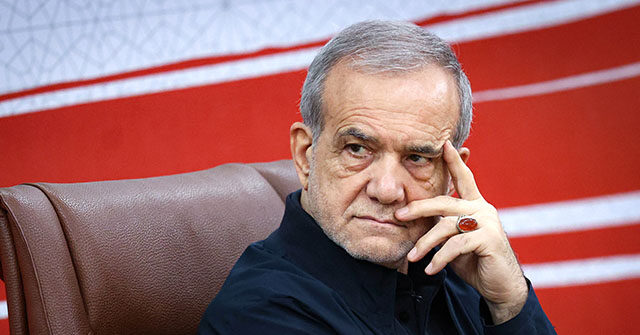
The New York Times reported that Rezaei’s elevation could signal that the more hardline wing of the Iranian establishment is gaining the upper hand amid tensions between President Masoud Pezeshkian’s government and powerful security figures over diplomacy with Washington. The outlet cited an Iranian security expert who said the appointment could also serve as a counterweight to Parliament Speaker Mohammad Bagher Ghalibaf, another former Guards commander who has played a leading role in negotiations with the United States.

The reshuffle came the same day Khamenei’s office claimed the virtually unseen supreme leader had recently met with Pezeshkian to discuss the country’s economy, military situation and the future of the conflict.

Khamenei has made no confirmed public appearance since he was reportedly wounded in the opening U.S.-Israeli strikes on February 28 that killed his father and predecessor, Ayatollah Ali Khamenei, and has remained out of public view since subsequently being elevated to supreme leader. Pezeshkian said only days ago that communicating with Khamenei was “very difficult at the moment,” while separate reports Friday citing sources close to the Iranian government claimed his health had deteriorated severely.

The Trump administration, meanwhile, has continued tightening the economic pressure that the president highlighted Sunday. Under the Treasury Department’s “Economic Fury” campaign, Washington has targeted Iranian oil revenue, shadow-banking networks, military procurement operations and other financial channels used by the regime and the IRGC.

Despite the absence of a broader Hormuz agreement, roughly eight million barrels of oil are now leaving the Gulf each night through the strait’s southern lane in coordination with the U.S. military, according to a U.S. official cited by Axios, with Washington seeking to increase that flow.

Vice President JD Vance said Saturday that Washington expects oil and gas traffic through the region eventually to return to pre-conflict levels, while stressing that the administration is judging Tehran by its actions rather than its assurances.

“We don’t trust. We verify,” Vance said. “We actually look not at people’s words but people’s deeds.”

Describing the broader confrontation with Iran as still unresolved, Vance said the administration would continue using the full range of pressure at its disposal. “This thing is not over. It’s obviously not at the beginning. We’re in the middle of the game, and we’re applying a whole host of tools — diplomatic, economic, military tools — to ensure that we get the best outcome for the American people.”

Joshua Klein is a reporter for Breitbart News. Email him at jklein@breitbart.com. Follow him on Twitter @JoshuaKlein.


Read the full article here

Share.
Leave A Reply

Exit mobile version