






Pro-American advocates for migration reform are praising President Donald Trump’s Executive Order to restrict banks’ cooperation with migrants and criminals.
“Excellent move,” responded Rep. Andy Ogles (R-TN). “Illegals should have 0 [zero] access to America’s financial institutions. Debank and deport them ALL.”
“This is a great way to protect American consumers!” said Sen. Jim Banks (R-IN). “Illegal aliens take out loans that they never intend to repay. Americans are left with the bill.”
“President Trump has officially moved toward de-banking illegal aliens with a new Executive Order released today,” said the Immigration Accountability Project Action group.
The Wall Street Journal reported:
Trump on Tuesday ordered regulators to rethink so-called “know your customer” rules meant to guard against money laundering and terrorist financing. The executive order would make a person’s immigration status an explicit part of a bank’s assessment of whether a customer poses a money-laundering risk.
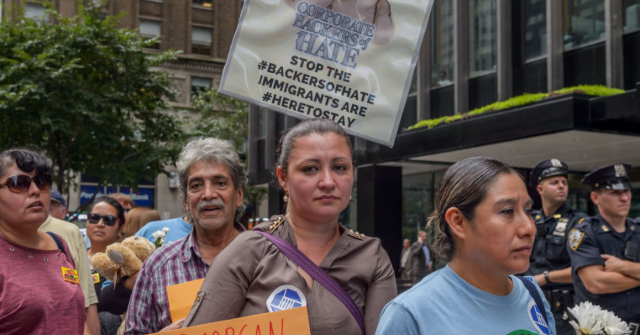
Migration supporters lamented the move; “With this executive order, it will be nearly impossible to send remittances to Mexico or receive payments, salaries, or loans if you are undocumented in the United States,” said Mexican journalist Anna Maria Salazar.
Since the 1980s, the federal government had quietly worked to help illegal migrants get into America’s banks just as it let migrants flood into workplaces and neighborhoods, schools and welfare networks.
For example, many migrants on temporary H-1B visas have been able to get mortgage loans from banks for buying the homes needed by young Americans. Foreign students take out large debts before exiting the United States. Chinese migrants were welcomed by President Joe Biden’s officials, even though Chinese criminal gangs are working closely with Mexico’s drug cartels.
Predictably, the draft order was loosened by lobbyists who pressured Trump on behalf of the banks, employers, and landlords who gain from the mass inflow of migrant consumers, renters, and workers.
The American Banker reported the win for lobbyists: “The White House’s executive order stops short of requiring banks to verify citizenship, instead directing agencies to issue guidance on indicators of suspicious activity involving undocumented workers.”
Semafor reported that the “executive order is a step back from initial proposals, which were expected as recently as Tuesday to direct financial institutions to collect proof of citizenship from their customers.”
It added: “In a win for Wall Street, the final version instead directs Treasury Secretary Scott Bessent to advise financial institutions on ways undocumented immigrants might open accounts or receive loans.”
The May 19 order, which is titled “Restoring Integrity to America’s Financial System,” directs regulators to look for evidence of wealth smuggling by migrants and international criminals. The order also targets the use of the “Individual Taxpayer Identification Number,” which was created in 1996 to help employers and banks work with illegal migrants who do not have Social Security Numbers.
The crackdown is needed, says the order, because:
Low-dollar cross-border funds transfers have been used to facilitate or commit terrorist financing, narcotics trafficking, human trafficking, and other illegal activity. Financial trend analyses have uncovered hubs of deadly fentanyl-related financial activity in the United States related to Mexico-based cartels. A recent analysis of Chinese money laundering networks identified how foreign passport holders have used United States-based accounts to facilitate the laundering of over $312 billion for criminal organizations, with human trafficking highlighted among the activities associated with the transfers. Robust customer identification programs and enhanced due diligence measures are necessary to mitigate these risks.
Banks and other financial institutions should also be attentive to the credit risks posed by the extension of mortgage and auto loans, credit cards, and other consumer credit to the inadmissible and removable alien population. Many of those borrowers face the possibility of the loss of wages due to removal or their employers’ decisions to comply with immigration law. Lending to aliens without legal work authorization or who face a substantial loss-of-wage risk creates a structural “ability to repay” deficiency that undermines the safety and soundness of the national banking system. Additionally, employers who violate immigration law may underreport wages, use mismatched or invalid Social Security numbers and taxpayer identification numbers, or fail to properly withhold or remit payroll taxes. Such schemes can create vulnerabilities within our financial system by obscuring income sources, distorting credit underwriting, and facilitating underground economic activity.
The tug-of-war will continue as lobbyists pressure Bessent to weaken the regulations and procedures directed by the Executive Order.
But Bessent is a champion for tighter oversight. “I don’t think it’s unreasonable, because: Why don’t we have information on who’s in our banking system?” he said in April.

Read the full article here


