






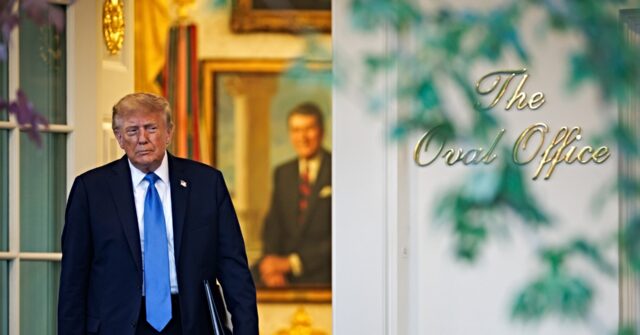
President Donald Trump rejected Iran’s latest proposal to reopen the Strait of Hormuz on Saturday, saying Tehran is “losing so badly” after the U.S. turned its attempt to close the waterway against it with what he called the “greatest blockade ever in military history” — while making clear he remains willing to reach an agreement on terms he considers acceptable.
Asked about Tehran’s proposal, Trump confirmed he had rejected it before turning to the pressure he said is driving Iran to seek an agreement.
“They want to make a deal where they open the Strait immediately because they’re losing so badly,” Trump told reporters.
Trump contrasted Iran’s isolation with the growing commercial traffic moving through Hormuz under U.S. protection, saying Washington is “winning tremendously” and reiterating that the United States has “total control” of the strategic waterway.
“Massive amounts of oil are coming out of the Hormuz Strait,” Trump said, pointing to 29 ships that had passed through the waterway the previous night.
Roughly 60 million barrels of oil moved through Hormuz over the previous 72 hours, according to U.S. officials, continuing a sharp increase in commercial traffic through the strait under U.S. protection.
Trump said Iran’s effort to close Hormuz to pressure the rest of the world had instead backfired, allowing Washington to turn the closure against Tehran while keeping the strategic waterway open to other commercial traffic.
“They outsmarted themselves,” Trump said. “They said, ‘Let’s close it and cause a problem for the world.’”
Trump said the United States responded by effectively reversing Iran’s strategy.
“And then I came along, and we put up the greatest blockade ever in military history,” he said. “It’s a wall of steel.”
The result, Trump argued, is a strait increasingly open to international commerce under U.S. protection but effectively closed to the Iranian revenues Tehran depends on.
“They don’t have any money now, because they wanted to close the Strait,” Trump said. “And I said, that’s fine. We’re going to close it on you, but everybody else is able to use it.”
But Trump drew a distinction between rejecting Tehran’s terms and rejecting a negotiated settlement altogether.
“They want to make a deal, and I think that’s fine,” Trump said. “I like making a deal too, but that deal would not be acceptable.”
Iranian Foreign Minister Abbas Araghchi had said Friday that Tehran was prepared to begin implementing a seven-day plan that could reopen Hormuz and restart negotiations with Washington if the United States accepted Iran’s conditions.
“If there is seriousness on the U.S. side to come to a deal and reopen the Strait of Hormuz, everything is now prepared,” Araghchi said.
Araghchi said initial steps could be completed within four to five days, with Hormuz reopening on the sixth day and U.S.-Iran talks beginning on the seventh. Accounts of Tehran’s proposal differ on some of the accompanying conditions, but Iran has consistently demanded an end to the U.S. naval blockade and a broader cessation of hostilities, including in Lebanon; other reported elements include relief from oil sanctions and access to frozen Iranian assets.
At the center of the remaining divide is the issue Trump has repeatedly described as nonnegotiable: Iran cannot be allowed to obtain a nuclear weapon.
Hours before publicly rejecting Tehran’s proposal Saturday, Trump underscored that position in an emphatic Truth Social post: “IRAN CAN NOT HAVE A NUCLEAR WEAPON!!!”
U.S. Ambassador to NATO Matthew Whitaker reinforced that position Saturday night when asked about the prospect of ending the conflict with an agreement that would merely restrict Iranian enrichment and restore inspections.
Whitaker said Washington is starting from a fundamentally different position: Iran “can’t have a nuclear program” or nuclear weapon and must abandon what it had been pursuing.
Whitaker argued that Washington has little reason to settle for less while the blockade and sanctions are inflicting mounting economic damage.
“Their economy is crippled. They are completely broke. Their currency is weak. Inflation is high,” he said, arguing that Tehran “desperately” wants an agreement.
That, Whitaker said, is why proposals amounting to “half-measures” or “illusory deals” are “just not acceptable.”
Tehran, however, has shown no corresponding willingness to surrender what it considers its nuclear rights. A senior Iranian official told Reuters that Iran would not relinquish its claimed right to enrich uranium or ship its highly enriched uranium abroad, even if Washington accepted a broader agreement.
Iranian President Masoud Pezeshkian has separately said Tehran is prepared to negotiate arrangements for renewed international inspections — leaving a substantial gulf between Iran’s willingness to discuss monitoring and Washington’s demand, as Whitaker described it, that Tehran abandon its nuclear program.
The nuclear dispute is not Washington’s only objection. Administration officials are also pointing to what happened after the previous U.S.-Iran memorandum as evidence that another agreement must be enforceable.
“They broke the last deal,” U.S. Ambassador to the United Nations Mike Waltz said Saturday on Fox News, noting that Iran began attacking civilian shipping shortly after the MOU took effect.
Waltz said 146 countries subsequently condemned Iran’s attacks on civilian shipping — a total he described as a U.N. record — and called the attacks a violation of international law.
Asked whether Trump’s rejection meant U.S. strikes could soon resume, Waltz declined to predict the president’s next move, saying he would neither get ahead of Trump nor take military options off the table.
Waltz instead pointed to the economic pressure Washington believes gives Trump little reason to accept Tehran’s current terms.
“The president has his foot on the neck of the Iranian economy,” he said.
Waltz cited the plunging rial, dwindling foreign reserves, rising inflation and an international pressure campaign being driven by Treasury Secretary Scott Bessent under Operation Economic Outcast.
Bessent provided fresh evidence Saturday of how that campaign is expanding, saying Treasury teams he dispatched abroad have persuaded governments and financial institutions to sever additional links with Tehran.
Türkiye and Oman have stopped Mahan Air flights, the United Arab Emirates has halted flights by Iranian airlines, and major commercial banks in Türkiye and the UAE have stopped transacting with Iran, according to Bessent.
“These efforts are delivering results,” he said, thanking the governments of the UK, Türkiye, Oman and the UAE while warning that “there is more to be done.”
The developments provide fresh substance to Trump’s declaration at the United Nations earlier this week that the United States was “completely isolating Iran financially.”
The financial squeeze is being reinforced at sea. U.S. Central Command said Friday that U.S. forces have redirected 122 commercial vessels under the blockade, while CENTCOM commander Adm. Brad Cooper said earlier this month that more than 2,000 protected commercial transits carrying more than one billion barrels of crude had moved through Hormuz with U.S. support.
The two figures illustrate the two sides of the operation Trump described Saturday: restricting Iranian commerce while protecting the international shipping Tehran had sought to disrupt.
Tehran did not walk away after Trump publicly rejected the proposal Saturday.
Araghchi said Iran had seen Trump’s remarks but had not yet received a formal U.S. response through the mediators, indicating Tehran would wait for that answer before deciding its next move.
RELATED: Exiger CEO — The U.S. Could Make $100 Billion by Guarding the Strait of Hormuz

“Our conditions are clear, and any move towards reopening the Strait of Hormuz is contingent on these conditions being met,” Araghchi said.
He nevertheless maintained that only a negotiated solution could break the impasse.
Even as Tehran kept the diplomatic channel open, senior Iranian military and political figures warned that renewed U.S. attacks would trigger a broader response.
Senior IRGC Navy commander Ali Mohammadi went so far as to challenge Trump’s assertion of American control over Hormuz, warning that another war could expand well beyond the strait.
“If another war breaks out, we will undoubtedly strike their vessels and destroyers even in the Indian Ocean,” he said.
Ebrahim Azizi, chairman of the Iranian parliament’s National Security and Foreign Policy Commission, separately told Lebanon’s Al Mayadeen that Tehran had prepared what he called a “multiplied and devastating response” to every American scenario.
Azizi also warned the UAE, Azerbaijan, Türkiye, Oman and Iraq against cooperating with Washington — directly targeting several governments the Trump administration has been pressing to restrict Iranian aviation, banking and commerce.
“Neighbors must be reminded that if they insist on cooperating with the enemy, they will receive a strong slap,” he said.
The confrontation now leaves Washington and Tehran negotiating under dramatically different assumptions: Trump argues that the blockade and economic pressure give the United States little reason to accept Iran’s terms, while Tehran insists Hormuz will remain restricted until Washington meets its conditions.
Yet neither side had abandoned the negotiating channel Saturday night. Iran was still awaiting Washington’s formal response through mediators, while Trump made clear that rejecting Tehran’s current terms did not foreclose an agreement.
“They want to make a deal, and I think that’s fine,” Trump said. “I like making a deal too, but that deal would not be acceptable.”
Joshua Klein is a reporter for Breitbart News. Email him at jklein@breitbart.com. Follow him on Twitter @JoshuaKlein.
Read the full article here


