




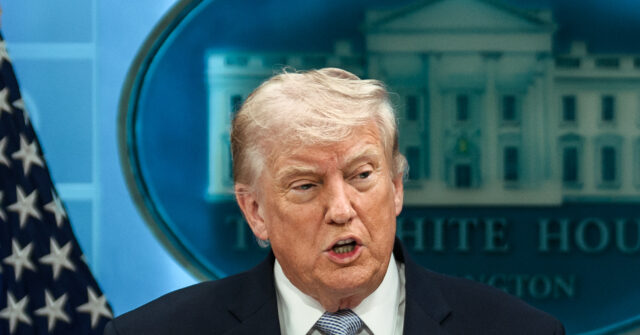
President Donald Trump announced on Friday that he had “PROHIBITED” the government of Israel from continuing its pervasive bombing campaigns throughout Lebanon as part of an agreement independent of negotiations to end hostilities with Iran.
The White House is currently engaging in Pakistan-mediated talks with what remains of the Iranian Islamist terror regime after nearly two months of “Operation Epic Fury,” a Pentagon action to erode Iran’s ability to pose a threat to its neighbors and the United States. The regime has lost dozens of its senior leaders, including “supreme leader” Ali Khamenei, and much of its naval and airstrike capacity. “Operation Epic Fury” was executed alongside related action by the Israel Defense Forces (IDF) against Iran and was paused for two weeks on April 8 to allow space for negotiations.
Simultaneously, the IDF launched a pervasive bombing campaign against the residential communities of southern Lebanon, alleging that the Iranian proxy terror organization Hezbollah, which operates as a political party in Lebanon, was using these communities for terrorist infrastructure and its residents as human shields. The IDF has demanded residents evacuate entire communities, displacing over a million people even as many in the Christian villages in the south of the country have refused to evacuate. The displacement has outraged the government of Lebanese President Joseph Aoun, which has endeavored to curtail Hezbollah’s influence in the country.
Israeli leaders have accused Aoun of not taking enough action against Hezbollah and thus forcing the IDF to attack. They have also highlighted the displacement of Israelis in the north of that country in the aftermath of the October 7, 2023, jihadist attacks by Hamas as a result of terrorist activity by Hezbollah in support of Hamas. Israeli Defense Minister Israel Katz said in March that the IDF is planning “an acceleration in the destruction of Lebanese homes in contact-line villages to neutralize threats to Israeli communities,” similar to Israel’s campaign against Hamas in Gaza.
In the immediate aftermath of the April 8 announcement of a ceasefire, Pakistani Prime Minister Shehbaz Sharif, in a message that President Trump later posted on his website Truth Social, suggested that the ceasefire between Iran and America would also translate into a ceasefire between Israel and Lebanon. Both the Israeli government and Trump denied this claim.
On Friday, announcing new developments in talks between Washington and Tehran, Trump claimed that Israel and Lebanon had unrelatedly come to a position on their conflict, taking credit for allegedly banning Israel from bombing Lebanon further.
“This deal [with Iran] is in no way subject to Lebanon, either, but the USA will, separately, work with Lebanon, and deal with the Hezboolah situation in an appropriate manner,” Trump wrote. “Israel will not be bombing Lebanon any longer. They are PROHIBITED from doing so by the U.S.A. Enough is enough!!!”
The Times of Israel reported later on Friday that Lebanese media had documented an IDF drone strike in the south of the country despite this announcement, though it emphasized that the IDF had not confirmed the strike at press time. It also suggested in its reporting that the ceasefire did not apply to action to prevent “planned, imminent, or ongoing attacks,” but rather the wholesale destruction of Lebanese communities.

Israeli Prime Minister Benjamin Netanyahu acknowledged the ceasefire on Friday, describing it as the beginning of a long road to resolving ties to Lebanon. Technically, Lebanon and Israel have been in a formal state of war since 1948 that has yet to be resolved. Netanyahu explained that, while the IDF had “not yet finished the job” of eliminating Hezbollah, the talks were “giving an opportunity to advance a combined diplomatic and military solution with the Lebanese government.”
Defense Minister Katz, in separate remarks, emphasized that the ceasefire did not mean that the IDF would vacate its positions in Lebanon.
“The IDF holds and will continue to hold all the areas it has cleared and captured,” he asserted.
In an address on Friday, Lebanese President Aoun, like Netanyahu, defended the negotiations and ceasefire as a step towards peace, but not a concession.
“These negotiations are neither weakness, nor retreat, nor concession. They are a decision born of the strength of our belief in our rights, of our concern for our people,” he declared, “and of our responsibility to protect our homeland by all means.”
“Negotiations do not mean, and will never mean, the abandonment of a right, the renunciation of a principle, or any infringement on the sovereignty of this country,” he emphasized, adding that Lebanon held as a primary goal the removal of the IDF from Lebanese territory.
Aoun also asserted that Lebanon needs to be strong, with “one armed force that protects us all,” seemingly a barb against the rogue jihadist forces of Hezbollah.
Israel and Lebanon held their first direct talks in decades this week in Washington between their ambassadors in that city, a move that Secretary of State Marco Rubio described as an “historic opportunity” to lay the groundwork for long-term peace.
From left, Michael Needham, counselor for the U.S. Dept. of State, U.S. Ambassador to the United Nations Mike Waltz, Secretary of State Marco Rubio, U.S. Ambassador to Lebanon Michel Issa, Lebanese Ambassador to the U.S. Nada Hamadeh Moawad, and Israeli Ambassador to the U.S. Yechiel Leiter pose for a photo before a meeting at the State Department in Washington, Tuesday, April 14, 2026. (Jacquelyn Martin/AP)
Follow Frances Martel on Facebook and Twitter.
Read the full article here


