








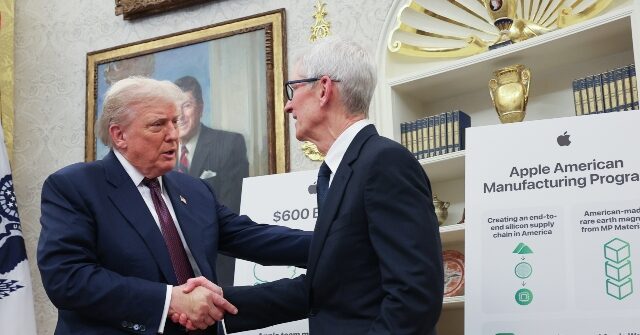
Apple has announced a significant expansion of its American Manufacturing Program on Thursday, bringing four new partners into its domestic supply chain as part of a broader push to strengthen U.S. manufacturing capabilities.
CNBC reports that Apple will invest $400 million through 2030 in new programs with Bosch, Cirrus Logic, TDK, and Qnity Electronics to manufacture essential materials and components in the United States. The companies will produce parts for Apple products that will be sold worldwide, marking a major expansion of the tech giant’s commitment to domestic manufacturing.
CEO Tim Cook characterized the partnerships as evidence of the potential of American manufacturing. “Another powerful example of what is possible when we invest” in U.S. manufacturing, Cook said of the new collaborations. The company stated that the expansion will create jobs and strengthen the country’s manufacturing capabilities.
The expansion accelerates Apple’s American Manufacturing Program, which serves as a cornerstone of the company’s $600 billion, four-year commitment to U.S. manufacturing and innovation. Apple launched the program in August 2025 alongside a $100 billion spending increase, with Cook appearing at the White House with President Donald Trump for the announcement. The company’s U.S. operations currently support more than 450,000 jobs across all 50 states, and Apple plans to directly hire 20,000 additional employees in research and development, silicon engineering, artificial intelligence, and software development.
Among the new partners, TDK will manufacture sensors in the United States for the first time. The Japanese supplier, which has worked with Apple for more than 30 years, will produce sensors including technology used for iPhone camera stabilization. These sensors will be shipped in devices sold globally and will increase the volume of chips Apple sources from U.S. silicon supply chains.
Bosch will produce integrated circuits for sensing hardware at Taiwan Semiconductor Manufacturing Company’s facility in Camas, Washington. These chips are essential for features like Crash Detection and activity tracking in Apple products. Cirrus Logic will collaborate with GlobalFoundries at its fabrication plant in Malta, New York, to develop mixed-signal semiconductors, including advanced chips to power Face ID systems. Qnity Electronics and HD MicroSystems will supply materials and technologies for semiconductor manufacturing and high-performance computing.
Since the program’s launch, Apple has exceeded its initial targets and sourced more than 20 billion U.S.-made chips from 24 factories across 12 states. In 2026, the company is on track to purchase well over 100 million advanced chips from TSMC’s Arizona fabrication facility, representing a significant increase from 2025 levels.
The program has already achieved several notable milestones. Amkor broke ground on a $7 billion semiconductor packaging facility in Peoria, Arizona, where Apple will serve as its first and largest customer. GlobalWafers began production at a new $4 billion silicon wafer plant in Sherman, Texas. Corning’s facility in Harrodsburg, Kentucky, is now fully dedicated to producing cover glass for iPhone and Apple Watch devices shipped globally.
In February, Apple announced plans to begin producing the Mac mini at its Houston factory later this year, marking the first time the product will be built in the United States. The Houston campus, which is already manufacturing AI servers ahead of schedule, will double its footprint with the addition of Mac mini production.
The program’s initial partners, including Amkor, Applied Materials, Broadcom, Coherent, Corning, GlobalFoundries, GlobalWafers America, MP Materials, Samsung, and Texas Instruments, are already reporting progress in expanding advanced manufacturing domestically.
The expansion highlights Apple’s broader strategy to deepen its U.S. supply chain at a time when both Washington and the technology industry are placing greater emphasis on domestic production, supply chain resilience, and reducing reliance on overseas manufacturing.
Read more at CNBC here.
Lucas Nolan is a reporter for Breitbart News covering issues of free speech and online censorship.
Read the full article here


