


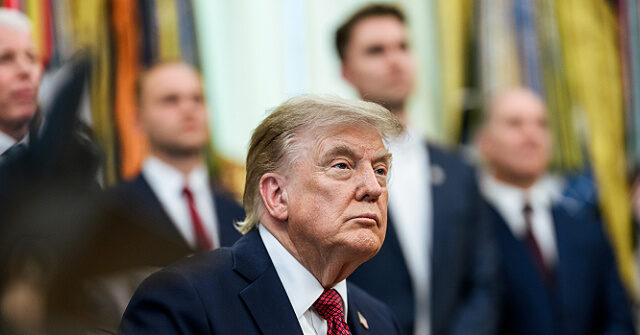
President Donald Trump announced Saturday night he canceled a planned U.S. attack on Iran after Tehran and other Middle Eastern countries asked him to hold fire. The “perimeters” of a deal were subsequently agreed to he said would fully reopen the Strait of Hormuz and end Iran’s nuclear threat.

The dramatic reversal came after Trump spent much of the previous day signaling that another major U.S. attack was imminent, with American officials saying Washington was preparing potentially sweeping strikes against Iranian energy and infrastructure targets as soon as the weekend.

“The U.S.A. is locked and loaded and ready to go against the Islamic Republic of Iran, at levels of Military Terror, Strength, and Power not seen since World War II,” Trump wrote on Truth Social.

“Despite this, we have just been asked by Iran, and other Middle Eastern Countries, to hold off any attack in that the perimeters of a deal has been agreed to,” he continued.

Trump said the emerging agreement “would include the Immediate, Complete, and Total OPENING OF THE HORMUZ STRAIT, and an end to Iran’s nuclear threat.”

“Based on this request, I have agreed, for the future benefit of the WORLD and, likewise, the survival of a successful and prosperous Iran, to cancel the attack, subject to being able to rapidly make a DEAL,” Trump wrote.

“The Country of Israel joins me in this commitment,” he added. “Get to work, everybody, and get it DONE.”

Trump did not provide additional details on the emerging agreement, including what concessions Iran had made beyond the two conditions he outlined or how quickly negotiations would have to produce a final deal for his decision to hold off on the attack to remain in place.

The announcement followed an intense diplomatic push Saturday by several Middle Eastern governments seeking to prevent another major escalation.

Saudi Crown Prince Mohammed bin Salman personally urged Trump to de-escalate and refrain from launching the planned strikes during a phone call Saturday, Axios reported, citing two U.S. officials and another source familiar with the conversation.

“The Saudis expressed concern and asked for clarity about the plan of action,” one U.S. official told the outlet.

The Saudi intervention came as Qatar, the United Arab Emirates, Turkey and Pakistan were also pressing Washington and Tehran to de-escalate.

Qatari mediators held separate talks Saturday with Iranian Foreign Minister Abbas Araghchi, White House envoy Steve Witkoff, and Omani officials in an effort to secure an agreement reopening the Strait of Hormuz. The talks had made progress by Saturday evening, although it remained unclear at the time whether they would be enough to avert an attack.

Araghchi also spoke Saturday with Pakistani army chief Field Marshal Asim Munir, who has played a key mediating role between Washington and Tehran, as well as the foreign ministers of Saudi Arabia and Turkey.

The diplomatic push came with the region bracing for what appeared to be an imminent escalation.

The Wall Street Journal reported Friday that Trump had ordered a fresh attack on Iran that could begin as soon as the weekend and last several days, with U.S. officials saying the goal was to force Tehran to surrender.

CBS News separately reported that the United States and Israel were preparing what could have been one of the harshest bombing campaigns of the conflict against Iranian energy infrastructure, with power plants and refineries among the potential targets.

Trump himself publicly warned Iran Friday that the United States was prepared to dramatically intensify its attacks.

“We’ll be hitting them very hard,” Trump told reporters during a Cabinet meeting at Camp David. “At some point, they’re going to say, ‘We just can’t take it anymore.’”

Asked about reviving diplomacy, Trump replied, “I think we just want to win.”

The president also said he was “losing faith” in negotiations, accusing Tehran of repeatedly lying and breaking its word.

“All they do is make me angry,” Trump said.

White House press secretary Karoline Leavitt later accused Iran of signing a memorandum of understanding with Washington last month, only to quickly break it by attacking commercial ships and killing American service members.

“President Trump is not going to stand by and allow this terrorist behavior to occur,” Leavitt said Friday. “Iran will continue to pay until they come to the table in, what President Trump deems, a meaningful way.”

Iran, meanwhile, had threatened sweeping retaliation if Washington followed through with another major attack.

A senior Iranian security official told the regime-linked Tasnim news agency Friday that Tehran had prepared a “comprehensive plan” targeting critical Israeli infrastructure and U.S. energy infrastructure across the region.

“We are fully prepared to carry it out,” the official said.

Araghchi similarly warned Saturday that any U.S. or Israeli attack — or cooperation by regional governments in carrying one out — would be met with a “decisive and proportionate response” by Iran’s armed forces.

Those threats helped fuel concerns across the Gulf that strikes against Iranian energy infrastructure could trigger attacks against energy facilities elsewhere in the region, a concern raised directly by Saudi Arabia in its diplomatic push with Washington.

Hours before Trump announced that he had canceled the attack, Israel had raised its military readiness amid expectations that a major U.S. strike could trigger Iranian ballistic missile attacks against the Jewish state even if Israel did not initially participate.

U.S. diplomatic missions across the Middle East simultaneously issued unusually broad security warnings Saturday urging Americans in the region to consider departing or be prepared to leave in the event of further escalation.

Trump’s announcement now puts the immediate focus back on negotiations — and particularly the Strait of Hormuz, which has emerged as one of the central sticking points in repeated efforts to halt the fighting.

A U.S.-Iran memorandum of understanding reached earlier this summer partially reopened the strategic waterway and was intended to provide a framework for broader negotiations over Iran’s nuclear program, but the arrangement collapsed after Tehran renewed attacks on commercial vessels and American forces.

Trump made clear Saturday that his decision to cancel the attack remains conditional on quickly turning the diplomatic breakthrough into an agreement — with the complete reopening of Hormuz and an end to Iran’s nuclear threat at its center.

Joshua Klein is a reporter for Breitbart News. Email him at jklein@breitbart.com. Follow him on Twitter @JoshuaKlein


Read the full article here

Share.
Leave A Reply

Exit mobile version