






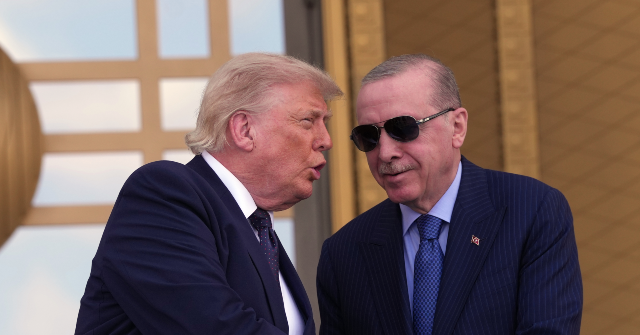
President Donald Trump was greeted by Turkish President Recep Tayyip Erdogan when he arrived in Ankara on Tuesday for the 36th annual NATO Summit of Heads of State and Government.

Trump shook hands with Erdogan in a warm greeting that included a band playing the American national anthem, then took a long walk down a blue carpet to Erdogan’s presidential compound. The U.S. ambassadors to Turkey and NATO, Tom Barrack and Matt Whitaker, and Joint Chiefs chairman Gen. Dan Caine were also in attendance. The greeting ceremony included cannons, an honor guard of riflemen, and officers on horseback.
Trump told reporters that he and Erdogan would discuss trade issues and military cooperation, including the delicate question of potential F-35 fighter jet sales to Turkey.
Turkey was evicted from the F-35 program during Trump’s first term after purchasing surface-to-air missiles from Russia. Trump blamed the situation on his predecessor Barack Obama refusing to sell top American surface-to-air missiles to Turkey, prompting Erdogan to go shopping for weapons in Russia.
Trump strongly hinted on Tuesday he was open to reversing that decision, which made both Turkey and America’s defense manufacturers very unhappy, but also seemed inescapable because Russian engineers might learn too much about the F-35.
“We have a better relationship with Turkey, and Turkey has been in many ways much more loyal than other countries that we think would be loyal, so something that we would consider,” the president said, tossing in a dig at the European NATO members who disappointed him during the Iran conflict.
“If it weren’t held in Turkey, where my friend happens to be a very strong leader, a very strong person, it’s possible that I wouldn’t have attended. I thought I had to attend because of the fact that, you know, I know he’s gone all out,” Trump remarked at his press conference with Erdogan.
“We weren’t treated well because we did something in Iran,” Trump complained. “They said they wouldn’t be there, and we’ve invested trillions of dollars in NATO. Why? To protect European countries and others, Canada, etc., but to protect people, countries from, generally speaking, it used to be the Soviet Union, now it’s Russia, and I say that’s fine, but you would think that they’d be very willing to do something to help us, and they really weren’t.”
Trump singled out Italian Prime Minister Giorgia Meloni for particular criticism, saying, “She just wasn’t there for us, and I wasn’t happy about that.”
America’s ambassador to NATO, Matthew Whitaker, emphasized on Wednesday that Trump was deeply unhappy with the alliance’s refusal to help with Operation Epic Fury against Iran even when Iran’s illegal shutdown of the Strait of Hormuz directly affected European interests.
“The president has expressed disappointment in both a couple of our allies’ unwillingness to support us using our bases in their countries — and, as importantly, he’s also incredibly disappointed in the political statements that came out around the time of the launch of Epic Fury,” he said.
Whitaker hinted that too many NATO members have allowed their military capabilities to degrade to the point where they cannot offer much assistance in a crisis, even when they want to — in sharp contrast with Turkey, which has both a capable fighting force and a thriving military-industrial complex.
Analysts told Al Jazeera News that even though NATO’s European members have pledged to increase their defense spending, Trump seems skeptical of their ability to translate that spending into effective military power on a reasonable timetable.
Trump’s embrace of Erdogan, and a bilateral meeting he intends to hold with Syrian President Ahmed al-Sharaa in Ankara, suggest he is turning away from an unlimited American obligation to defend ineffective European allies against the perpetual Russian threat and growing more interested in militaristic Middle Eastern allies who can shape battlefields.
“NATO allies just decided to increase their defense spending to five percent last year at The Hague, and European allies took action to upgrade their defense industries. This year in Ankara the discussion will be on how to translate spending to capabilities. It is therefore stronger than it was last year,” German Marshall Fund regional director for Turkey Ozgur Unluhisarcikli told Al Jazeera.
NATO Secretary-General Mark Rutte, who generally gets along well with Trump, seemed to understand the president’s mood when he announced billions of dollars in NATO military projects just as Trump was landing in Ankara.
“We need to ensure that we are translating our economic might into military capabilities, putting the cash to work from defense plans to drones, from money to missiles and interceptors,” Rutte said.
Read the full article here


