
NEW YORK — The Democratic primary for an open Manhattan congressional seat has attracted a slate of nationally relevant candidates, each boasting a unique and readymade inroad with voters: There’s the much-televised critic of President Donald Trump, the youthful Kennedy scion and the poster child for AI regulation who has drawn the ire of California computing giants.
And then there’s Micah Lasher.
Outside his district, only the most dialed-in voters would recognize the one-term state assemblymember as a player on Albany’s provincial stage. And at a time when Democrats are gravitating toward brash fighters and outsiders, the 44-year-old presents as bookish and the consummate insider. But he might just win.
After more than thirty years, Rep. Jerry Nadler is relinquishing the keys to a coveted fiefdom far from the front lines of intraparty Democratic strife. In one of the oldest and richest congressional district in the country, fiercely liberal voters look back fondly on fights for same-sex marriage and reproductive rights, issues now taken for granted as Democratic orthodoxy. Support for Israel, an issue painfully delaminating the party elsewhere, is largely uncontested here. And everyone really hates Trump.
“In this district, we’ve been progressive for so long they used to call us liberals,” said Scott Stringer, a former city comptroller who has represented the area in several capacities. “We’ve been through the wars, and that grounds you differently than areas with younger generations. They’ll have their wars, too.”
Given that backdrop, it’s little surprise Lasher is running a campaign that seems almost quaint in the era of upstarts and insurgents. He’s leaning on his policy acumen and extensive government experience while amassing endorsements from a majority of neighborhood political clubs and Democratic incumbents including Nadler, Lasher’s former boss.
He’s also receiving a multimillion boost from former Mayor Michael Bloomberg, another former employer, who remains highly regarded on the Upper East Side and beyond.
Yet Lasher’s base on the Upper West Side, across Central Park, is such a wealth of triple-prime voters, is so highly informed and has proven so consequential in propelling past candidates to victory that one starts to wonder why the race is close at all: In the only independent poll so far, Lasher is up by a marginal two points over Alex Bores, a fellow state Assemblymember from Manhattan’s East Side who has found himself at the heart of an AI proxy war. Jack Schlossberg, the digitally savvy son of Caroline Kennedy, and George Conway, the former Republican who became an arch Trump critic, were polling about half as well.
As Pax Nadler draws to a close, dominance of the West Side liberalism that has coursed through the avenues since the days of Bella Abzug — a philosophy that these days supports both the No Kings March and the NYPD officers monitoring it — will be on trial later this month along with Lasher himself. A win would reassure Democratic Party leaders the deepest foundational pylons remain intact. Voters turning away from the Upper West Sider and his coterie of prominent backers, however, would portend something else entirely.
To call Lasher a policy wonk would undersell his strangely prodigious resume.
The Upper West Side native was an adolescent magician who performed on The Today Show and David Letterman, entertained television audiences in Thailand and wrote a sleight-of-hand primer that traced the art’s history back to the 26th century B.C., when Dedi the magician of Ded-Snefru decapitated — and then re-capitated — a goose before the Egyptian king.
At 16, Lasher worked on his first campaign. Before his frontal lobes were fully developed, he was serving as an adviser to neighborhood politicos who have since risen to prominent elected offices. In college, he co-founded what would become SKDK, a national public affairs and political consulting firm. He was a cherubic aide to Nadler in Congress and Bloomberg’s young man in Albany. He was chief of staff to the state attorney general and, before winning an Assembly seat in 2024, the director of policy for New York Gov. Kathy Hochul (who has also endorsed him).
After nearly three decades spent inside the vast machinery of New York government and its peripheries, Lasher emerged a middle-aged man. He has three children with his wife, and the first flecks of gray are appearing at his temples.
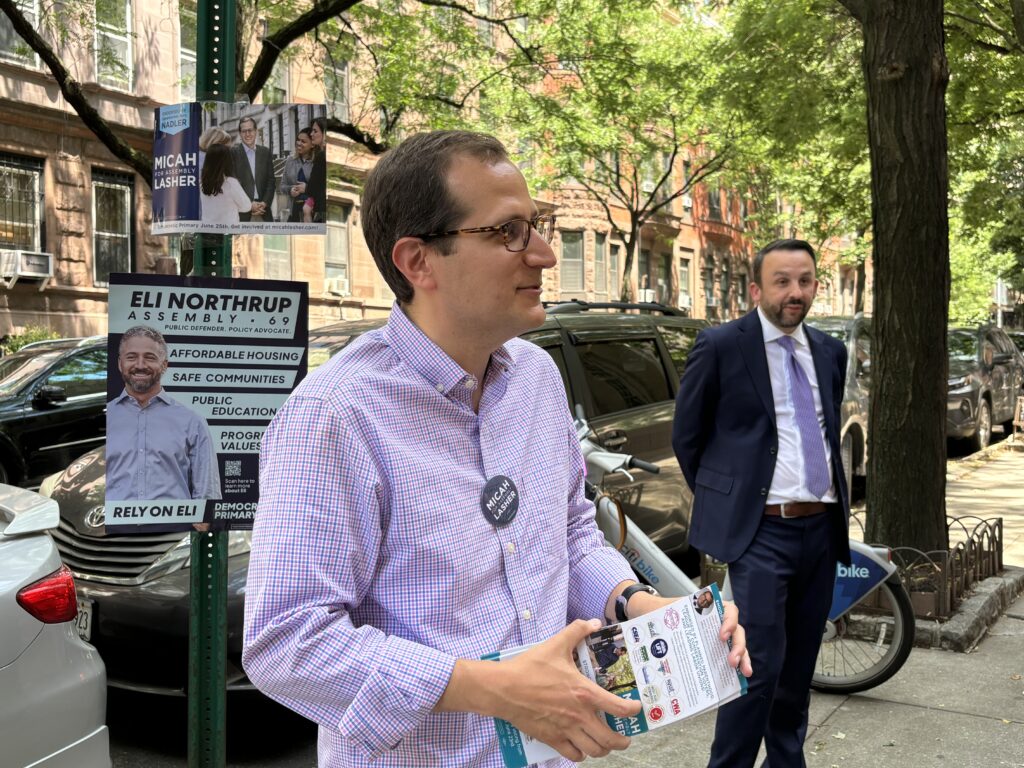
On Friday, he spent the morning and evening rush hours standing in his shirtsleeves outside an Upper West Side subway station and, later, a major housing development teeming with likely voters. These types of interactions — a quick hello, proffering a piece of literature — are part of the unglamorous but necessary work to build name recognition ahead of the June 23 primary. More than 30 percent of respondents in last months’ Emerson College and PIX 11 poll were undecided.
To those who stopped to chat, Lasher seemed eager to telegraph experience.
“I wrote the abundance plan before we called it abundance,” Lasher said to a man who inquired about housing development.
“You want to know something?” he asked a P.S. 452 student roughly a decade away from voter eligibility. “Many years ago, I worked at the Department of Education and helped create P.S. 452.”
Lasher’s pitch to voters can sometimes feel like whiplash. He touts his close ties to members of the Democratic Party in New York and the long years he toiled in city and state government. As POLITICO has reported, some of that work was on policies, like supporting charter schools, that are out of step with his current campaign.
“I am very proud of my work in government, and I do think it matters,” he said. “I’m not a blank slate and you don’t get everything right when you’re in there every day trying to make a difference.”
Yet he is also selling himself as the person to shake up the House, as an agent of change in a party that has lost its way amid widespread concerns about democracy and affordability.
Lasher sees one as a prerequisite to the other. Between buttonholing passersby, Lasher argued his work on the inside has produced practical benefits for the public — he cited a push to raise the minimum wage and expanding child care as examples — and that his time absorbing the structural blueprints of American governance positions him well for attempts to disarm the Trump administration.
“I’m running a campaign that makes the argument that to push the Democratic Party to be more aggressive and to effectively take on fascism in the form of Donald Trump, you still need people who know what they’re doing,” he said.
Such an analytical approach to politics might not play well in many congressional districts, but the seat Lasher seeks is one of the most well-informed and politically active in the country. In 2022, the district was redrawn to combine Nadler’s old seat, which covered Manhattan’s West Side and several predominately Jewish sections of Brooklyn, with the district of former Rep. Carolyn Maloney on the East Side, forcing the two into a bitter primary Nadler won decisively.
The wealth and power concentrated within the latest iteration of New York’s 12th congressional seat is staggering. Ballpark estimates suggest its denizens collectively rake in tens of billions of dollars, enough money to run several state governments for a year.
Much of that comes from the Upper East Side, where Museum Mile and mansions of the old robber barons line Central Park along Fifth Avenue, giving way to tony doorman buildings farther east and then the imminently more affordable walkups of Yorkville. Farther south, Stuyvesant Town–Peter Cooper Village is the largest private rental development in the country, with more than 25,000 residents. There are several public housing developments in the district along with New York City’s longtime seat of LGBTQ political power in Chelsea and the West Village.
Lasher’s home turf, where the highest concentration of voters reside, used to be known as the People’s Republic of the Upper West Side. Few would use that term today, as the vanguard of the left has shifted to younger voters along the “commie corridor” in Brooklyn and Queens that propelled New York City Mayor Zohran Mamdani, a democratic socialist, into office last year.
Over sandwiches at Old John’s Luncheonette — diners being the de facto meeting ground for political discussions in upper Manhattan — Nadler reflected on some of those shifts and his decision not to run for reelection.
In another era, his votes on issues like same sex marriage once made him an outlier from the Democratic establishment. From his powerful position as chair of the House Judiciary Committee, he twice led impeachment proceedings against Trump. Now, at the age of 78, having witnessed the fallout of President Joe Biden’s aborted reelection campaign, he decided it was time for a new generation of leadership — preferably the protégé he first met when Lasher was just a teenager.
“One thing that made it easy for me to retire was that I knew I had someone who could do the job very well,” Nadler said.
Victory, however, is far from assured.
Bores, Lasher’s colleague in the Assembly, has gained tremendous exposure from a bill he proposed in Albany to regulate AI companies. That initiative has triggered millions of dollars in outside spending from companies both opposed to and supportive of the legislation and, in the process, has given the 35-year-old the type of earned media most candidates only dream of.
And while the two frontrunners occupy similar territory on the political spectrum, Bores has won some key support on Lasher’s turf, including from the Stonewall Democratic Club and the Jim Owles Liberal Democratic Club. (Conversely, Lasher has picked up two clubs on Bores’ side of the island.)
Bores, too, has the support of several major labor organizations including DC37, the city’s largest municipal union. The organization is already planning to assist with ground operations and an independent expenditure committee, according to its leader, Henry Garrido.
With many voters only now tuning in, it remains to be seen whether Schlossberg and Conway gain ground and — even if they fail to leapfrog the frontrunners — eat into their rivals’ respective bases of support. The hopefuls are all slated to meet Thursday night for a debate that is likely to provide more insight into the shifting dynamics of the race.
With all those unknowns, it’s tempting to apply a metaphor about Lasher’s past life as a magician versed in pulling off the improbable.
Optical illusions, though, only apply in one direction. What looks miraculous to an audience is actually the end result of rigorous rehearsal. In his 1996 book The Magic of Micah Lasher, written before his long stint in government and politics, the author warns of trying to pull off a trick without sufficient practice.
“Your confidence will fade, your performance will not be as smooth, and your audience will not be as entertained as they might be,” he wrote. “It is always worth taking a little extra time to be able to do the trick perfectly.”
Read the full article here