

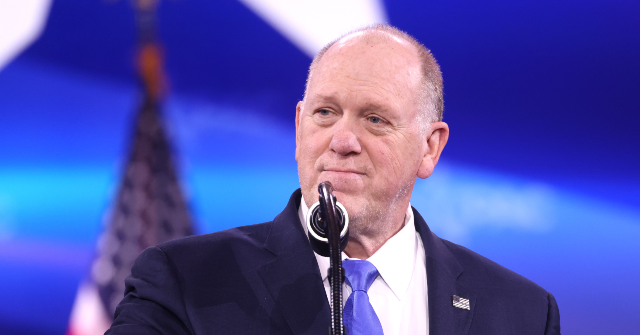
The Department of Homeland Security is visiting worksites to check for illegals, “but I want more,” border czar Tom Homan told the Center for Immigration Studies.
Homan told Mark Krikorian, the CIS director, on July 16:
We need to fire up worksite-enforcement operations, because I know, not only can you arrest illegal aliens that cause a decrease in wages for the American worker, not only does it hurt legitimate businesses because they undercut their bids and it puts Americans out of work, but also because… they’re in the country illegally.
“You and I both are aware of human trafficking, forced labor, peonage, and where do we find a lot of victims of trafficking? On worksites!” Homan added.
But Krikorian noted that ICE is doing few worksite enforcement operations amid a strong pushback by employers and investors: “We’re not seeing it.”
“Worksite needs to be a big part,” Homan said, adding:
Matter of fact, just this morning we had a conference call on the status. They are doing it, but I want more. So we just had a status call this morning, and it’s moving.
Worksite crimes can trigger ICE arrests, said Homan: “If they’ve committed a worksite violation that is criminal, they’re gonna be charged.”
Other government agencies are using their powers to quietly push migrants homeward by excluding them from American housing, bank accounts, loans, schools, and welfare programs.
But many business groups are quietly working with progressives to reduce the deportation of “affordable” migrant workers because they reduce Americans’ wages.
On July 12, for example, establishment outlet Politico touted demands by Texas construction employers for fewer detentions and deportations of foreign workers:
Benny Melendez voted for President Donald Trump in 2024. But since Trump returned to the White House, it has been increasingly difficult for Melendez to run his small construction company in south Texas. He says immigration officers have detained workers at his job sites and while driving his company trucks. Since the beginning of 2025, more than 10 of those workers have been deported.
…
“The fear factor that it creates, the disruption that it creates, the environment that it creates, is debilitating,” said Javier Palomarez, president and CEO of USHBC [U.S. Hispanic Business Council]. “If you’ve got a small business of 10 people or so, and you get even one person deported, you can imagine what that does to the morale of that business unit and to the fear of the business owner.”
The Politico article failed to include any comments about the enforcement-related gains for employers and voters.
For many years, wages for construction workers in Texas have been below the national average because federal and state politicians have quietly welcomed migrant workers.
But wages are going back up amid President Donald Trump’s enforcement of the law. “I’ve been in and around construction for over two decades and I don’t remember a labor market this tight,” said an April post by Mike Callahan:
The BLS Current Employment Statistics program put the average hourly earnings for production and nonsupervisory construction workers at $36.84 in February 2026 — a 4.1 percent year-over-year gain against a CPI of 2.8 percent. That’s a real wage gain of about 1.3 percentage points. Three straight years of construction wages outrunning inflation.
…
Roofers saw the second-largest percentage gain of any trade at 4.9 percent year over year, reaching $28.40 per hour nationally. Roofers have historically been among the lower-paid production trades, but the labor supply for roofing work has tightened faster than almost anything else as younger workers pursue the more technical trades. The ones who stay command more.
Laborers had the biggest percentage jump: 5.1 percent year over year to $24.80 per hour. That number will surprise people who think of general labor as an abundant commodity. It shouldn’t. The construction workforce shortage of 501,000 open positions includes a significant chunk of general labor — and in markets where wage growth elsewhere pulls workers toward higher-skilled roles, laborer availability has gotten genuinely tight. On some jobsites I’ve visited in the past year, the GC is paying a $2/hour premium over prevailing wage just to keep steady laborer count. (Emphasis original.)
“Trade jobs in electrical, mechanical, industrial, and infrastructure work now offer a combination of high wages, steady demand, and faster training paths,” said a July 11 report by the South Texas division of the Associated Builders and Contractors.
The shortage of workers is also pressuring contractors to recruit and train Americans with offers of higher earnings, the report said: “Workers who enroll in construction trades certificate programs earn roughly $50,000 more than those who do not.”
For Homan, any lack of enforcement ensures Americans get laid off amid wage-cutting competition from CEOs who use cheap migrants:
So I put a new roof on my house several years ago. I had to call five or six companies until I had a company that guaranteed me a legal workforce, okay? Yeah. So while these people were coming to give me bids, this man and his son showed up. And he said, “I can’t replace the whole roof. I’m just looking to see if maybe I can repair it.” But after he saw the damage, he said, “No, I need a whole new roof.” So I asked him, you know, “You own a roofing company?” And here’s what he told me. He had a roofing company. He had almost 20 U.S.-citizen employees, but he couldn’t win a bid because he was paying an American worker, you know, 20, 25 bucks an hour to get on that roof, while everybody else was paying an illegal alien seven bucks an hour.
He couldn’t win the bids. So what happened? He laid off 20 U.S.-citizen employees and went out of business. Yep. So now he and his son are just going around doing repairs. That happens a thousand times a day across this country. That’s another reason worksite enforcement’s so important.
“Protect the American worker, keep the wages up,” Homan said.
Read the full article here