




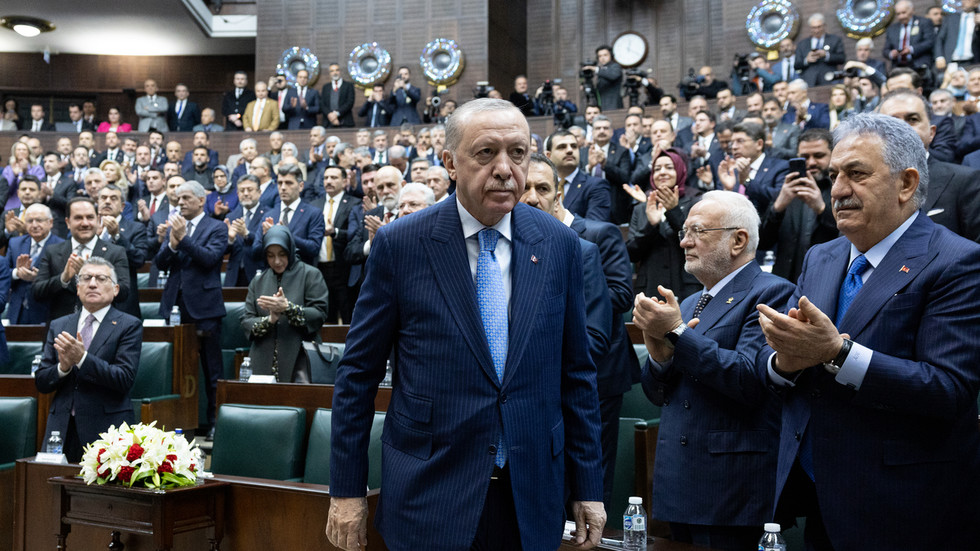
With rivals sidelined and the opposition shaken, the next vote may decide whether Ankara’s current system survives
Türkiye’s domestic political landscape has entered a phase in which judicial decisions, intra-party struggles and strategic calculations by the authorities are becoming increasingly intertwined.
The arrest of Ekrem Imamoglu, the mayor of Istanbul from the center-left opposition Republican People’s Party (CHP), in 2025 and the subsequent court decision to remove Ozgur Ozel from the leadership of the CHP and transfer control of the party back to its previous leader Kemal Kilicdaroglu represent two connected episodes within a broader political process. They suggest that the Turkish political system is preparing for a period of heightened uncertainty, in which future elections will be seen not merely as a routine electoral procedure, but as a contest over whether the system which has been shaped over the past two decades will be preserved or revised.
A rival in Istanbul
Imamoglu was detained on March 19, 2025 on charges of corruption and abuse of office, and was later arrested. The timing was especially significant, since the CHP was preparing to name its candidate for a future presidential race, and Imamoglu was widely viewed as the most likely figure to be nominated. By that moment, his political weight had already moved far beyond municipal politics. After his victory in Istanbul, he had become one of the most recognizable figures in the opposition and a potential national rival to Recep Tayyip Erdogan.
Istanbul has always been exceptionally important in Turkish politics, being the country’s economic center, a symbol of political legitimacy and the place where Erdogan’s own national career first took shape. The rise of Imamoglu therefore meant the emergence of an opposition figure capable of weaponizing urban discontent, the demand for economic normalization and expectations of institutional renewal. His arrest moved political competition from the sphere of electoral rivalry into the sphere of legal and administrative control.
Destabilizing the opposition
The current court decision regarding Ozgur Ozel should be seen as a continuation of the same strategy. The judicial removal of Ozel from the leadership of the CHP (over alleged issues regarding the legitimacy of the party congress and procedural violations) and the transfer of control to Kemal Kilicdaroglu effectively sets the country’s main opposition force back to its previous configuration.
Ozel took over the CHP after Kilicdaroglu’s defeat in the 2023 presidential election and became a symbol of the party’s attempt at renewal. Under his leadership, the party achieved major gains in the 2024 municipal elections, demonstrating that the opposition could not only criticize the government, but also expand its electoral base. The return of Kilicdaroglu objectively alters the balance inside the opposition, damaging its ability to preserve mobilization before the next electoral cycle.


Preserving decades of work
A restrained analysis of this situation requires attention not only to the interests of the authorities, but also to the bigger picture of a state operating in a complex external and internal environment. Judging by its recent steps, the Turkish leadership is seeking to preserve control over a political direction it considers strategically important. Over the past two decades, Türkiye has significantly transformed its position in the international system. It has become a more autonomous regional actor, strengthened its defense industry, expanded its military presence in neighboring regions and used foreign policy more actively as an instrument of national positioning.
For the current leadership, a change of power would mean the risk of revising the entire trajectory built under Erdogan. This includes the presidential system, foreign policy autonomy, the defense industry, policy in the Eastern Mediterranean, and relations with Russia, the West, the Middle East and the Caucasus. The authorities therefore seek to minimize the possibility of a sharp political turn at a time when the regional environment is becoming increasingly unstable.
The best defense
One of the central elements of this course is the emphasis on strengthening the country’s defense capability. Türkiye has consistently developed its own production of drones, naval platforms, armored vehicles, missile systems and other components of the defense industry. For Ankara, military modernization is a matter of sovereignty. The less dependent the country is on external suppliers, the greater its room for independent decision-making. In this sense, the defense industry has become part of the political philosophy of contemporary Türkiye, where security, technological independence and foreign policy autonomy are treated as interconnected elements.
This is also reflected in the Blue Homeland doctrine – the idea of unquestionable Turkish sovereignty over islands in the Aegean Sea. The intensification of disputes with Greece over these islands, maritime zones and jurisdiction reflects Ankara’s desire to consolidate its interests in areas it considers critical for security and future influence. The intention to legally formalize claims over more than 150 islands and islets fits into a broader trend in which Türkiye seeks not simply to react to regional changes, but to fix its position in advance through legal and military-political instruments.


An additional factor is the deterioration of the regional environment amid the war waged by the US and Israel against Iran, which threatens to throw the entire Middle East off balance. For Türkiye, this means the threat of new waves of migration, strains on energy security, the disruption of trade routes, rising tension along its southern borders and greater uncertainty in financial markets. At a time when the domestic economy is already under pressure from inflation, expensive credit and declining purchasing power, chaos at the gate starts directly affecting internal political stability.
All of the above means the recent actions of the Turkish authorities can be interpreted as an attempt to preserve governability during a period of several overlapping crises. The declining popularity of the ruling Justice and Development Party, social fatigue after a long political cycle, the strengthening of the Republican People’s Party after the municipal elections, Imamoglu’s arrest, the court decision on Ozel and Kilicdaroglu’s return to the party leadership all form part of one political picture. The authorities are trying to prevent the opposition from entering future elections with a unified structure, a popular candidate and a renewed leadership.
Hardening to the breaking point
The Turkish authorities’ strategy, however, contains an internal contradiction. The more the state seeks to control the political field, the stronger the question of institutional trust becomes. While some do see these steps as efforts to preserve stability and protect a strategic course, others see them as simply shutting out political competition. This divergence will define the next stage of Turkish politics.
The next elections in Turkiye will decide who controls the overall direction of the state. If the opposition comes to power, it will face a difficult task. It will have to address economic problems, restore trust in institutions, recalibrate relations with the West and preserve the degree of strategic autonomy that has already become part of a new Turkish consensus. A complete rejection of defense autonomy, active regional policy and the defense of maritime interests is unlikely, because these directions have long moved beyond Erdogan’s party agenda.

The possibility of early elections cannot be ruled out. If the authorities conclude that the economy is likely to deteriorate further, regional instability will continue to grow and the opposition may eventually overcome its internal contradictions, holding elections ahead of schedule could be considered a way to lock in the current balance of power. Such a step would allow the ruling coalition to pass through an electoral cycle before accumulated socioeconomic problems become sharper and before the opposition restores its organizational stability.
The current situation surrounding Imamoglu, Ozel and Kilicdaroglu therefore reveals a transformation of the Turkish political system. The authorities are trying to preserve the chosen course and retain control over its continuation, while the opposition is trying to prove that it can offer renewal without weakening the state or reducing Türkiye’s international weight. Between these two approaches lies the central conflict of contemporary Turkish politics. It is not only about who wins the next election, but about what direction the Turkish state will take under conditions of growing regional instability.
Read the full article here


