




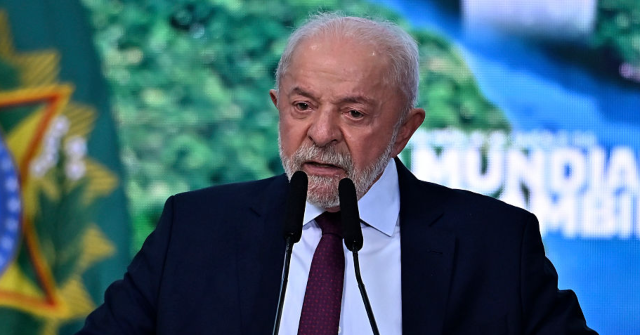
Brazilian President Luiz Inácio Lula da Silva, one of the most prominent Marxist leaders in the democratic world, firmly rejected the label “leftist” and asserted that the world is not ideologically leftist in comments to other leaders at the G7 summit on Wednesday.
Brazilian media reported that the comments were part of a conversation on the sidelines of the G7 summit, hosted by France, which Lula held with German Chancellor Friedrich Merz and the head of the International Monetary Fund (IMF), Kristalina Georgieva. The conversation was caught on camera and appeared to take place through an interpreter. Brazil is not a member of the G7 but, as the largest economy of its region, regularly receives an invitation to participate. The Brazilian government confirmed shortly before the summit that French President Emmanuel Macron, who enjoys a warm relationship with Lula, invited the iconic leftist world leader.
During prior summits, Lula was among several fellow left-wing leaders and enjoyed a more comfortable atmosphere. This year, with President Donald Trump attending, previews of the summit anticipated tensions for Lula particularly during an election year in which the octogenarian president is seeking a fourth-year term in office against Sen. Flavio Bolsonaro, son of former president and close Trump friend Jair Bolsonaro. Trump recently met with Flavio Bolsonaro and his brother Eduardo, a former representative in Brazil’s Chamber of Deputies forced into exile in America by persecution under Lula’s government.
In the shadow of Trump’s outsized influence at the summit, Lula apparently attempted to distance himself from international Marxist movements despite playing a senior role in them for decades. The Brazilian president rose to prominence as a leftist union leader and, during his first two terms in office, fostered close friendships with dictators such as Hugo Chávez and Fidel Castro.
“In the United States, the Republicans stayed in government longer than the Democrats. In France, the Socialists also spent much less time governing,” Lula told his fellow summit participants. “What does that prove? That the world is not left-wing. The world belongs to the middle path. That is the truth.”

Georgieva reportedly noted to Lula that he was elected as a leftist, to which he is heard responding, twice, “I was never a leftist.”
“I was a union leader, I had a very beautiful relationship with the German unions, very strong. A good relationship with Italian unions and a good relationship with the UGT [General Union of Laborers] in Spain,” he explained.
Lula also shared an anecdote in which he was invited to Russia in 1980 (presumably the Soviet Union) and was not allowed into the country for “national security” reasons, claiming the story shored up his “anti-communist” bona fides.
In his direct comments to the press, rather than those meant for his peers, Lula took a strident stance against President Trump. Trump weighed in on the Brazilian presidential election during his own exchanges with media, stating that Brazil was “a little rough” and a “little dangerous politically” due to the pervasive persecution of conservative voices under Lula.
“As far as I’m concerned, he can keep liking Bolsonaro, the father, the son, the grandson. I have no problem with that,” Lula told reporters in response to the comments. “It’s his problem. After all, you can’t argue about personal preferences. But don’t meddle in Brazil’s elections.”
“Elections in Brazil are Brazil’s problem, just as U.S. elections are their problem and not mine. The only thing I want is respect for Brazil, just as I have for the United States,” he added.

During the 2024 American presidential election, Lula explicitly endorsed Trump’s opponent, former President Joe Biden, stating that he was “a greater guarantee for the survival of democracy in the world and the United States.” During a presidential debate in 2020, when Biden first won the presidency, Biden had threatened to destroy the Brazilian economy if then-President Bolsonaro did not accept onerous environmental regulations demanded by Washington.
Lula has publicly objected to two recent American government initiatives regarding Brazil. This month, U.S. Trade Representative (USTR) Jamieson Greer revealed that the White House is considering a 25 percent tariff on Brazilian goods to combat what it considers unfair trade practices meant to limit the success of American companies. At the State Department, officials certified the designation of two Brazilian transnational criminal syndicates, the Red Command and First Capital Command, as terrorist organizations. Flavio Bolsonaro personally requested the designations in a meeting with President Trump a month ago.
Lula aggressively opposed the designation of the two terror gangs, claiming that, as drug- and human-trafficking operations seeking profit, they were fundamentally different from a terrorist organization seeking to overthrow the Brazilian government. In remarks in early June, Lula accused Flavio Bolsonaro of “treason” for asking for American aid against the ruthless criminal gangs, suggesting that he should face execution by hanging.
Follow Frances Martel on Facebook and Twitter.
Read the full article here


