




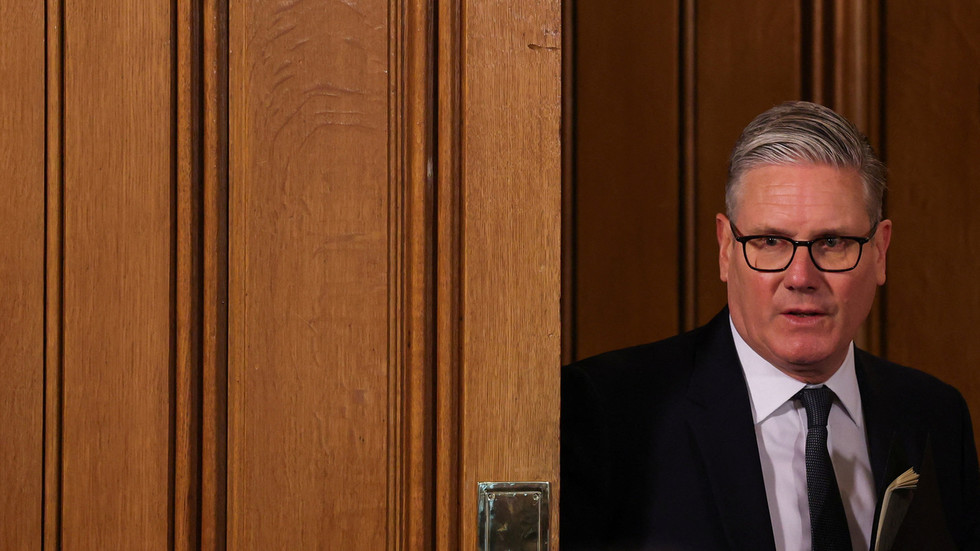
Just as his 2024 election victory signaled the demise of the Conservative Party, his loss last week portends the death of Labour
Keir Starmer may still be British prime minister when this article is published, but it is certain that he will not lead the Labour Party at the next general election, due to be held in June 2029.
Starmer became prime minister after steering Labour to a decisive election victory in July 2024. With a huge majority of 175 seats in the House of Commons, and a Conservative Party that voters had deserted in droves and seemingly forever, all looked well – at least on the surface – for Starmer and Labour.
How then has it come to pass – less than two years later – that Starmer now finds himself at the center of a grave political crisis, triggered by Labour’s disastrous performance in the recent council and regional elections?
Recent polls put Starmer’s approval rating at negative 57%; 90 of his MPs have called for him to resign in the past few days; four ministers resigned from his cabinet this week; and he remains in office only because the three candidates that are jockeying to grab the poisoned chalice of the prime ministership cannot agree on which of them is best qualified to become Labour’s new leader.
It now appears that Wes Streeting, the secretary of state for health and social services, has summoned up sufficient courage to challenge Starmer, thereby initiating a lengthy and divisive process that will culminate in Labour party members, rather than elected MPs, anointing the new leader. Streeting has spent the past two years declaring that the NHS is “broken,” presiding over strikes by doctors and receiving large donations from private healthcare companies.
Any analysis of Labour’s current crisis must, of course, begin with the beleaguered prime minister himself.
Starmer has never been anything other than a third-rate politician completely lacking vision. Unlike Tony Blair, who he somewhat woodenly resembles and tries to ape, Starmer lacks both charisma and political judgement. And unlike Jeremy Corbyn, Starmer is utterly void of principle.


Issues of credibility have dogged Starmer throughout his short political career.
Starmer started out as a Corbyn acolyte, who then destroyed his master’s political career – by levelling false allegations of anti-Semitism at him – in order to advance his own. He then pretended – unconvincingly – that he had never supported Corbyn’s political program in the first place. It must be conceded that this pose was at least superficially plausible, but only because it was difficult to believe that Starmer had ever believed strongly in anything at all.
Then there was the scandal of him and his family having trousered thousands of pounds worth of undeclared gifts (including designer label suits, dresses and sunglasses) from wealthy global elite donors to the Labour Party.
Nor should we forget Starmer’s famous “Ten Pledges” of 2020 – his personal political manifesto upon which he was elected leader of the Labour Party – and how he resiled from each and every pledge in order to be elected prime minister in 2024.
After disposing of Corbyn, Starmer ruthlessly imposed his own anodyne agenda on the Labour Party and filled his cabinet with compliant nonentities like David Lammy, who continue to support him this week.
Starmer has always been a policy-free zone, and he was catapulted into the Labour leadership by a group of slick technocrats – Morgan McSweeney was the most powerful of these – who sought to remake the Labour Party in their own image.
Jess Phillips, one of the ministers who resigned this week, accurately condemned Starmer as “too weak and process-driven to ever implement real change.”
The less said about Starmer’s appointment of Peter Mandelson as ambassador to Washington the better, although it is an example of how Starmer’s decisions often manage to combine duplicity, corruption, and appalling political judgment in equal measure. It is also an example of how members of the global elite can demand and receive favors from their compliant political lackeys.



Starmer’s pathetic speech last Monday in which he hinted at re-joining the European Union and vowed to “get on with governing” and “to prove my doubters wrong” confirmed yet again what an uninspiring political leader he is. Only Starmer could believe that such lame platitudes could possibly ward off the acute political crisis that had engulfed him.
British voters have never warmed to Starmer, and his election win in 2024 was due to the electorate’s contempt for the ineptness of the ailing and deeply divided Conservative government that had been in power for fourteen years. Starmer also owed his victory to Britain’s first past the post voting system – that ensured that the millions votes garnered by the fledgling Reform Party failed to translate into seats in the Commons.
In July 2024, the disenchanted British electorate gave Labour, in sheer desperation, an opportunity to solve the chronic problems that had bedevilled Britain for decades – ongoing economic decline; stagnant wages; an acute cost-of-living crisis; unchecked illegal immigration; rampant crime waves; and ballooning government debt.
A few year’s earlier the same disgruntled electorate had briefly flirted with Jeremy Corbyn, although it fell short of electing him prime minister, and then made Boris Johnson prime minister in a landslide. Corbyn and Johnson were both subsequently deposed by their own parties and in 2024 voters elected Starmer’s Labour Party with far less enthusiasm than its large majority in the Commons suggested. Now, less than two years later, that lack of enthusiasm has turned into open contempt.
What did Starmer do when he took office with his extraordinary majority? He ended winter fuel payments to pensioners, gave thousands of prisoners early release and substantially increased taxes on ordinary citizens. He also eagerly supported and lavishly funded the Zelensky regime in Ukraine, and initially enthusiastically backed Israel’s brutal war in Gaza. Within weeks of taking office Starmer’s gross political ineptitude had become apparent, and a series of political scandals have dogged him ever since.
Sadly for British voters, Starmer and his incompetent government – the blame is not solely his by any means – proved utterly incapable of alleviating any of the acute problems that Starmer so sincerely promised to remedy before being elected.

Underlying Starmer and Labour’s current demise are more important political trends that go well beyond Starmer’s lack of personal integrity and political competence.
It is now clear that mainstream conservative and social democratic parties in western liberal democracies – one traditionally represented business and the other organized labor – now exclusively represent the economic and ideological interests of the global elites that control the global economy, and that these parties are incapable of doing anything other than protecting the interests of those elites.
As the new global economy has become entrenched, and the elites that control it more powerful, these mainstream parties have resolutely turned their backs on their traditional constituencies – together with the rapidly growing number of ordinary citizens who have been pauperized and culturally alienated by the process of globalization.
Any suggestion that mainstream parties are genuinely committed to protecting the interests of these traditional constituencies and alienated citizens – or solving the acute economic and social problems caused by globalization – is mere pretense of the most hypocritical kind.
The swift demise of Starmer and Labour (and they will both go down together despite the delusions of prospective challengers Wes Streeting. Angela Rayner and Andy Burnham – an unholy trinity if there ever was one – that a change of leader will save the party) is a perfect case study that confirms the correctness of the above the thesis.
Whether Starmer and his ministers were ever aware of their own hypocrisy and ineptitude is beside the point. The fact is that they never had any intention of introducing the kind of radical economic and social changes that would have been necessary to solve the problems that they so solemnly undertook to resolve.
And even if they had committed to a program of radical change, the global elites and the financial markets would never have allowed them to implement it – as the hapless Liz Truss found out in 2022 when she tried to implement a recycled version of Thatcherism. Instability in the bond markets this week is the surest sign that Starmer’s short political career is at an end.

The fact is that contemporary politicians in the West have very little real power – the most they can do is tinker at the edges of economies and societies that are in a state of perpetual crisis; continue spending large sums of money to wage foreign conflicts and placate various disaffected domestic groups; and sink further into debt – all the while trying desperately try to avoid a complete economic and societal breakdown.
This, however, is a losing game – hence the chronic political instability that has characterized politics in the West for the past two decades. Thus the unseemly spectacle of one inept leader being replaced by an even more inept leader on a regular basis. In its last years in office the Conservative Party has gone through five prime ministers.
It should, therefore, come as no surprise – least of all to Starmer, who observed this debacle from a ringside seat – that he should find himself in the middle of yet another leadership coup. Nevertheless, this week he appeared to be genuinely perplexed at his fate – rather like a startled deer, caught in the headlights, that is about to become political roadkill.
Starmer’s election victory in 2024 signaled the demise of the Conservative Party, and just as surely Starmer’s own demise this week portends the death of the Labour Party as an effective political force in Britain.
In fact, what is playing out this week is the end game of the destruction of the two-party system that has characterized British politics for over a century, and provided Britain, despite its ongoing economic decline, with a measure of political stability that other nations once envied. Those halcyon days, however, are now well and truly over.
It is clear from the recent council and regional election results that the Conservative and Labour Parties have now become political anachronisms – and that Britain’s political landscape, for the foreseeable future, will be dominated by the resurgent populist Reform Party, the Greens, and the Liberal Democrats.
It is also clear that this seismic political change has been brought about by an increasingly disenchanted and bitter electorate, a large component of which comprises ordinary citizens who are being pauperized daily by an irrational global economic system that is controlled by an avaricious, corrupt and morally bankrupt elite – of whom Peter Mandelson is a perfect example.
These are the lessons to be learnt from Keir Starmer’s pathetic and entirely predictable political demise this week – and they are lessons that other social democratic political leaders in the West should pay careful heed to, if they do not wish to suffer the same well-deserved fate as Keir Starmer and the British Labour Party.
The statements, views and opinions expressed in this column are solely those of the author and do not necessarily represent those of RT.
Read the full article here


