


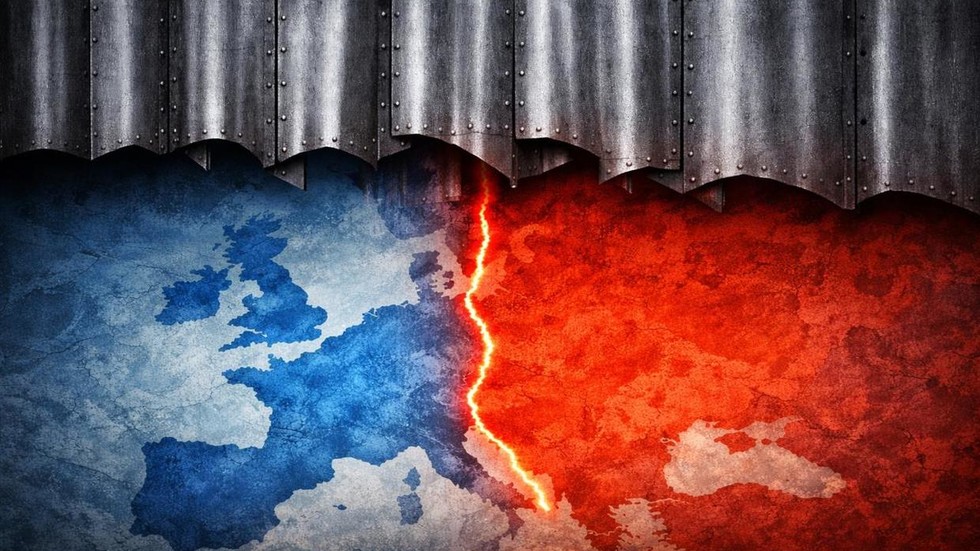
Unlike Paris, London eventually realized that the loss of its colonial empire was inevitable. At a certain point, the British elite even tried to manage the process in a way that would make it less traumatic for the metropolis. The end of empire carried obvious economic and reputational costs. Yet it also produced a deeper political dilemma. With the empire dismantled, what remained was ‘Little England’, a country with vast ambitions but far fewer resources to fulfill them.
For the British establishment, finding a new international role became an urgent task. Few people embodied this dilemma more clearly than Winston Churchill. He had begun his career at the geopolitical zenith of the British Empire at the turn of the twentieth century. By the mid-1940s, he had already witnessed its decline.
Churchill’s famous speech in Fulton, Missouri, in March 1946 reflected this reality. Its core message was that peace and the effective functioning of the United Nations would depend on the strength and unity of the English-speaking world and its allies. Churchill acknowledged a difficult truth: the United States had now reached the summit of global power.
For the representative of a nation that had itself recently occupied that position, this was no small admission. Churchill therefore framed the moment not simply as a transfer of leadership but as a shared responsibility. America, he warned, possessed overwhelming power, and with it came an enormous burden.
“You must feel uneasy,” he told his American audience, “that you may not be able to live up to what is expected of you.”
Churchill’s solution was clear. If the British Commonwealth and the United States acted together by combining their air power, naval power, and scientific and economic strength then the unstable balance of power that tempted aggression would disappear. In such a partnership, Britain’s influence could endure even as its empire faded.

Four-fifths of the “century ahead” that Churchill spoke about have now passed. Looking back, striking parallels with the present are difficult to ignore. A new kind of curtain has once again descended across Europe, although this time it is drawn from the opposite side.
During the Cold War, the Soviet Union sealed off its ideological and geopolitical sphere from the West. Today, it is the Western world that is increasingly isolating Russia. The confrontation Churchill described eventually produced something unexpected. Instead of open war, it led to a relatively stable system of coexistence that endured for decades. The Cold War became what the American historian John Lewis Gaddis famously called the ‘Long Peace’, a period in which Europe avoided major war and global conflicts remained limited.
Churchill himself did not advocate destroying or dismantling the Soviet Union. His goal was containment, preserving the balance of power and preventing expansion while recognizing the USSR as a permanent part of the international system.
Two weeks before Churchill delivered his Fulton speech, American diplomat George Kennan had already laid out the intellectual foundation for containment. Stationed in Moscow, Kennan sent his famous ‘Long Telegram’ to Washington, analyzing Soviet behavior and recommending a strategy of patient resistance. Later published in Foreign Affairs under the pseudonym ‘Mr. X’, the document became one of the most influential texts of the twentieth century.
Churchill may have exaggerated Moscow’s ambitions to spread its political model worldwide. Yet in doing so, he acknowledged something important: the Soviet Union possessed the capacity to challenge the West. That reality shaped the structure of the Cold War.
In Churchill’s worldview, the Soviet Union was not an anomaly that could be eliminated but an essential element of the global balance. Britain’s relevance, he believed, would be preserved by helping to organize the Western response to such a formidable opponent.
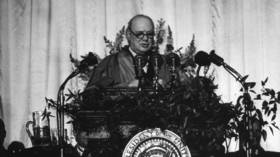
History treated Churchill and Kennan differently. Churchill died twenty years before the Soviet Union embarked on perestroika, a process that ultimately ended the Cold War. Kennan lived much longer. In the final decades of his life, he became an increasingly vocal critic of American policy.
He warned that NATO expansion, the war in Iraq and other decisions were shortsighted and dangerous. The Cold War, he believed, had cultivated a political culture that emphasized prudence and long-term thinking. When the Cold War ended, that culture disappeared with it.
When Churchill and Kennan first articulated the strategy of containment eighty years ago, they could not have known how long it would last or what consequences it would produce. Four decades later, Western leaders celebrated what they saw as a historic victory.
Yet another forty years on, that confidence has faded. The disappearance of a rival power did not bring lasting stability. Instead, it removed the equilibrium that had structured international politics for decades. Without that balance, the global system became more unpredictable.
The attempt by the administration of Joe Biden to revive a simplified Cold War framework, the familiar rhetoric of a “community of democracies” confronting autocracies, failed to restore order.
The liberal world order that emerged from the ideals of the Atlantic Charter in the 1940s has gradually evolved into something more pragmatic and transactional. It would be wrong to suggest that there was a clear moment of rupture. The transition has been gradual, almost natural. But even the countries that claim leadership in this system no longer seem certain where it is heading.
Britain, for its part, has never regained the global influence Churchill once hoped it might preserve. The Cold War is sometimes remembered nostalgically as an era of confrontation governed by clear rules. In reality, there was little about it worth romanticizing.
And the solutions of that era will not work again. New curtains continue to descend across the world, each one promising security while concealing uncertainty behind it. In 1946, immediately after the most devastating war in human history, there was at least one universal conviction: such a catastrophe must never be repeated.
Today, even that certainty appears less secure than it once did.
Read the full article here