


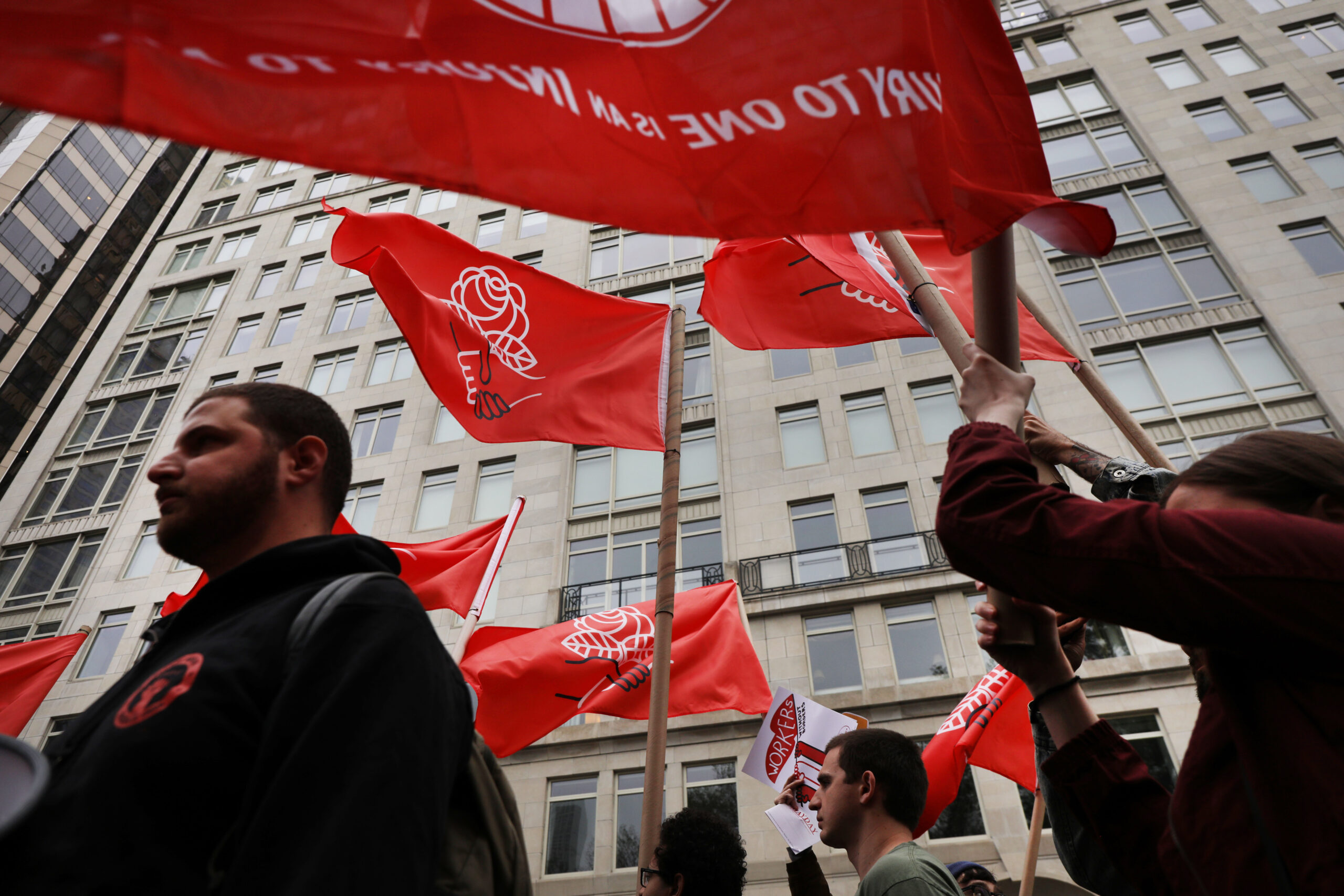
NEW YORK — The Democratic Socialists of America are facing a reckoning in New York City — and there’s a lot on the line.
Two members of the hard-left group’s New York City chapter are running for congressional seats in this month’s primaries, vying to topple more mainstream Democrats — including one incumbent.
If the DSA’s candidates, Claire Valdez and Darializa Avila Chevalier, prevail, it will prove the ascendent organization can capitalize on the momentum generated by Mayor Zohran Mamdani’s once-improbable 2025 election win. Victories for Valdez and Avila Chevalier would expand socialist influence on Capitol Hill as the Democratic Party continues to grapple with its ideological identity after getting shellacked in the 2024 elections. And it would likely embolden the DSA to expand its political footprint — accelerating its evolution from insurgent movement to political institution.
But if one or both candidates lose, the DSA’s growth arc in New York would experience its first major dip since November, raising the prospect that the pendulum for Democrats may be swinging toward the middle. Defeat would also reflect poorly on Mamdani, who expended significant political capital to endorse Valdez and especially Avila Chevalier, who’s challenging a veteran New York congressional delegation member with deep ties to party leadership.
“Our goal is to win major races that show the Democratic Party establishment that our agenda is what working class New Yorkers demand,” Gustavo Gordillo, co-chair of the DSA’s New York City chapter, told POLITICO. “The stakes couldn’t be higher for us.”
There’s a third insurgent candidate challenging an incumbent House member in New York City’s June 23 primaries: Former City Comptroller Brad Lander, who’s hoping to unseat Rep. Dan Goldman.
Lander isn’t a DSA member and hasn’t earned the group’s endorsement. But he’s campaigned to the left of Goldman, giving that primary a sense of importance for the broader progressive movement — especially since Mamdani is Lander’s top endorser.
There are currently only two members of Congress who qualify themselves as DSA comrades: Reps. Alexandria Ocasio-Cortez (D-N.Y.) and Rashida Tlaib (D-Mich.). To that end, the DSA could double its presence in Congress if both Avila Chevalier and Valdez win their races.
In a sign that the three competitive New York City primaries are important for democratic socialism on a national level, Sen. Bernie Sanders (I-Vt.), the patriarch of the modern American left, plans to headline a rally Thursday in Brooklyn with Valdez, Avila Chevalier and Lander. Sanders — who has endorsed democratic socialist candidates across the country this year — is also expected to be joined on stage by Mamdani.
The DSA’s influence in New York has increased considerably since Mamdani’s rise, but it hasn’t been without growing pains.
Take New York’s 7th Congressional District. Valdez, a state Assembly member, is facing off against Brooklyn Borough President Antonio Reynoso and City Council member Julie Won in a race to replace retiring Rep. Nydia Velázquez.
Velázquez, a matriarch of local progressive politics and an early supporter of Mamdani’s 2025 run, has soured on the mayor — and the DSA as a whole — after they threw their weight behind Valdez despite the outgoing incumbent’s wishes to be succeeded by Reynoso.
In a candidate forum last week, Reynoso, a non-DSA progressive, suggested the socialist group has turned into a “machine” with Mamdani as its “boss” — language that harkens back to an era when the heads of the city’s county parties ruled local politics and could handpick whoever they wanted for any given elected office.
“She is beholden to the powers of the new administration, the same way all political machines are,” Reynoso said of Valdez at the June 8 forum hosted by WNYC.
There are indeed aspects of the DSA’s operational structure that resemble the component parts of a political machine.
With Mamdani as its figurehead, the DSA’s leaders rarely criticize him — even when he stakes out policy positions that run afoul of their dogma — a reticence that evokes how the county bosses of yesteryear were loath to tolerate dissent among their ranks (the group did issue a rare rebuke of Mamdani last week over his support for increasing the NYPD headcount this year).
The DSA has also shown itself highly capable of deploying thousands of loyal volunteers on canvassing efforts for its preferred candidates — another hallmark of a machine.
Basil Smikle, a political scientist and former executive director of the New York State Democratic Party, said the DSA is on its way to becoming a full-fledged political machine, but argued it’s not quite there yet.
“If they start creating local political clubs in individual neighborhoods, push to create its own ballot line and, frankly, just win more elections so they have more members in positions of power, that’s when it really starts to become the sort of machine that’s systemic and more similar to the old school political machines,” he said.
Frank Carone, an attorney who has been deeply involved in the Brooklyn Democratic Party for decades, said he “can certainly see why” Reynoso would draw the comparison, noting that the DSA’s canvassing prowess is undeniable.
But Carone, an ardent DSA critic and confidant of former Mayor Eric Adams, said Reynoso’s attempt to use the machine term as a cudgel against the socialist group is “bullshit.”
“Same way he did against county back then, he’s doing it against DSA now,” Carone said, referring to Reynoso’s longrunning beef with the Brooklyn Democratic Party. “Any time you’re invoking emotion to do this type of name-calling, it’s bullshit. It’s essentially cowardly.”
In an interview last Wednesday, Valdez also took a dig at Reynoso for the machine jab.
“The Brooklyn borough president doesn’t understand where DSA’s power comes from,” she said. “Our membership is the boss of this organization. We steer the ship, and it’s a misunderstanding to say there’s a single figurehead.”
As it relates to the looming election, Valdez said “the power” the DSA has built in New York won’t dissipate even if she and Avila Chevalier lose their races. If they win, “it would cement this organization as a major power-player in New York City,” said Valdez, who first joined the DSA in 2019.
Polling has been scant in the race for the 7th District, which spans gentrifying parts of Brooklyn and Queens. A PIX11 survey released on May 21 showed Valdez and Reynoso neck-and-neck, with Won far behind in third place.
Asked how much is at stake for the DSA in the race, Reynoso told POLITICO he’s “glad to see this much energy on the left.”
“The only way any of us actually delivers for working people is by working together instead of fighting over who gets the credit,” he said. “With Trump back in the White House and ICE tearing families apart, that is the fight that matters, and I intend to be a partner to every group ready to roll up their sleeves and get something done.”
On the other side of the East River, Avila Chevalier has emerged as the DSA’s riskiest gamble this election cycle.
A first-time candidate known for her pro-Palestinian activism, Avila Chevalier is challenging Rep. Adriano Espaillat, the chair of the Congressional Hispanic Caucus who has over the years built a political machine of his own in upper Manhattan and parts of the Bronx.
As in the Valdez-Reynoso-Won race, there hasn’t been much polling in the contest between Espaillat and Avila Chevalier. A survey conducted last week on behalf of a pro-Espaillat super PAC found him leading Avila Chevalier by a 35-27 percentage point margin. A second poll commissioned at the beginning of this month by Justice Democrats, a progressive group supportive of Avila Chevalier, showed her beating Espaillat by a 39-35 margin, though that survey only had a sample size of 319 likely voters.
For the DSA, any momentum stands to be blunted, however, by a torrent of old social media posts from Avila Chevalier. In her since-deleted missives, she denigrated Democratic politicians, the police, Israel and private property. The posts have surfaced since Mamdani and the DSA got behind her. Espaillat and super PACs that support him have seized on her social media history, airing ads that characterize her past online screeds as evidence she’s too extreme.
“This is what it looks like when movements stop asking for a seat at the table and start building our own,” Avila Chevalier said in a statement when asked about the DSA’s impact on her campaign. “Our movement is fighting for and powered by the people, and I look forward to bringing it home for our community on June 23.”
Ironically for the DSA, Lander seems like the most potent progressive running for Congress in New York City this cycle. Polls are showing him ahead of Goldman by double digits, and he has benefited greatly from an endorsement from Mamdani, who won Goldman’s Manhattan and Brooklyn district by a wide margin in last year’s mayoral election.
The DSA generally doesn’t endorse candidates who aren’t dues-paying members. Lander, who’s Jewish, left the DSA in late 2023 over the group hosting a rally ostensibly celebrating Hamas’ Oct. 7 terror attack against Israel shortly after it happened.
Gordillo, the DSA co-chair, would not comment on Lander’s race. But speaking generally, he said he’s bullish about pickups in New York City.
“Last year’s mayoral election showed there’s a citywide constituency for democratic socialist politics,” he said.
Read the full article here