






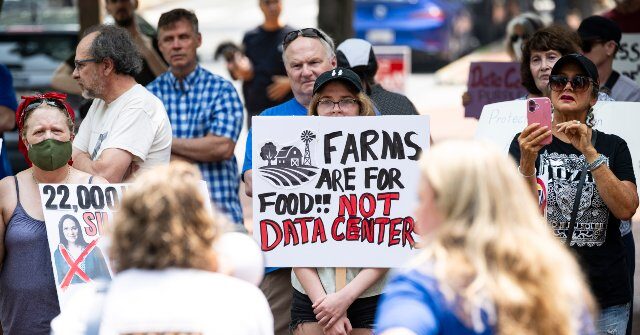
In July, roughly 1,000 Georgia residents gathered at the Effingham County College & Career Academy to hear what OpenAI could offer their community. They also faced protesters angry about the impacts of AI data centers.
The Wall Street Journal reports that a day after announcing plans for a new data center near Savannah, Georgia, OpenAI held an open house for residents’ questions. Attendees passed protest signs reading “I didn’t vote for AI” and “You can’t drink data!!!” Inside were OpenAI-staffed booths with facility information, QR codes to a job board, site renderings and a taco bar. OpenAI pledged the community $80 million, plus up to $71 million in coding credits for local students.
OpenAI Chief Global Affairs officer Chris Lehane called the open house “an important piece” of winning community support. “People really do want to know, like, ‘Are my electricity bills gonna go up or not? Is this gonna impact my water supply? Am I gonna pay more or less in taxes?’” he said.
Open houses, multimillion-dollar pledges and free food were not standard for an industry that typically won approval through speed, confidentiality and political connections. That’s changing as grassroots backlash threatens the buildout’s momentum. Companies add job guarantees and water investments to deals, cite facilities that cut tax burdens, and frame AI’s impact around opportunity, not job losses.
“The politics of data centers have become more prominent and unambiguous across the country,” said Microsoft Vice Chair and President Brad Smith. Microsoft, he said, saw the need for a community-focused approach after the issue surfaced in last November’s elections, including New Jersey’s governor’s race, which Democrat Mikie Sherrill won after campaigning on electricity prices. “As soon as, especially, the New Jersey race was over, it was clear that this was on a different trajectory,” he said. Two months later, Microsoft announced commitments on electricity, water use, jobs and taxes.
Opponents cite rising electricity prices, environmental effects and noise; some object to AI itself over job-loss fears or broader social harm. Clifford Young, chair of Ipsos Public Affairs, said the backlash reflects a “broader-based belief that the system is broken and no longer working for the average person… it’s become, I would say, even a poster child for it.”
Breitbart News reported this week that a elderly Kentucky and her daughter have emerged as unlikely folk heroes for refusing a $26 million bid for their family farm slated for an AI data center project:
“Kick rocks and don’t come back,” Bare told the company’s representative after successfully revoking the agreements. She and her mother, self-described “country hicks,” have since become polarizing figures in the rural fight against AI infrastructure. Bare, 54, is nearly blind from diabetes. Huddleston is an 83-year-old churchgoing widow who walks with a cane. “One of us is blind and the other’s cripple,” said Huddleston.
The family’s land, first purchased in 1848, fed them through the Great Depression. Bare grounds her refusal in faith. “What I believe in is something called Jesus Christ, and he said to occupy, wherever you’re standing, you occupy until he returns,” she said. She also said, “I believe artificial intelligence will be the destruction of the human race.”
Activists say nondisclosure agreements between developers and local governments block public opposition before approval. In March, Microsoft said it would stop using them where it plans to build.
In Gilroy, California, many residents learned of a $2 billion Amazon data center only after construction began. After criticism, Amazon met residents and held its own open house, said AWS economic development vice president Roger Wehner. He said Amazon has contributed more than $1 billion “to support community partners and organizations around the world, helping to address their most critical needs and make a lasting impact” over the past three years. Amazon said the project went through multiyear approval with public notices and comment periods.
On utility costs, Amazon, OpenAI, Meta, Microsoft, Google and others signed the White House’s Ratepayer Protection Pledge this year, agreeing to cover their facilities’ electricity costs instead of passing them to consumers.
University of Michigan assistant professor of information and public policy Ben Green sees a gap between industry messaging and action. “They’re saying on the one hand, ‘Oh, we want to be a good neighbor. We want to support the community.’ On the other hand, they’re fighting back against moratorium bills and other regulations,” he said.
Smith said public relations only goes so far without real substance. “People are smart. Even if you don’t inform them, they find ways to inform themselves,” he said.
The heated debate over AI data centers underscores the vital importance of building strong positions on this emerging technology. Breitbart News Social Media Director Wynton Hall has written his instant bestseller Code Red: The Left, the Right, China, and the Race to Control AI to serve as the definitive guide on how the MAGA movement can create positions on AI that benefit humanity without handing control of our nation to the leftists of Silicon Valley or allowing the Chinese to take over the world.
Read more at the Wall Street Journal here.
Lucas Nolan is a reporter for Breitbart News covering issues of AI, free speech, and online censorship.
Read the full article here


