







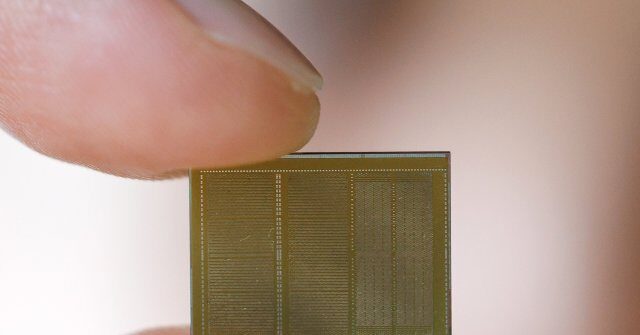
The AI boom has driven up demand for memory chips so sharply that companies in other industries, from tech giants like Apple to medical device manufacturers, are now asking the federal government for help securing chip supplies.
The New York Times reports that memory chips, which store data in everything from smartphones to cars, are being bought up by AI companies for giant data centers. Prices have quadrupled in a year, a problem that impacts everything from iPhones to MRI machines.
Medical device makers, car manufacturers and consumer electronics companies such as Apple are pressing the government for help. Interviews with 18 people, many anonymous because they were not authorized to speak publicly, show proposals ranging from conventional policy fixes to federal rules pushing chip makers to set aside more supply for industries outside AI.
Some are suggesting conditioning 2022 CHIPS and Science Act funds on selling to a broader set of customers; five said others asked the Trump administration to invoke the Defense Production Act, a Korean War-era law, to require allocating chips beyond AI.
“We’re in what I would characterize as a 100-year flood on the memory pricing, with exponential increases in memory prices,” Apple chief executive Tim Cook said last month during an earnings call.
In June, a group of trade associations warned Treasury Secretary Scott Bessent and Commerce Secretary Howard Lutnick of “risks to large parts of the economy” from an “urgent imbalance” in the memory chip market.
Diane Swonk, chief economist at KPMG US, said memory chips are starting to feed U.S. inflation, with shoppers already cutting back on video game consoles and more electronics increases coming. “The AI boom is so strong that it is bidding up costs elsewhere,” Swonk said.
Whether Washington will intervene is unclear: officials want prices down but fear diverting chips from data centers seen as central to staying ahead of China in AI White House spokesman Kush Desai said domestic semiconductor manufacturing is a top priority for President Trump, whose policies have already secured hundreds of billions of dollars in sector investment.
Micron Technology, Samsung and SK Hynix want their own support, with three people saying some are lobbying Congress for another CHIPS Act-style funding round and relaxed environmental rules to speed new U.S. facilities.
Micron has committed more than $250 billion to the U.S. memory sector, the largest such investment, according to executive vice president Manish Bhatia, who said U.S. chip factories take longer to build than anywhere else and permitting needs streamlining while the work force expands. “This is something that’s going to take a concerted effort from the manufacturers as well as the suppliers as well as the government,” Bhatia said.
Samsung and SK Hynix, both South Korean, make most of their chips in South Korea and China, and two people said their representatives and customers have discussed expanding Chinese production. Both administrations have pushed domestic expansion, and all three companies have pledged hundreds of billions for U.S. and overseas facilities that are costly and take years to build.
Chip makers still resist heavy intervention. In July, trade group SEMI argued against dictating chip pricing or allocation, recommending trade deals to boost production, regulatory cuts and an extended domestic manufacturing tax credit. SK Hynix said it was “pushing to maximize production to fully meet surging demand,” raising capital expenditure 50 percent this year. Apple declined to comment; Samsung did not respond.
Apple, which has cited the shortage in recent price increases, is working with other electronics companies to seek permission to buy Chinese memory chips, seven people said, though restrictions apply. A 2022 effort to buy from Yangtze Memory Technologies Corporation, or YMTC, collapsed under lawmaker pressure.
Four people said many officials remain skeptical, since Apple has long promised to shift more of its supply chain to the United States with limited progress, while China faces its own shortage and proved unreliable after restricting mineral exports last year. Two people said Micron, which manufactures in the United States, Japan and Taiwan, has pushed for tighter restrictions on Chinese competitors, arguing more Chinese purchases would undermine U.S. production.
Lawmakers have criticized Apple’s renewed interest. In July, a bipartisan group of senators urged the company to avoid Chinese memory chips altogether, and Representatives John Moolenaar, a Michigan Republican who chairs the House Select Committee on China, and George Whitesides (D-CA), urged Lutnick to add CXMT to the entity list and bar American companies from buying from listed firms. “Dependence on Chinese memory manufacturers creates an unacceptable risk for U.S. national security, economic security and supply chain security,” they wrote.
The AI race continues to lead to unintended consequences like a memory shortage for companies in all sectors. Breitbart News Social Media Director Wynton Hall has written his instant bestseller Code Red: The Left, the Right, China, and the Race to Control AI to serve as the definitive guide on how the MAGA movement can create positions on AI that benefit humanity without handing control of our nation to the leftists of Silicon Valley or allowing the Chinese to take over the world.
Read more at the New York Times here.
Lucas Nolan is a reporter for Breitbart News covering issues of AI, free speech, and online censorship.
Read the full article here


