






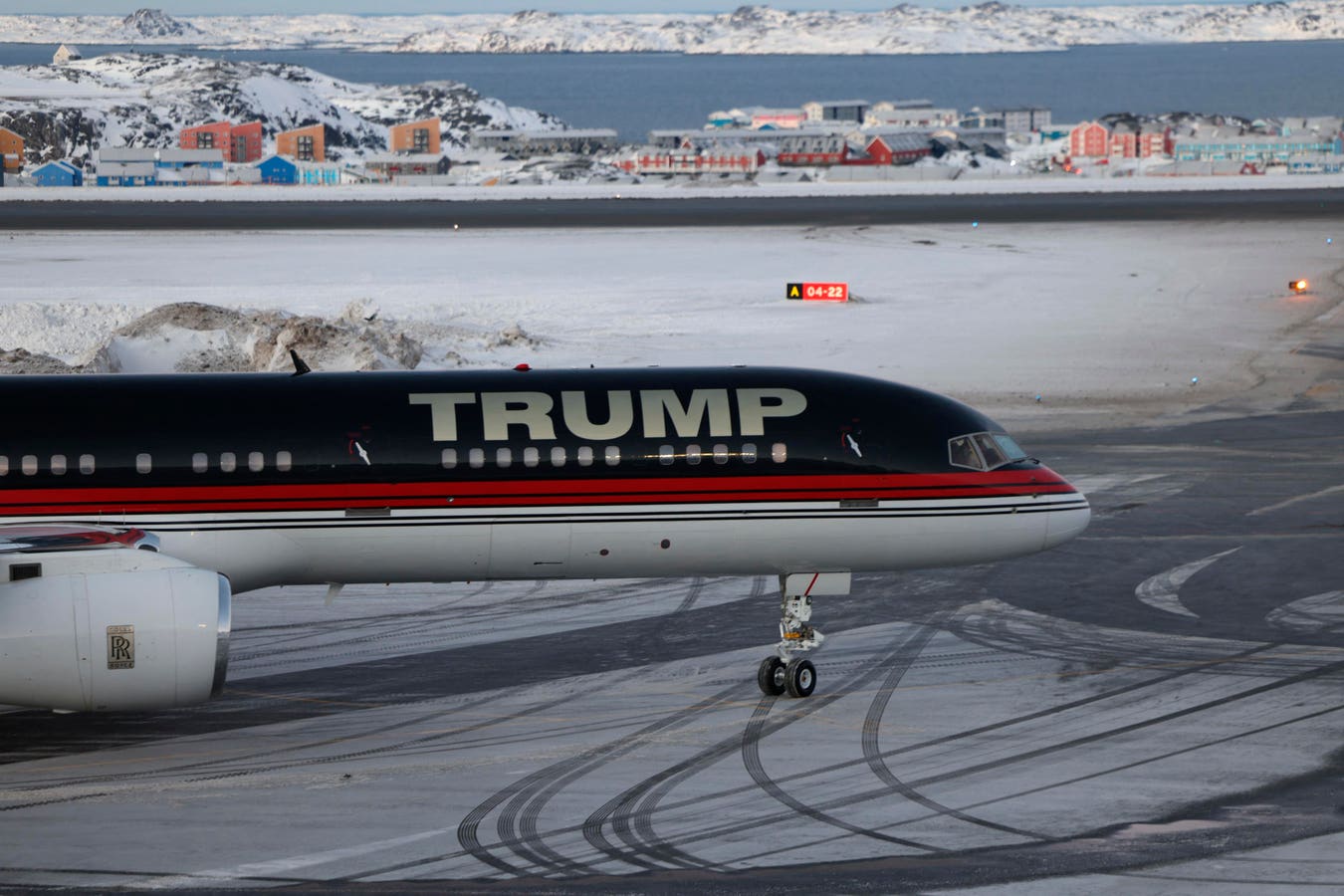
TOPSHOT – An aircraft alledgedly carrying US businessman Donald Trump Jr. arrives in Nuuk, Greenland on January 7, 2025. Donald Trump Jr’s plane landed in Nuuk, Greenland, where he is making a short private visit, weeks after his father, US President-elect Donald Trump, suggested Washington annex the autonomous Danish territory. (Photo by Emil Stach / Ritzau Scanpix / AFP) / Denmark OUT (Photo by EMIL STACH/Ritzau Scanpix/AFP via Getty Images)
Ritzau Scanpix/AFP via Getty Images
The number of implausible events, strategies, directives and actions the country has seen this year is remarkable in scope. But where is there enough human invention to continue the creation of such distraction and danger?
Academics who study creativity say the basis is the combination of disparate concepts in new ways. And that is where the U.S. and its taxpayers now stand with the merging of tariffs and Greenland.
How Trump’s Greenland Push Risks A NATO Clash
Donald Trump has made it clear that he wants Greenland. Longtime journalist James Fallows pointed to part of the recent New York Times interview with Trump. When asked why not just reopen U.S. bases in Greenland, allowed by a 1951 agreement, the president said that he wanted “to do it properly” and that, to him, it meant ownership which might make one wonder about every other country in which the U.S. has a military presence.
Looking through the entire Times transcript, it’s never clear why he considers Greenland so important for success, or what that would mean. But more objectively, it involves geopolitics on a vast scale, including putting the U.S. at odds with all NATO nations, as Denmark, which owns Greenland, is a member. The “most fundamental principle” of the North Atlantic Treaty is Article 5, which states that “an armed attack against one NATO member shall be considered an attack against them all.”
There currently are 32 members of NATO, including Canada, France, Germany, Italy, Norway and the U.K, aside from Denmark and 25 others. Four of the first five were charter members in 1949, and Germany joined in 1955. The NATO bloc has vast importance to the stability of the entire world, including the U.S., its many global interests and international trade.
Any disruption can’t promise disaster for this country and its citizens; however, it would vastly increase the risk, and taxpayers of all forms — including the many millions who pay significant portions of their income in payroll taxes that don’t get counted as income tax — are the ones who ultimately are presented the bill.
The Price Of Trump’s Self-Admitted Psychological Need
When asked by the Times why ownership is important, Trump responded, “Because that’s what I feel is psychologically needed for success. I think that ownership gives you a thing that you can’t do, whether you’re talking about a lease or a treaty. Ownership gives you things and elements that you can’t get from just signing a document, that you can have a base.” On a follow-up question about whether it was psychologically important to him or to the United States, Trump replied, “Psychologically important for me. Now, maybe another president would feel differently, but so far I’ve been right about everything.”
In fact, as Reuters reported, Trump connected his stance toward Greenland to his not having received the Nobel Peace Prize: “In a written message to Norway’s Prime Minister Jonas Gahr Stoere that was seen by Reuters, Trump said: ‘Considering your country decided not to give me the Nobel Peace Prize for having stopped 8 Wars PLUS, I no longer feel an obligation to think purely of Peace, although it will always be predominant, but can now think about what is good and proper for the United States of America.’”
How Trump’s Tactics Drive Up Costs for U.S. Taxpayers
There are three basic ways for Trump to “own” Greenland for his psychological comfort, as he admitted to the Times. The U.S. could buy it, could take it by military force or could persuade Denmark and all of NATO to give in.
If Denmark and Greenland agreed to a friendly sale, which seems beyond unlikely, the U.S. would have to pay an enormous amount. That would come from borrowing and, ultimately, from taxpayers.
Should Trump initiate military action, that is also real money in addition to the ugly potential of injuries and deaths, again coming from taxpayers in the military.
As for persuasion, Trump has already marked a course: more tariffs, as Reuters, among others, reported. He has promised an additional 10% import tariffs starting Feb. 1 on goods from Denmark, Norway, Sweden, France, Germany, the Netherlands, Finland and Great Britain. Such goods already face tariffs, and the 10% would jump to 25% on June 1 until there was a deal for the U.S. to buy Greenland. U.S.-imposed tariffs are taxes on domestic consumption, so costs to U.S. taxpayers, again, and businesses.
Additionally, it’s more uncertainty on the part of U.S. trade policy, which means worry in financial markets around the world. The yield of the 10-year Treasury note, a primary financial metric that governs many things, including mortgage rates, jumped nearly 0.10 percentage points over the weekend, a big move.
The saga would make a great book. Call it The Art of the Peace Deal. Coming soon to a bookseller and tax bill near you.
Read the full article here


