






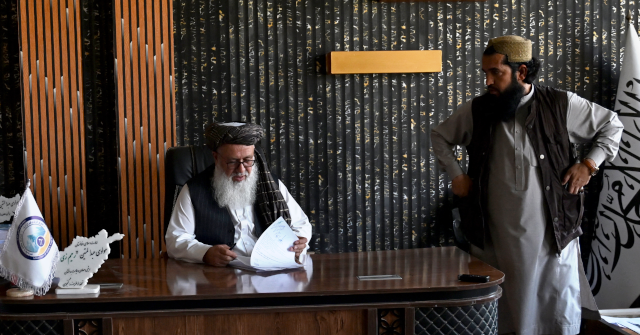
Taliban “foreign minister” Amir Khan Muttaqi boasted in an interview with the BBC this week that the terrorist organization, which will mark five years since seizing power in Afghanistan on Saturday, has expanded its diplomatic outreach to include over 40 embassies and consulates around the world.
Muttaqi laughably described the brutal, repressive jihadist regime he represents as “inclusive” — a word the Taliban threw around liberally in the early days of its conquest in pursuit of global financial support — and denied the copious reports documenting how jihadist terrorist activity continues unabated in Afghanistan under Taliban rule.
On August 15, 2021, following two decades of war against America, the Taliban successfully toppled the U.S.-backed Afghan government, storming Kabul and prompting then-President Ashraf Ghani to abruptly flee via helicopter. The conquest was preceded by then-President Joe Biden violating an agreement with the Taliban, brokered by President Donald Trump, to withdraw from the country in May 2021, expanding the war into August. The days following the takeover were bloody and chaotic, marked by mass killings, thousands of citizens attempting to flee the terrorist group, and the August 26 Abbey Gate bombing which killed 13 American servicemembers.
The Taliban has ruled with an iron fist ever since with no significant resistance or challenge to its authority. United Nations reports this week detailed the near-complete elimination of women from public life, forcing millions into a de facto state of house arrest and depriving the nation’s girls of an education. Terrorist organizations such as the Islamic State Khorasan Province have continued activities in Afghanistan, contrary to Taliban claims, and the country remains mired in poverty and destitution. The terrorists in charge nonetheless plan to celebrate the five-year anniversary of the collapse of Afghan society under their shackles, typically marked by military parades and speeches by senior jihadi leaders.
Speaking with the BBC on Thursday, Muttaqi made the case that, despite the Taliban’s horrific record of systematic human rights abuses and terrorism, the Foreign Ministry had made significant diplomatic strides, receiving some form of acceptance in dozens of countries. The United Nations does not recognize the Taliban as the government of Afghanistan, and very few rogue states, such as Iran and China, have only formally recognized the Taliban as an “interim” government. Despite this, Muttaqi said that the Taliban is now operating over 40 embassies and consulates around the world.
Muttaqi stated that countries have a right not to recognize the Taliban, but should explain themselves.
“It is their own decision that countries do not recognize us, but they should be asked why they do not recognize the Emirate,” he told BBC, according to the Afghan outlet Tolo News.
He also suggested that formal recognition is not enough for Afghanistan to be allowed to fully thrive in the global community, using one of Afghanistan’s closest neighbors as an example.
“Iran is recognised by the whole world, but the country remains under international sanctions. International recognition is tied to the decision of some big powers,” he was quoted as saying.
The Iranian government, besieged by economic woes after pouring billions into supporting global Islamic terrorism, sent a top official to Kabul this week seeking to expand economic ties. Agriculture Minister Gholamreza Nouri Ghezeljah is reportedly in the country through the end of the week to attend a livestock exhibition and discuss how to expand trade volume with the Taliban.
Iran is far from the only country pursuing official dealings with the Taliban, as Muttaqi highlighted. The over 40 outposts around the world is a significant increase from three years ago when “Deputy Prime Minister” Mawlawi Abdul Kabir claimed the Taliban had successfully staffed 16 Afghan embassies around the world. At the time, reports identified the countries receiving Taliban diplomats to include Iran, Turkey, Pakistan, Russia, China, and Kazakhstan. Qatar, which once served as the base for the Taliban’s “political” headquarters during the 20-year Afghan War, is now also the base of operations for Taliban envoy Suhail Shaheen, one of the most prominent spokesmen for the terrorists following the fall of Kabul.
The BBC noted that the Taliban’s diplomatic reach is no longer limited to its own neighborhood, however.
“Some countries and organisations, including the European Union and the UK, still have visiting diplomats in Kabul and continue to meet Taliban officials,” it observed.
The E.U. maintains a keen interest in conversations with the Taliban to deport the minority of Afghan migrants reaching the continent that the E.U. does not allow to remain in Europe. In June, a delegation of five Taliban terrorists traveled to Brussels to meet with European Union migration officials at the organization’s headquarters, causing some outrage given the Taliban’s status as a jihadist terror gang. The Europeans reportedly sought out some communication to send Afghan migrants hope.
“It’s no option not to talk to these people in order to improve the situation,” EU migration commissioner Magnus Brunner said in October, prior to the confirmation that the Taliban would be allowed entry into Belgium. “It is important to talk to them at least to improve the situation for Europeans, but also for asylum applicants, for asylum-seekers.”
Brunner made the comments after 19 EU member states wrote a letter demanding that the entity come up with a quick and efficient plan to address the large number of Afghan migrants stuck in Europe after having their asylum claims denied.
In another bizarre diplomatic incident, the Taliban made its debut in 2024 at a climate change conference including members of the United Nations and hosted by the Norwegian Afghanistan Committee (NAC). Taliban leaders were later invited to COP29, the United Nation’s flagship climate alarmism conference, that year. That invite was not repeated for COP30 in 2025, which prompted Taliban leaders to object.
“The exclusion of the Afghan people from the right to participate in this conference contradicts the principles of climate justice, global cooperation, and human solidarity,” the Taliban “National Environmental Protection Agency” said in an outraged letter.
Follow Frances Martel on Facebook and Twitter.
Read the full article here


