




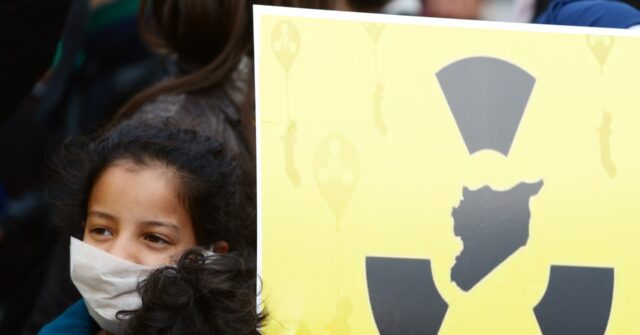
The government of Syria, under former al-Qaeda jihadist President Ahmed al-Sharaa, confirmed before the United Nations on Thursday that it had begun the process of destroying caches of illicit chemical weapons formerly possessed by the deposed regime of dictator Bashar Assad.
Syria’s United Nations representative, Ibrahim Olabi, explained before the Security Council that the country is working with the U.N.’s the Organization for the Prohibition of Chemical Weapons to find and eliminate the banned weapons as a part of a larger campaign to restore Syria’s position as a legitimate and trustworthy country within the community of nations. The elimination of chemical weapons, when completed, will be a milestone achievement for Syria given the prevalence of such weapons in the civil war that consumed the country from 2011 to 2024.
United Nations officials repeatedly denounced that evidence on the battlefield suggested Assad had used several varieties of chemical weapons. The Assad regime and its allies, notably the governments of Iran and Russia, stood by Assad and rejected the accusations of chemical weapons use, instead blaming the rebel groups attempting to overthrow the government.
Assad fled the country, taking refuge in Moscow, in December 2024 after Sharaa’s militia, Hayat Tahrir al-Sham (HTS), successfully surrounded Damascus. HTS, an offshoot of al-Qaeda formerly known as the al-Nusra Front, shocked observers in November 2014, breaking through a prolonged stalemate in the war and seizing control of the beleaguered city of Aleppo before bringing the Assad regime down.
Sharaa has since abandoned his jihadi pseudonym, “Abu Mohammed al-Jolani,” and pursued friendly relations with Western states, including America, in pursuit of foreign investment to rebuild the largest destroyed country. Cooperation with the United Nations on the chemical weapons issue, Syrian officials have attested, is part of the process of reintegrating Syria into the world after the war.
According to the state-run Syrian Arab News Agency (SANA), Olabi, the Syrian U.N. envoy, announced the the Security Council that the process of destroying chemical weapons caches in Syria had begun with U.N. support.
“Ambassador Olabi explained that the ongoing cooperation extends beyond technical aspects to reflect a profound political shift in Syria’s approach to preserving the multilateral system,” SANA shared. “He said the shift sends a message that a state located in a conflict-prone region has chosen to return to the international community through responsibility and fulfillment of its commitments, at a time when the international system is facing weakness and fragmentation.”
The process of destroying the weapons requires a thorough inspection of the country’s military sites to uncover them, he explained.
“Olabi said the objective is to protect the Syrian people from the risk of remnants of chemical weapons falling into the wrong hands, while the work also protects the region and the wider world,” SANA added. “Securing each site and identifying each munition, he noted, reduces the threat posed to global security.”
“What we are doing on the ground safeguards international laws and institutions and protects the world from a security perspective,” the ambassador was quoted as saying.
Olabi also used his time before the Security Council to confirm that the Sharaa government is working on prosecuting and holding trials for former Assad officials believed to be responsible for the use of chemical weapons. He also denounced the government of Israel at the Security Council, claiming that the Israeli “occupation” is threatening stability in Syria. Israel and Syria dispute ownership of the Golan Heights, which Israel has controlled for decades, and the Israeli government has also engaged in limited military action in Syria that it has justified as necessary for the national security of the country.
“We cannot safeguard regional security while our security is being threatened by Israel, nor can we safeguard the international system while Israel disregards international law,” Olabi was quoted as saying.
The governments of Syria and Israel reportedly held peace negotiations, at the behest of the United States, in late August, following an incident in which the Israel Defense Forces (IDF) reportedly conducted airstrikes against military targets in Syria. Israeli officials denounced that the reported presence of Turkish officials at the Abu Duhur military airport in Idlib was a threat to Israel given Turkish strongman Recep Tayyip Erdogan’s vocal support for jihadist terrorist organizations such as Hamas and his public hatred of Jewish people.
The peace talks did occur, according to SANA, and “focused on establishing practical mechanisms to halt Israeli attacks, arrests and targeting operations, and reviving negotiations with the aim of reaching a security agreement that could serve as the basis for a more comprehensive future agreement.”
Syrian officials first announced in May that they had discovered what they described as “remnants” of Assad’s chemical weapons program. The government invited the Organization for the Prohibition of Chemical Weapons (OPCW) to Syria to help address the situation, which described the move as unprecedented, as it revealed a cache of chemical weapons in Syria that had been unused and, thus, could be disposed of without causing harm.
The work to dispose of these weapons began on August 22, according to Syrian Foreign Minister Asaad al-Shaibani.
“Tomorrow, the Syrian Arab Republic begins a new phase in addressing the burden of these weapons, as we have initiated the necessary technical and operational measures to eliminate them in cooperation with international partners,” al-Shaibani said in a social media message on August 21.
Follow Frances Martel on Facebook and Twitter.
Read the full article here


