





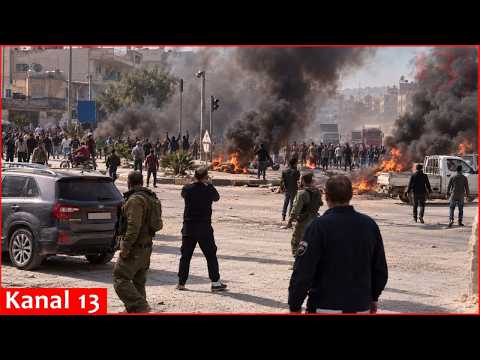
Protests in dozens of cities and towns throughout Syria erupted on Sunday and continued into Monday, marked by large fires and roadblocks triggered by the government announcing a major increase in the price of gasoline and diesel fuels.
The Syrian government, under former al-Qaeda-linked jihadist President Ahmed al-Sharaa, announced on Sunday that it would significantly increase the price of various oil-based fuels due to domestic and international reasons. Internationally, oil prices have soared in the past few months as a result of the conflict between Iran and the United States, in which Iran has actively disrupted commercial shipping in the Strait of Hormuz, one of the world’s most active oil shipping lanes. Domestically, authorities announced that they were rehabilitating one of the country’s biggest refineries after over a decade of civil war, explaining Syria’s oil production would be reduced during the rehabilitation process, leading to higher prices.

The protests are the first major eruption of civil unrest linked to economic circumstances since Sharaa and his militia, Hayat Tahrir al-Sham (HTS), seized power in December 2024 after ousting longtime dictator Bashar Assad. Syria has since seen a variety of protests against Sharaa, but most have been the result of sectarian conflict, primarily protests by Alawites, Christians, and other non-Sunni Arab groups who have faced deadly attacks by HTS remnants. Shortly after the end of the Assad regime in late 2024, for example, Christians took the streets of Damascus asserting their right to live without being slaughtered by Sunni jihadists.

The Kurdish news outlet Rudaw reported on Monday that protests had been documented in as many as 80 municipalities nationwide, including many in Syrian Kurdistan, or Rojava. Locals say the price increases make it impossible for them to commute to work or, if they work in transportation, to actually conduct their business.
“Because of the rise in the price of gasoline, diesel, water, electricity, bread, basically everything has become expensive, we can no longer manage,” Samir Dawod, a minibus driver, told Rudaw. He explained that he now is now expecting to pay $4.10 a week for gasoline but only makes $16 a month with his business, making his livelihood untenable.
Outside of Rojava, the Emirati newspaper The National reported roadblocks in between the cities of Damascus and Aleppo and large-scale protests in cities such as Hama, Khan Sheikhoun, and Maarat Al Numan. The protests focused their ire on Energy Minister Mohammed Al Bashir who made the price announcement, but also demanded the Sharaa government repair the economy to allow for higher wages and better livelihoods, expressing disillusion with its performance since toppling Assad.
“We went to sleep and woke up to this,” a local in Idlib told The National. “It was a shock, because this is not just about fuel, it will affect the cost of living.”
Images of the protests online show large fires across major roads and crowds of people in major cities shouting slogans against the government, or demands that their need for an opportunity to work be met. Road blockades have also featured crowds of people simply standing on major bridges or roads while traffic appears to be slowed as access to fuel is limited by the higher prices.

The state-run Syrian Arab News Agency (SANA) reported on Sunday the various new prices of fuels:
The new prices, which took effect at midnight Sunday, set 95-octane gasoline at SYP 195 per liter (about $1.60), 90-octane gasoline at SYP 185 per liter ($1.52) and diesel at SYP 175 per liter ($1.43), based on an exchange rate of SYP 122 to the dollar. Household LPG was set at SYP 1,600 (about $13.11), while industrial LPG was priced at SYP 2,560 ($20.98).
About $1.60 a liter translates to roughly $6.06 a gallon. About $1.52 a liter would cost about $5.75 a gallon. Diesel, at $1.43 a liter, would cost about $5.41 a gallon. According to Syria’s Energy Ministry, “Syria currently requires around 300,000 barrels per day of crude oil and petroleum products, compared with domestic crude production of roughly 100,000 barrels per day.” Domestic production has diminished in the context of the shutdown of the Baniyas Refinery for a major rehabilitation to ultimately increase its production.
“The [energy] ministry said some domestically produced Syrian crude is heavy and is not fully compatible with the capabilities and specifications of existing refineries, limiting the extent to which local crude can replace imported gasoline and diesel,” according to SANA. “It stressed that the increase was temporary and that prices would remain under review as global market conditions change and domestic refining capacity returns following completion of the Baniyas overhaul.”
SANA reported on Monday that the government would bring al-Bashir, the energy minister, into Parliament to answer questions at a hearing. The state media outlet did not report on the protests, but the scheduling of a hearing on the price hike appears to be a response to public outrage.
“The hearing, approved at the request of the head of the Assembly’s Energy Committee, will seek clarification from the Energy Ministry on the factors behind the increase and the considerations behind the decision,” according to SANA.
Follow Frances Martel on Facebook and Twitter.
Read the full article here


