






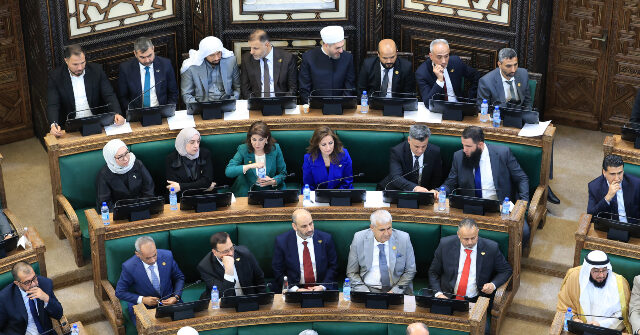
The official national parliament of Syria, a legislative body built to replace the institution drafting laws under dictator Bashar Assad–taking some lawmaking powers away from President Ahmed al-Sharaa–and tasked with writing a new constitution, opened for business on Sunday.
The first order of business for the Parliament on Sunday was to elect its leadership. Attorney Abdul Hamid Al Awak was elected speaker of the Parliament, sworn in by Sharaa. Al Awak had already been given the prestigious role of working to draft a new constitution for the country. Mustafa Moussa of Idlib province, who state media described as a “humanitarian” and relief expert, was elected first deputy speaker of Parliament. Runner-up for the position Madonna Bishara was elected second deputy speaker, identified as a civil engineer. Bishara is the only woman elected to a top position; political scientist Mueyed Habib took the position of secretary of the Parliament during the session.
Sharaa addressed the Parliament to urge them to become a “model of responsibility and competence” for the country. Reports noted that he did not receive ebullient applause nor a standing ovation when taking the floor, in contrast to the effusive welcomes Bashar Assad received from his rubber-stamp body, and the tenor of the event was largely subdued.
“Mutual acceptance is essential to overcoming division, resolving differences and reaching sound judgment,” the state Syrian Arab News Agency (SANA) quoted Sharaa as telling the lawmakers. “Syria is writing a new chapter in its history. We now face a shared responsibility to build our nation and place the national interest above all else.”
SANA added that Sharaa “said the legacy of years of authoritarian rule, war and destruction had left deep challenges affecting the country’s people, infrastructure and economy, requiring collective action, public service and a renewed commitment to state-building.” Since taking over the country, the Syrian leader has prioritized seeking out foreign investment and cutting deals with international actors to help rebuild the heavily bombed country and its weakened infrastructure. Sharaa again reportedly mentioned attracting investment in his speech.
“He said rebuilding the economy, improving public services, creating an attractive investment climate, generating employment and increasing production were national priorities requiring the participation of all state institutions,” SANA paraphrased, “with the People’s Assembly playing a central role through legislation that supports reconstruction, meets the aspirations of Syrians and advances development and prosperity.”
Sharaa, the former leader of the al-Qaeda offshoot Hayat Tahrir al-Sham (HTS), took over the country in December 2024 when his militia won the decade-long Syrian Civil War, sending Assad and his family fleeing to Russia. Over the past year, Sharaa has largely wielded full political power, facing resistance from Syrian minorities in some Druze, Kurdish, and Alawite areas but otherwise consolidating his power and using it to represent the country internationally. Sharaa has promised a government representative of the people, but has stated in interviews that so much of the country has been devastated by war and displaced across the world that widespread elections will take years to hold. According to the United Nations, about 3.5 million Syrian refugees have fled the country throughout the war, most of them to neighboring Turkey.
The parliament that held its first session on Sunday was created in October through an extremely limited, invitation-only election process criticized around the world for not being representative of the people. Sharaa defended the process by stating that it was the most that Syria could currently do given the devastation of the war, promising in some long-term future the return of more common election structures.
The Parliament has 210 seats, representing most of Syria. Groups of “regional electoral committees” totaling about 6,000 people voted to elect two-thirds of the representatives, while Sharaa personally chose the other third. Sharaa’s government approved all the 1,578 names that appeared on ballots for the electoral committees to choose, citing the need to ensure that those on the ballot did not belong to “terrorist organizations, separatist movements, or foreign interference” operations. It is unclear if HTS, whose members now run the government, was recognized as a “terrorist organization” in this process.
When the electoral process occurred, the Syrian government claimed to reserve 14 percent of Parliament seats for women, though this week, reports indicated that the number of women in the lawmaking body was closer to about ten percent. Sharaa reportedly chose 15 of the 21 women in the Parliament.
The process also attracted complaints from ethnic minorities, who noted that voting did not take place in Suwayda, an enclave of the Druze people who faced ethnic targeting following Sharaa’s seizure of power. Several Kurdish groups boycotted the process, though at least one representative appeared on Sunday in traditional Kurdish garb, Fasla Yousef of the Kurdish National Council. Some reports suggest that small numbers of Alawites and Christians are also in the legislative body, representing groups that have faced jihadist violence following the collapse of the Assad regime.
The Parliament is expected to serve for 30 months, allowing the Syrian government to build the infrastructure necessary for broader elections. Of high priority is the drafting and adopting of a national constitution to separate powers and secure the electoral process. The Emirati newspaper The National observed that handing over lawmaking power, and especially constitutional drafting powers, to the Parliament takes those powers off of Sharaa’s plate, at least partially.
“The constitutional declaration gives the parliament limited authority, mainly the power to approve legislation, while foreign policy, the military, cabinet formation and appointments of senior officials remain under the purview of the President,” the newspaper explained. “Laws will now have to pass through parliament rather than be issued directly by Mr. Al Shara.”
The Parliament is expected to complete the constitution and a law governing elections by the end of 2028, as well as a “transitional justice law” to process human rights criminals from the Assad era.
Follow Frances Martel on Facebook and Twitter.
Read the full article here


