






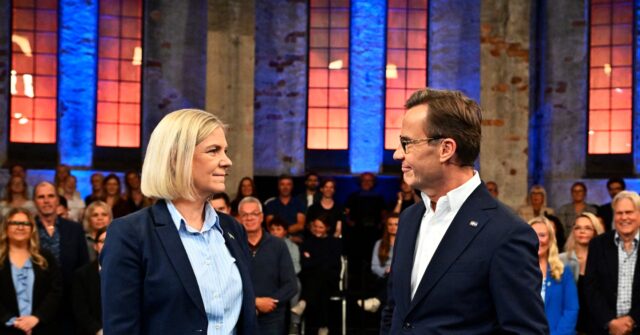
The left-wing voting bloc in Sweden appears to have narrowly won Sunday’s general election after eking out a razor-thin lead over the governing right-wing coalition; however, forming a government may prove difficult for the Social Democrats.
While exit polling from public broadcaster Sveriges Television initially predicted a comfortable victory for the left-wing opposition parties, as the counting of actual votes continued, it became clear that their lead over Prime Minister Ulf Kristersson and his allies was not so significant.
Counting of votes continued into the early hours of the morning on Monday, with a preliminary result of 49.5 per cent for the left-wing bloc comprised of the Social Democrats (S), Green Party (MP), Left Party (V), and Centre Party (C) compared to 49.1 per cent for the governing right-wing bloc of the Moderate Party (M), Sweden Democrats (SD), Christian Democrats (KD), and Liberals (L), according to Aftonbladet.
This would result in a breakdown of 176 seats for the left and 173 for the right, with 175 seats needed for a governing majority in the Riksdag parliament in Stockholm.
Yet with just thousands of votes separating the two factions, the result could still flip, particularly with an estimated 50,000 early votes not expected to be counted until Wednesday.

Even if the margins remain the same, it also may not be so simple for Former Prime Minister Magdalena Andersson and her leftist Social Democrats, who, despite coming out on top, are on pace for their worst-ever election result since 1928 at just over 28 per cent.
For Andersson to form a government, she would need to form a coalition with the far-left Greens and Left parties, as well as the liberal Centre Party. For its part, the Centre Party has previously stated that it will not serve in a government with the Left Party, which, for its part, does not want to be a mere support party, and be forced to remain outside of the government looking in.
Nevertheless, Andersson put on a confident air when addressing supporters, saying that she would “seek a new spirit of cooperation in the Riksdag” and form a new government.
However, given the potential friction in forming a left-wing government and the possibility that the vote could still swing, Prime Minister Kristersson has so far refused to resign or give up hope of forming another government. Outside of his current coalition hitting the 175-seat mark with the outstanding votes, the Moderate Party leader noted that there could be a potential deal to be had to form a “non-socialist majority”.
“If now, after the election, there are conditions for some form of cooperation for growth and security, cooperation that protects the line of work and Swedish companies and that protects the wallets of hard-working families, I will try that question with a very open mind. This election result could therefore lead to a complicated government formation,” Kristersson said.
To accomplish this, it would likely mean courting the same Centre Party upon which the prospective left-wing government would rely. While the Centrists are more socially progressive than the parties in Kristersson’s bloc, the party is fundamentally pro-business, naturally putting it at odds with the Greens and the Left, as well as the high-tax, spend-heavy Social Democrats.
Yet, this closeness to business also means the party has traditionally favoured high levels of immigration to drive down labour costs, putting it at odds with the Kristersson government’s restrictive approach to immigration.
Similar to the demands made of the Social Democrats by the Left Party, any deal between the conservatives and the Centre Party would likely require Kristersson to abandon his plans to include the anti-mass-migration Sweden Democrats (SD) in his government.
While the SD are expected to have the second-most seats among any right-wing party, their results on Sunday were disappointing, down about three points from the 2022 election to just over 17 per cent. It remains to be seen whether party leader Jimmie Åkesson will accept a deal to remain out of government to prevent the left-wing bloc from regaining power, yet he said on Sunday morning that his party puts “substantive policy first”.
Yet even though the Sweden Democrats were not a part of the Kristersson government, they still played an influential role from the outside, influencing the government to take a stricter line on immigration, which likely contributed to the stunning success in combating the gang crime wave that took over the country following the mass influx of foreigners under previous Social Democrat governments.
Follow Kurt Zindulka on X: Follow @KurtZindulka or e-mail to: kzindulka@breitbart.com
Read the full article here


