




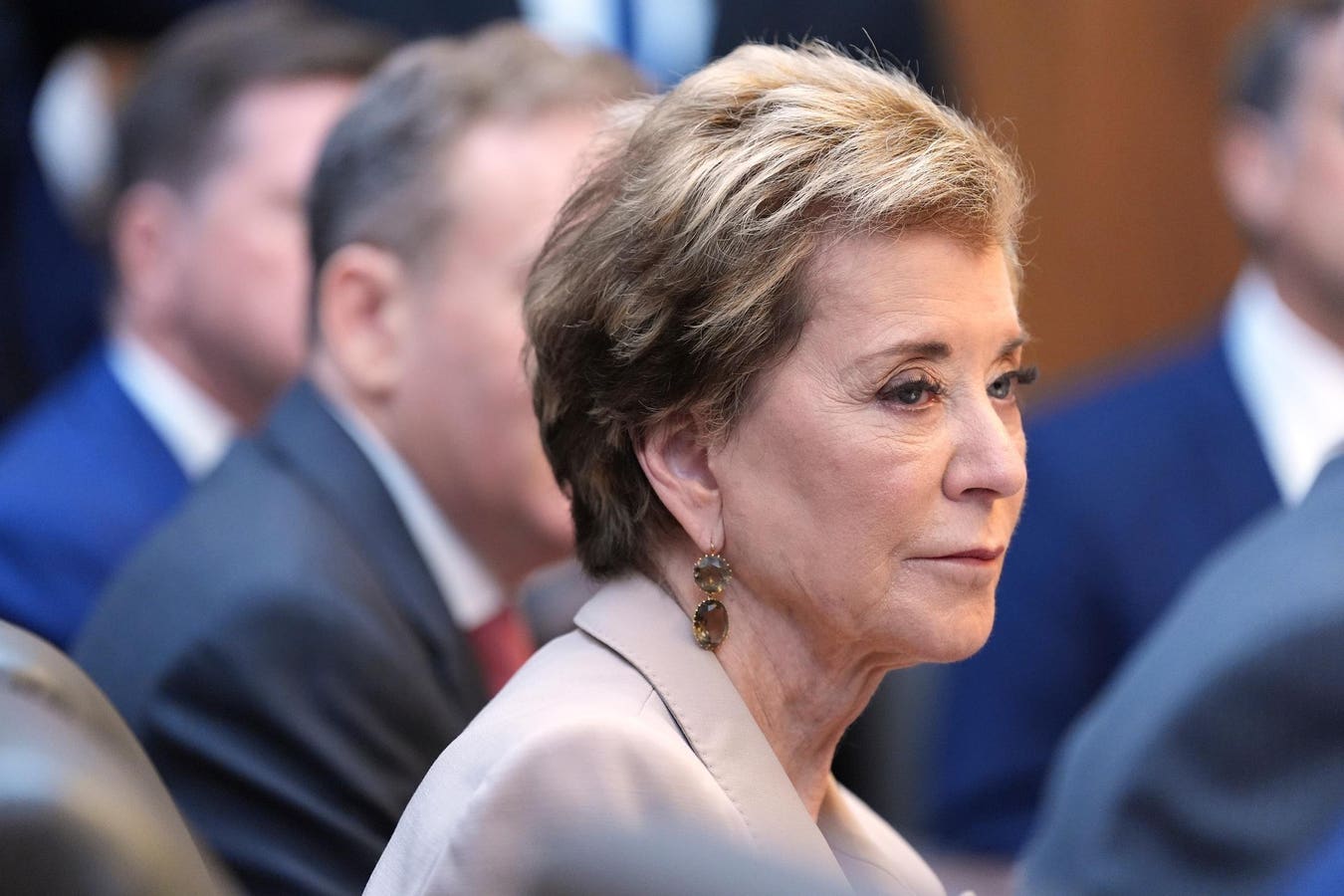
Education Secretary Linda McMahon attends a cabinet meeting, Friday, July 31, 2026, at Camp David, the presidential retreat, near Thurmont, Md., Friday, July 31, 2026. McMahon and the Education Department are facing a legal challenge over the department’s efforts to force student loans out of the embattled SAVE plan. (AP Photo/Jacquelyn Martin)
Copyright 2026 The Associated Press. All rights reserved.
A serious legal challenge brought by student loan borrowers over efforts by the Education Department and Secretary of Education Linda McMahon to dismantle the SAVE plan reached a critical stage this week. The challengers hope to block the department from continuing to force SAVE plan borrowers to move their student loans onto other, more expensive, repayment plans. With briefing now completed on the challengers’ motion for a preliminary injunction to halt the department’s efforts, the court could issue a ruling in the relatively near future.
The SAVE plan, a popular income-driven repayment program launched under President Biden in 2023, has been blocked for more than two years after Republican-led states filed legal challenges arguing the program was an unlawful executive branch overreach. Those states then reached a settlement agreement with the Trump administration last December, which a federal judge ultimately entered into court in March. Under the terms of that settlement agreement, the regulations governing the SAVE plan have been vacated, effectively terminating the program.
Following the entry of the settlement agreement, the Education Department has been systematically pressuring borrowers to move their student loans out of SAVE and into other repayment programs. But the process has been bumpy, and the challengers in the latest lawsuit claim it is unlawful. Here’s where things stand, and what student loan borrowers should know.
Education Department Pressures Borrowers To Move Student Loans Out Of the SAVE Plan
The Education Department has been telling borrowers for months that they need to move their student loans out of the SAVE plan and into other repayment programs. The department sent out a series of preliminary notices starting in March, warning borrowers that their time remaining in the SAVE plan was coming to an end. Then, starting in July, the department’s contracted student loan servicers began sending out official letters giving borrowers 90 days to enroll their federal student loans in a different “lawful” income-driven repayment plan. If they don’t comply, the letters warned, they would be placed instead in a Standard repayment plan, which would likely be unaffordable for most borrowers.
“You Have 90 Days to Select a New Repayment Plan,” reads the standard letter. “A recent legal settlement ended the Saving on a Valuable Education (SAVE) Plan, and it is no longer available to borrowers. As a result of the settlement,” student loan servicers were “directed by the U.S. Department of Education (ED) to move all borrowers out of the SAVE Plan. You must now select a new repayment plan.”
The Education Department has also been alerting SAVE plan borrowers to change plans through its official website and on key social media platforms.
“We strongly encourage you to act now so that you’re in the plan that best meets your repayment goals,” wrote the department in updated guidance on its website last month.
“Enrolled in the Saving on a Valuable Education (SAVE) Plan? You don’t have to wait for your loan servicer to contact you,” said the department’s Office of Federal Student Aid in a statement on X last week. “We strongly encourage you to act now so you’re in the repayment plan that best meets your financial goals.”
Challengers Argue Forcing SAVE Plan Student Loans Into Other Plans Is Unlawful
In a legal challenge filed in March, a group of federal student loan borrowers argued that the Education Department’s process of kicking student loans off the SAVE plan is entirely unlawful. The borrowers have filed a motion for a preliminary injunction to try to block the department from continuing its efforts, contending that the current implementation of the settlement agreement amounts to a “shadow repeal” of SAVE’s predecessor plan, the Revised Pay As You Earn plan, or REPAYE. The REPAYE plan would, for many borrowers, be more affordable than the other currently-available income-driven repayment plan options. The challengers argue that they should be permitted to enroll in REPAYE, because that plan was never actually properly repealed.
“Because the 2023 SAVE amendments modified the preexisting REPAYE rule, the vacatur of those amendments restored REPAYE by operation of law,” argued the borrowers in their motion for a preliminary injunction filed in June. “The defendants’ actions leave little doubt that they have shadow repealed the REPAYE plan.”
The borrowers maintain that in order to actually have effectuated the repeal of REPAYE, the Education Department would have had to go through a lengthy and cumbersome negotiated rulemaking process, which it did not do. But the department disagreed, arguing that the settlement agreement properly, and lawfully, terminated both the SAVE plan and REPAYE, which the Eighth Circuit Court of Appeals had blocked and ruled unlawful as part of the SAVE plan litigation.
“This case is about whether a federal agency is required to reinstate a student loan repayment plan that the Eighth Circuit enjoined in August 2024 and declared unlawful in February 2025,” wrote the department in its opposition. “The agency had created REPAYE and SAVE under color of the same statute, and the panel held both plans suffered from a common legal infirmity.”
The department also argued that student loan borrowers who have brought the challenge cannot demonstrate that they would be irreparably harmed, a requirement for parties pursuing a preliminary injunction. The unavailability of the REPAYE plan is trivial, the department argues, and borrowers can enroll their student loans in other available income-driven repayment plans that would still be affordable.
After submitting additional declarations from student loan borrowers outlining the higher costs of alternative income-driven repayment plans for student loans, the challengers tried to refute that argument in their latest court filing.
“In response to this motion, Defendants seek to minimize and brush away the lived experience of millions of borrowers caught in a system that is failing to deliver what the law requires,” wrote the student loan borrowers in their reply brief filed last week. “Even what may appear to be small dollar figures on their face represent real financial tradeoffs for Plaintiffs.”
Student Loans Caught In Cascading Processing Problems
The court has not issued a ruling yet on the challenger’s arguments. And so far, the Education Department has given no indication that it intends on deviating from its efforts to push student loans out of the SAVE plan and into other income-driven repayment programs, with REPAYE not an available option. But with briefing now completed, the court is expected to hear oral arguments in the coming weeks, after which the judge overseeing the challenge could issue the first major ruling in the case.
Borrowers should be aware that even if there is a favorable decision in the litigation, Congress passed legislation last year that repeals both SAVE and REPAYE by July 2028. That means that even if one or both of the plans are restored by the court, both plans will disappear again in less than two years, barring any further action by Congress to modify that timeline. Borrowers would then have to select from the same repayment options available now, which generally are more expensive than both SAVE and REPAYE in most cases.
In the meantime, student loan borrowers who have been heeding the department’s advice to change repayment plans are increasingly being caught up in cascading processing problems. Some loan servicers have been erroneously reporting borrowers as being delinquent on their federal student loans, despite having no payments due. Other borrowers have been instructed to reapply a second time for a new income-driven repayment plan after the department miscalculated their payments. And last week, some borrowers pursuing student loan forgiveness saw their earned credit toward forgiveness disappear overnight due to a department data glitch.
Read the full article here


