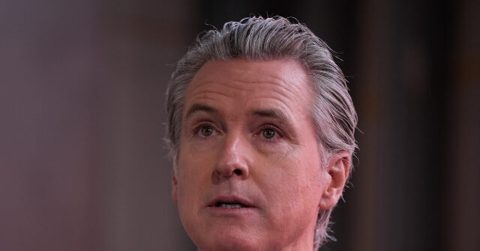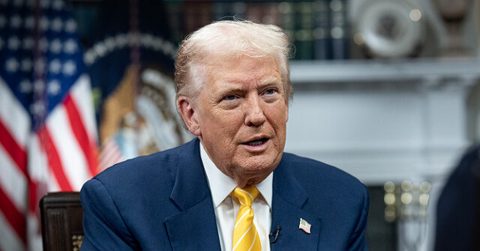


Steve Hilton, the leading Republican candidate for California governor, told voters on Tuesday that he wants to grow the state’s economy through innovation and productivity, not by increasing the state’s illegal migrant population.
Hilton’s economic strategy is very different from that of Democrats, who want to grow California’s economy by extracting low-wage workers, welfare-funded consumers, and apartment-sharing renters from poor countries, and then shielding them from federal law enforcement within Democratic-enforced “sanctuary state” amnesty-enclave laws.
The Democrats’ strategy was described by Katie Porter, one of the Democratic candidates in the TV debate on Tuesday night:
The sanctuary state policy is designed to make sure that our state resources, the taxpayer dollars, the public servants that we have, are focusing on doing their jobs, which is not cooperating with the federal immigration authorities. These [illegal migrants] are Californians. They contribute to our economy, they pay taxes, and they’re one of the only ways that our state has been growing in recent years.
Steve Hilton, the leading GOP candidate in the race, responded:
She said something very revealing, which is the only way really that California’s economy has been growing in the last few years is through illegal immigration, and I just don’t think that’s the right way for us to be growing.
I think we need to help small businesses create jobs and opportunity and for Californians to be able to earn more and live the California Dream, and for entrepreneurs to want to start businesses in California. That’s how we should be growing our economy, not by illegal immigration.
“You’re an immigrant, and you added to the population, and we’re all having to live with the consequences of that decision,” Porter answered, adding, “I was saying that immigration has been a major source of growth in California’s economy, and that is true.”
Porter’s policy was implemented nationally by President Joe Biden’s deputies as they imported more than 15 million illegal, legalized, and temporary migrants. That economic strategy boosted the stock market — but flatlined wages, spiked inflation, raised housing prices, and pushed many Americans out of high-opportunity states, cities, and careers.
California’s embrace of extraction migration since the 1970s has transformed the state’s image from a middle-class paradise into a chaotically diverse and sharply unequal land of wealthy elites, unionized workers, and discarded Americans.
“The [income] gap between top and bottom incomes in California has increased substantially (by 57%) since 1980, when families at the top earned seven times more than those at the bottom,” an April 2026 report by the Public Policy Institute of California said. “In 2024, California families at the 90th percentile of the income distribution earned 11 times more than families at the 10th percentile. Eight other states had wider income gaps.”
In contrast, Trump, his team, and some leading investors argue that lower immigration levels will help expand productivity, automation, innovation, and general prosperity.
“We’re going to need robots … to make our economy run because we do not have enough people,” Trump told Breitbart News in August 2025. “We don’t have enough people to do it. So we have to get efficient … Then, somebody is going to have to make the robots. The whole thing, it feeds on itself … we’re going to streamline things. We need efficiency.”
The promise of cheap labor is ”a drug that too many American firms got addicted to … [and] globalization’s hunger for cheap labor is a problem precisely because it’s been bad for innovation,” Vice President JD Vance told an audience of Silicon Valley investors in May 2025. “Nearly every country, from Canada to the U.K., that imported large amounts of cheap labor, you’ve seen productivity stagnate. That’s not a total happenstance. I think that the connection is very direct.”
“I can argue, in the developed countries, the big winners are the countries that have shrinking populations,” BlackRock founder Larry Fink said at a 2024 pro-globalist event hosted by the World Economic Forum in Saudi Arabia. He continued:
That’s something that most people never talked about. We always used to think [a] shrinking population is a cause for negative [economic] growth. But in my conversations with the leadership of these large, developed countries [such as China, and Japan] that have xenophobic anti-immigration policies, they don’t allow anybody to come in — [so they have] shrinking demographics — these countries will rapidly develop robotics and AI and technology …
If a promise of all that transforms productivity, which most of us think it will — we’ll be able to elevate the standard living in countries, the standard of living for individuals, even with shrinking populations. (Emphasis added)
“President Trump has said we want to have high-value migration into this country, not low-value migration,” Stephen Miller told Fox News in April, adding:
We have to deal with the fact that we have millions and millions of people here who are on welfare, who are not contributing, who commit a lot of crime, who consume a lot of public resources, and it’s in the best interest of this country for those people to be humanely returned home. … And so this old Washington conversation about amnesty is missing the whole point.
“The real conversation is, ‘How do we have an immigration policy that makes America stronger and more unified, not weaker and more divided?’” Miller said.
Read the full article here