




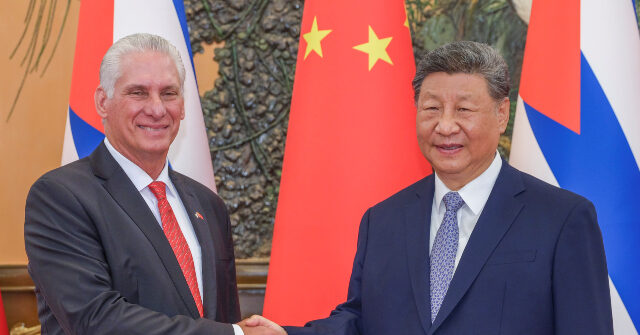
The State Department on Monday detailed China’s intelligence-gathering operations against the United States taking place in Cuban facilities under the auspices of the communist Castro regime.
The intelligence-gathering operations, which pose a serious risk to U.S national security, are reportedly taking place in three facilities in Cuba used by China to collect signals intelligence (SIGINT) to spy on the United States.
On Monday, the State Department published a 100-page report titled, “Cuba: The Capital of 21st Century Communism.” The document contains an extensive account of the subversive acts committed by the Castro regime against the United States throughout the decades following Fidel Castro’s violent takeover of Cuba in 1959.
The report also details the alliances the Cuban regime maintains with international terrorist organizations, ideologically aligned anti-U.S. regimes, and adversarial states to the U.S. such as China, Iran, and Russia — as well as the risks that such alliances pose to U.S. national security. Equally worrisome, the State Department’s new report details the efforts of the Cuban Communist Party to infiltrate and weaken U.S. politics and the Castro regime’s “priority” to infiltrate university campuses across America.
The State Department explained that following the collapse of its previous top benefactor, the Soviet Union, Cuba saw its military size and budget reduced significantly. While this limited the Cuban regime’s international reach, it did not reduce its anti-U.S intelligence operations — instead, it made America the regime’s central focus and almost its only target, aided by China and Russia. The State Department noted that both the Chinese and the Russian regimes have reportedly tripled the number of intelligence agents in Cuba over the past three years.
With regards to China, the State Department explained that the Chinese regime — which refers to its Cuban communist peers as a “good brother, good comrade, good friend” — reportedly brokered a secret multibillion-dollar agreement with the Castro regime in 2023 for the construction of a new Chinese SIGINT facility in Cuba. The facility, the State Department emphasized, grants the Chinese regime’s intelligence services the ability “to scoop up electronic communications throughout the southeastern U.S., where many military bases are located, and monitor U.S. ship traffic.”
According to the State Department, 18 such facilities exist in Cuba — of which three are actively run by Cuba. A report published by the Center for Strategic and International Studies (CSIS) in June indicated that at least one of the mentioned Chinese-run facilities is presumed to be operational.
The State Department referred to an earlier report published by CSIS in 2024 that identified four active or under-construction SIGINT facilities in Cuba located at Wajay, Calabazar, El Salao, and Bejucal. The State Department pointed out that the Bejucal base is the Soviet-era nuclear warhead storage facility known for its role in the 1962 Cuban Missile Crisis.
The report further explained that in 2025 CSIS published an addendum report warning that, based on an analysis of satellite imagery, a new Circular Disposed Antenna Array (CDAA) capable of monitoring signals from 3,000 to 8,000 miles away had been installed at the Bejucal base.
The State Department’s report reads:
The Chinese intelligence presence in Cuba poses an acute risk to U.S. military operational security. Military installations, Combatant Commands, space launch centers, and other sensitive sites located in the southeastern United States are especially vulnerable to technical surveillance in Cuba – not to mention U.S. air, space, and maritime activity in the region.
The State Department also explained that, while China benefits from its intelligence-gathering presence in Cuba, the Castro regime in turn benefits from its alliance with the Chinese regime through foreign assistance, canceled debts, and billions of dollars’ worth of investment.
China’s alliance with the Cuban Castro regime has implications not just for Cuba, but for the entirety of Latin America. The State Department noted that the Chinese regime conducted more than 200 high-level assessments across the region between 2002 and 2019. Additionally, China’s trade with Latin America went from $12 billion to nearly $315 billion in that same time period. China, much like Russia, provides the region’s repressive regimes with surveillance technology to stifle dissent and marginalize pro-U.S. opposition parties.
“China has also expanded its military footprint in the region; the Office of the Director of National Intelligence’s 2024 Annual Threat Assessment noted that Cuba was among the locations that the People’s Liberation Army was considering for the construction of new military facilities,” the State Department said in the report.
“Recent Chinese wargames have involved combat scenarios in Latin America and the Caribbean, reflecting Beijing’s view that the region could be a viable theater in a future conflict with the United States,” the text continued.
Christian K. Caruzo is a Venezuelan writer and documents life under socialism. You can follow him on Twitter here.
Read the full article here


