




The State Department reportedly wrote a letter to Congress on Wednesday that said Turkey has not met the legal “conditions” for rejoining the F-35 Joint Strike Fighter (JSF) program.
President Donald Trump expelled Turkey from the program in July 2019 but has lately signaled that he wants Ankara back on board.
Turkey, as a member of the North Atlantic Treaty Organization (NATO), joined the F-35 program in 2002, a year after it was launched. Turkey invested some $1.4 billion into the program and hoped to buy at least a hundred of the cutting-edge jet fighters when they became available.
Turkey was expelled from the program during the first Trump administration for insisting on the purchase of Russian-made S-400 surface-to-air missiles – one of the weapons that F-35 pilots would be most concerned about facing. The security risk of Russian engineers gaining access to F-35s was deemed intolerable.
Turkey refused multiple warnings to give up on its Russian missile purchases, in part because Erdogan wanted to build closer ties with Russia after their falling-out over the Syrian civil war, so Turkey was finally excommunicated.
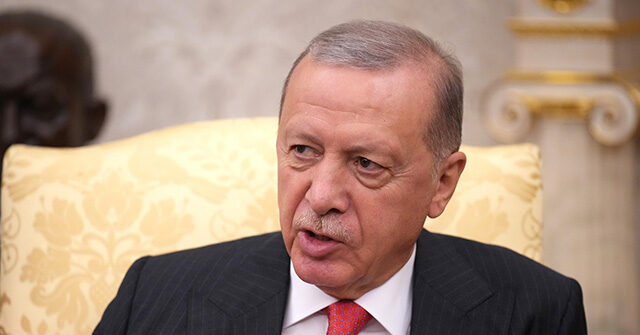
President Trump received a warm welcome when visiting Turkey for a NATO summit in June and, while in Erdogan’s company, he said he wanted to sell F-35s to Turkey. Erdogan mentioned the substantial amount of money Turkey had already invested, and praised Trump for opening the door to a long-desired acquisition of the warplanes.
“Together with my friend Trump we are opening the door to a new chapter in Turkish-American relations,” he proclaimed.
The proposal faced immediate bipartisan opposition in Congress, as lawmakers cited the enduring security concerns around the S-400 missile, Erdogan’s authoritarianism, Turkey’s ever-more-problematic friendship with Russia during the Ukraine war, and Turkey’s hostility to U.S. allies Greece and Israel.
Even Trump’s ally Sen. Lindsey Graham (R-SC), who passed away suddenly this month, was deeply ambivalent about putting F-35s on the tarmac for Turkey. Graham essentially said he would like to see Turkey, a “great ally and the only Muslim nation in NATO,” find a way back into the program, but it was not there yet.
On Wednesday, the State Department’s Bureau of Legislative Affairs responded to an inquiry from Rep. Wesley Bell (D-MO), a staunch critic of Turkey’s F-35 ambitions, by stating that Turkey has not met the statutory requirements to receive F-35 shipments. That response was obtained and reported by the right-leaning Greek newspaper Kathimerini.
The State Department letter reportedly gave Turkey credit for taking steps in the right direction, including its support for U.S. counter-terrorism efforts and regional diplomacy, and even gave Ankara a little wiggle room for its troublesome dealings with the Hamas terrorist organization, but said the S-400 missile issue remains unresolved.
The statutory concerns mentioned by the State Department are found in the 2020 National Defense Authorization Act (NDAA) and the 2017 Countering America’s Adversaries Through Sanctions Act (CAATSA).
CAATSA was invoked to sanction Turkey for its S-400 acquisition in December 2020. It might be possible for the Trump administration to give Turkey a waiver for those sanctions, but the relevant section of the 2020 NDAA is much more difficult to get around, since it included a binding legal requirement for Turkey to prove it has divested itself of all S-400 missiles.
Turkey has been thinking about getting rid of its S-400s, which at this point are clearly more trouble than they are worth. Turkey never got around to integrating the Russian surface-to-air missiles into its defense network – it took delivery on a few s-400 batteries, but never did anything with them.
In early July, Turkey reached out to Russia and the United Arab Emirates (UAE) to discuss a plan for transferring Turkey’s S-400 systems to the UAE, for a payment of about $2.5 billion. This could potentially cause a whole new set of problems, because the UAE has been operating America’s vaunted Terminal High Altitude Area Defense (THAAD) system for over a decade, and it has American-made Patriot missiles as well, plus air defenses purchased from Israel after the UAE joined the Abraham Accords in 2020.
There are also questions about whether Turkey would sell all of its problematic Russian missiles to the Emiratis, and the laws cited by the State Department clearly state that all of them must go.
The State Department pledged to “continue to engage Ankara on resolving the S-400 issue, while also strengthening our NATO cooperation.”
Russia has reportedly indicated its approval for transferring the S-400s to the UAE, but it seems unlikely that even the six F-35s sitting in storage with Turkey’s name on them will be delivered until that S-400 deal goes through.
Read the full article here


