




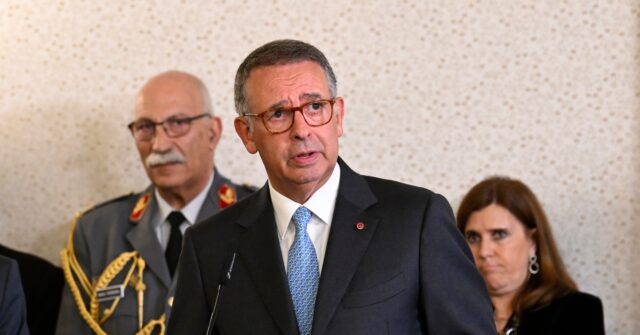
Socialist President of Portugal António José Seguro urged the European Union this week to become more self-reliant, warning that the bloc cannot continue to depend on the United States to defend its own territory.
President Seguro issued his calls for a greater “strategic autonomy” of Europe’s defense on Thursday during an official two-day visit to Italy to mark the 50th anniversary of the founding of the European University Institute in Florence.
Speaking in the Maggio Musicale Fiorentino theatre, the Portuguese President criticized the “inertia” of the 27-member state bloc in preparing for rapid response to international challenges, saying that the EU “barely moves when there is consensus” and that the response “always comes late.”
“Europe has realized that Russia is a real threat and cannot continue to depend on the United States to ensure its security and defense,” Seguro told his audience, according to the Portuguese public broadcaster Rádio e Televisão de Portugal (RTP).
Several EU top-ranking officials were present during Seguro’s speech, including European Parliament President Roberta Metsola and the President of the European Council António Costa, alongside other European leaders, academics, researchers, and students.
While the Portuguese President called for the EU to stop relying on the United States or any other nation for its defense, he clarified that his suggestion for more military autonomy does not imply a break of Europe’s alliance with the U.S. nor the end of NATO. Seguro affirmed that his proposal involves the European Union “buying European” defense supplies and achieve economies “of scale in the defense sector.”
“The strategic autonomy I advocate is not anti-Atlanticist; it is about responsibility. We must maintain NATO, but within a relationship of allies who cooperate on an equal footing — without drama, but with great clarity,” he said.

In contrast to neighbouring Spain, Portugal was notable among European nations for providing assistance to the United States in the war against the Islamist regime in Iran, providing logistical support by allowing the U.S. military to use its base on Terceira Island in the Azores. U.S Secretary of State Marco Rubio praised Portugal’s assistance during his March 31 phone call with Foreign Minister Paulo Rangel.
Per RTP, the Socialist president also expressed his concerns over the rise of “nationalisms in Europe” and, after stressing that historical mistakes “must not be repeated,” argued that patriotism and nationalism are not the same.
“Loving the country one comes from is a legitimate and noble sentiment. Turning that love into a weapon against others is the path to the abyss and to collective destruction,” he said.
Following the event in Florence, the Portuguese President travelled to Rome to meet with his Italian counterpart Sergio Mattarella, who also agreed on the need for Europe to gain greater strategic defensive capabilities. Speaking to reporters after the meeting, Seguro reiterated his calls for a more muscular EU, saying that “Europe must stand on its own” and take a step forward for greater collaboration among EU members.
Seguro once again asserted that although Europe should not depend on the United States or third countries to defend its territory, this does not mean the EU should break its alliances — instead, he claimed, alliances must be reinforced into what he described as a “spirit of cooperation among allies, not in a spirit of subjugation.”
“Ultimately, we need a European pillar of defense that is capable of operating on a larger scale. Each army does not need to have its own tank, submarine, or helicopter, and even when it comes to operations in, say, theaters of war — which I hope will never come to pass — we stand to gain from having resources that complement one another,” the Portuguese President told reporters after his meeting with Mattarella.
Read the full article here


