


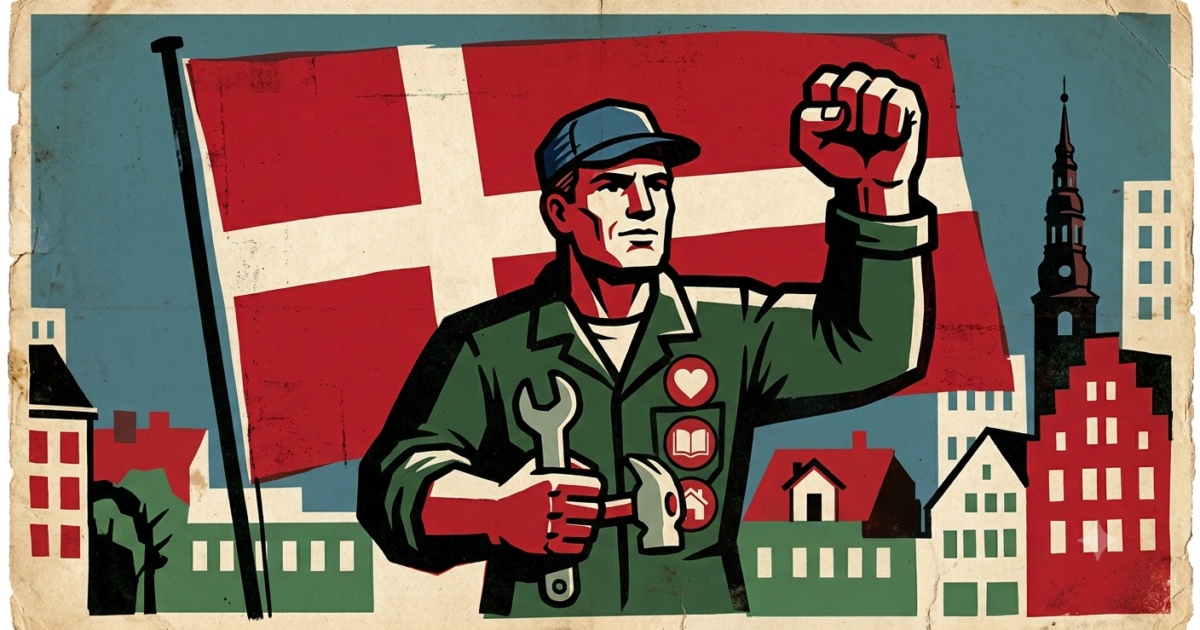
Denmark is regularly held up in U.S. political debate as proof that socialism works, with the country’s high taxes, universal healthcare, and generous benefits cited as a model the United States could adopt if it were only willing to embrace socialism the way Denmark has. The comparison usually comes with a pointed question: if socialism produces this standard of living in Denmark, why can’t the United States do the same?
The record of countries that have actually implemented socialism answers that question on its own. China, Cuba, Laos, North Korea, and Venezuela have all organized their economies around state or Communist Party control of production. All five rank among the world’s most repressed economies and least free societies. Denmark’s nominal GDP per capita is high at $77,046, but it still trails the United States’ $89,991. The other five countries badly trail both: China sits at $13,968, Venezuela at $3,736, Laos at $2,288, and North Korea at just $640.
Cuba’s official GDP per capita is reported at more than $7,000 per year. That figure is calculated using the government’s official exchange rates, which bear little resemblance to the rate used in everyday transactions. At market exchange rates, the average state worker earns only about $15 to $25 per month.
On political rights and civil liberties, Freedom House’s 2026 report rates China at 9 out of 100 and North Korea at 3, both among the world’s least free states. Cuba, Laos, and Venezuela are all rated “Not Free” as well. Socialism, in its actual historical applications, has consistently produced restricted freedom and a low standard of living for the citizens living under it.
Denmark is frequently described as a socialist success story, but the label does not match how the Danish economy actually functions. Socialism, in its standard economic definition, means state or collective ownership of the means of production, with government directing investment, pricing, and output. Denmark does not operate this way. It is a capitalist market economy with private ownership of firms, competitive markets, and free trade. It carries a large tax-funded welfare and transfer system layered on top. That is the same market foundation the United States has, just carrying a much heavier tax load.
According to the OECD’s Revenue Statistics 2025, Denmark’s tax-to-GDP ratio reached 45.2% in 2024, the highest in the OECD for the second consecutive year, up from 44.0% in 2023. By comparison, the OECD average was 34.1% in 2024, and the United States collected roughly 25.6% of GDP in tax revenue, near the bottom of the OECD. That revenue funds redistribution and social insurance, not state-run enterprise.
Denmark’s private sector remains dominant, and government involvement is concentrated in financing benefits rather than owning production. The result is a market economy with a Gini coefficient of 28.6, among the lowest measures of income inequality globally, and a poverty rate of about 4% as of 2021.
Supporters of socialism believe that Denmark’s positive outcomes result from the redistribution of wealth through taxation. However, the country’s success is more strongly rooted in its cultural and demographic characteristics.
On crime, Denmark’s homicide rate has run near 1.2 per 100,000 people. That is far below the global average of 7.4 and well under the roughly 5.76 per 100,000 recorded in the United States in 2023 among G7 nations.
Denmark ranks among the highest-trust societies in the world. Seventy-four percent of Danes say most people can be trusted, according to global trust rankings compiled from the Integrated Values Surveys, putting Denmark first worldwide alongside Norway and Finland. That trust extends to institutions. Perceived government corruption in Denmark sits under 20%, the lowest level recorded among OECD countries, per OECD social indicators.
A strong but balanced work ethic is another feature of Danish culture that makes the economic system work. Denmark’s employment rate stood at 77.0% in Q3 2025, compared with 71.7% in the United States the same quarter. Labor force participation shows the same gap. 82.4% of Denmark’s working-age population, ages 15 to 64, was in the labor force in Q3 2025, versus 75.1% in the United States.
On unemployment, however, the United States performs better. Denmark’s rate climbed to 7.4% in January 2026, its highest level since 2004. It eased to 7.0% by March 2026, according to Eurostat data. The US, by comparison, held at 4.3% in April 2026, per OECD data.
One likely explanation is that Denmark’s payroll taxes and mandatory employer contributions raise the cost of hiring, making firms more cautious about adding workers. At the same time, Denmark’s generous unemployment benefits reduce the urgency for unemployed workers to return to work. Together, these factors may help explain why Denmark’s unemployment rate is higher than that of the United States, where taxes are lower and the social safety net is less extensive.
The homogeneity of the Danish population was one reason its socialist policies were able to function as intended. However, as Denmark admitted larger numbers of immigrants from North Africa, Africa, the Middle East, and other lower-trust societies, crime increased and welfare dependency rose.
Denmark’s demographic composition has shifted substantially since 1980. African and Asian migrants rose from about 1% of the population in 1980 to roughly 6% by the mid-2000s, according to Minority Rights Group. By January 2005, non-Western immigrants and their descendants made up 5.9% of the population.
By January 2024, that figure had grown to 10% non-Western plus 6% Western, for a combined 16% of the population, according to Denmark’s own migration report to the OECD. The report describes the non-Western share as having “increased continuously since 1980.”
Over the same broad period, violent crime has moved in the same direction. Reported violent crimes rose over the 2012–2022 decade even as total reported crime fell, driven by a sharp decline in property crime. Immigrants and their descendants are markedly overrepresented in the resulting conviction and incarceration figures.
In 2022, of 17,240 penal code convictions among 15 to 79-year-olds, 29.7% involved immigrants or descendants, who made up only 15.2% of that population. That is a conviction rate roughly 2.4 times the native rate, with the widest gaps in homicide, robbery, and rape.
Non-Western immigrants specifically, 8.4% of the population, accounted for 14% of aggravated violence convictions and 24.3% of rape convictions. Their Denmark-born children, just 2.2% of the population, accounted for a further 15.6% of violent crime convictions and 8.1% of rape convictions, according to Ministry of Justice figures.
The pattern carries through to Denmark’s prisons. People of Danish origin made up only 50.4% of the population in closed prisons nationally, and just 33.9% in Copenhagen prisons, despite Danish-origin residents accounting for 84% of the national population and 72% of Copenhagen’s.
The welfare dependency gap is large and persistent. The employment rate for non-Western immigrants ran about 22% below that of ethnic Danes as of 2020, according to the Bertelsmann Stiftung’s Sustainable Governance Indicators report on Denmark. Earlier research found welfare dependency among non-Western immigrants “remains high after many years in Denmark,” with an employment rate around 47% versus 76% for natives.
A 2021 Danish Ministry of Finance analysis found that immigrants from the Middle East, North Africa, Pakistan, and Turkey cost the Danish welfare system a net 14,200 euros per person annually. By comparison, the average Dane contributed a net 1,100 euros, and a Western immigrant contributed a net 4,700 euros.
Denmark’s own policy response has been to cut benefits specifically for immigrants rather than for the population broadly. In 2002, Denmark reduced welfare payments for non-EU immigrants by roughly 50%. In 2015, it did so again, replacing standard unemployment support for migrants with a lower “integration benefit.” Both moves were a deliberate attempt to reduce the immigration incentive the Danish welfare system otherwise creates.
Returning to the comparison with the United States, one reason the United States does not seek to adopt the Danish model is that it functioned in a small, homogeneous society. Since the 1990s, as immigration has increased, the benefits of that model have steadily declined, crime has risen, and taxes have remained high. Taken together, there appears to be little about the Danish system to suggest that socialism works or that the United States should replace its current economic system with the Danish model.
Ad block users: Some site features may not work correctly while an ad blocker is enabled, because they break scripts and content this website depends on. If you can’t see comments below, for example, please disable your ad blocker.
Read the full article here