




President Donald Trump confirmed on Saturday evening the “supreme leader” of Iran, Ayatollah Ali Khamenei, was dead after an American and Israeli bombing campaign targeted Tehran this weekend.
The Pentagon launched “Operation Epic Fury” on Saturday, intended to degrade the Iranian Islamist regime’s ability to engage in terrorism and target American assets specifically. According to the Pentagon’s Central Command (CENTCOM), which operates in the Middle East, the objective of the operation was to “dismantle the Iranian regime’s security apparatus, prioritizing locations that posed an imminent threat.”
“Targets included Islamic Revolutionary Guard Corps command and control facilities, Iranian air defense capabilities, missile and drone launch sites, and military airfields,” CENTCOM said in a statement.

The attack followed weeks of negotiations with Iranian regime officials in which Washington sought to convince Tehran to stop its illicit nuclear development while the Iranians urged the United States to limit sanctions. While parties to the talks vaguely described them as a constructive, none offered any details on what Iran was willing to concede to make an agreement, causing them to stagnate.
In addition to the strikes, President Trump announced Khamenei’s death on his website, Truth Social.
“The heavy and pinpoint bombing, however, will continue, uninterrupted throughout the week or, as long as necessary to achieve our objective of PEACE THROUGHOUT THE MIDDLE EAST AND, INDEED, THE WORLD!” he warned.
Khamenei ruled Iran since 1989, taking over for the first leader of “revolutionary” jihadist Iran, Ruhollah Khomenei. His demise leaves Iran at a crossroads with a host of questions needing an answer for the country to chart a path into the future. Below, five questions that, as of Saturday night, remain largely unanswered, and how their resolution will impact the success of Trump’s latest foreign policy project.
1) Who, exactly, is currently running Iran?
Khamenei’s title, “supreme leader,” is exactly what it sounds like: while Iran has ruling cleric councils and a nominal “president,” Masoud Pezeshkian, all major regime decisions were believed to be made directly by Khamenei. Who is making those decisions now? Iranian state media only admitted that Khamenei in the early morning hours of Sunday local time, similarly insisting that Pezeshkian was also still able to fulfill his limited duties. But Pezeshkian himself has made no public statements at press time and his whereabouts and grasp on power is completely unclear. Much of the leadership of the terrorist Islamic Revolutionary Guard Corps (IRGC), was also eliminated in the joint U.S./Israeli strikes. Figuring out who emerges from the ashes in control of the country will be pivotal to understand whether the regime will continue to perpetuate itself or collapse.
2) How much firepower and institutional leadership is left in the IRGC?
The IRGC is the most powerful and bloodthirsty of the Iranian armed forces wings. Tehran has relied on it, and its Quds Force particularly, to organize the chaotic gaggle of foreign proxy terrorist organizations under the Iranian umbrella and to stage international terrorist attacks, most notoriously the 1992 bombing of the Argentine-Israeli Mutual Association (AMIA) in Buenos Aires, which killed 85 people. Without the IRGC, the Iranian military will likely not be able to sustain itself.
An infographic titled “Iranian leader Khamenei and senior officials killed in US-Israeli attacks” created in Ankara, Turkiye on March 1, 2026. ( Bedirhan Demirel/Anadolu via Getty Images)
The Israel Defense Forces (IDF) announced the elimination of several high-ranking IRGC officials on Saturday, including commander Mohammad Pakpour. Pakpour replaced former Commander Hossein Salami, eliminated in a similar fashion last year. The IRGC is, at press time, still publishing belligerent press releases declaring that it will exact brutal revenge on America and Israel, but it is unclear exactly who is behind that messaging (see question one) and who is left alive to organize a competent counterattack. Early returns on IRGC strikes – targeting the United Arab Emirates (UAE), Qatar, Saudi Arabia, Bahrain, Jordan, Kuwait, and Iraq, but causing only one known casualty at press time – are not looking good for Tehran.
3) Will average Iranians deliver the death blow to the regime inside the country?
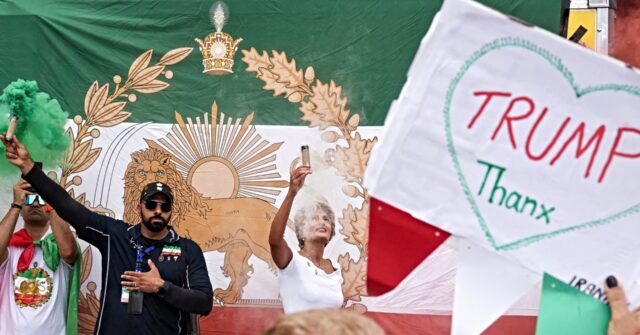
What the Iranians who have taken to the streets by the thousands – and been killed by the thousands – in Iran will do following death of Khamenei will also make or break this attempt to end the brutal terrorist Islamic regime. President Trump laid out a plan for the next steps in Iran on Truth Social, writing on Saturday, “This is the single greatest chance for the Iranian people to take back their Country. … Hopefully, the IRGC and Police will peacefully merge with the Iranian Patriots, and work together as a unit to bring back the Country to the Greatness it deserves.”
“That process should soon be starting in that, not only the death of Khamenei but the Country has been, in only one day, very much destroyed and, even, obliterated,” he added.
Celebrations, some reports indicate, have erupted in the streets of Tehran, but no “morality police” or Basij thugs have reportedly attacked them – a sign that the Iranian people may, indeed, get a genuine chance at rebuilding the country. That situation could become volatile rapidly, however, and it is too soon to know just how robust a popular uprising will follow Khamenei’s death.
4) Who will take over if the regime collapses entirely?
As with every tyrannical regime that lasts over two decades, there are no obvious opposition leaders that can easily become the next president of Iran on the ground in the country, as anyone expressing any dissent with the regime is rapidly killed or forced into exile. Some names in Western media, such as Reza Pahlavi, the son of the leader before the Iranian Revolution, and Maryam Rajavi, the exiled leader of the National Council of Resistance of Iran (NCRI), regularly circulate as options, but the regime’s oppression makes it essentially impossible to effectively gauge whether they, or anyone else, is popular as a potential alternative to Khamenei within Iran itself.
President Trump told CBS News on Saturday that he knows “exactly who” will succeed the regime, but refused to name them.
5) What will BRICS do?
Iran is a member of BRICS, the anti-American coalition led by China that also includes Russia, South Africa, and India, among others. China was among the first countries to vocally condemn Operation Epic Fury, but has done nothing concrete since President Trump began his second term in office to help Iran stabilize and the regime remain in power (China did help Iran mend fences with Saudi Arabia during the Biden era, at a time when U.S.-Saudi relations were at a historic low). Iran helps Russia by offering its Shahed drones to be used in Ukraine, and sells heaps of oil to China, so the two countries have an interest in helping – but it may not be worth angering Trump to do so.
6) How does the rest of the Muslim world respond to these events?
Whether the most influential Islamic countries in the world – such as Indonesia, the most populous, and Saudi Arabia, custodian of the holiest sites in the faith – react to the campaign against Iran as if it were an attack on the entire ummah, or global Muslim population, could have a major impact on the regime’s chances of survival. As mentioned above, China brokered a tentative peace between Iran and Saudi Arabia in 2023 that may have been useful to Iran – had Iran not bombed Saudi Arabia on Saturday as part of its retaliation for the campaign. Countries such as the United Arab Emirates (UAE), Jordan, and Iraq also reported drone and missile attacks out of Iran in their territory, resulting in little political goodwill toward Iran from its neighbors. Many of these governments have little love for Israel, however, and a population that may pressure them out of full support for toppling the regime. How they proceed in the coming week will be a key factor in the outcome.
Follow Frances Martel on Facebook and Twitter.
Read the full article here


