
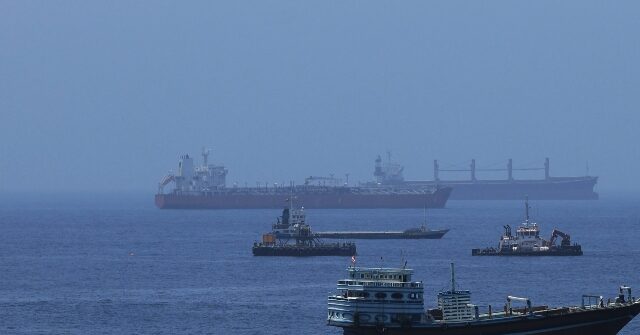
Maritime intelligence firm Kpler said on Tuesday that a total of 172 ships have passed through the Strait of Hormuz since the U.S. and Iran signed their Memorandum of Understanding (MOU) last week, and over 200 tankers appear poised to attempt the passage.
However, the Iranian military said on Tuesday that it would only allow a limited number of ships to cross the strait each day.
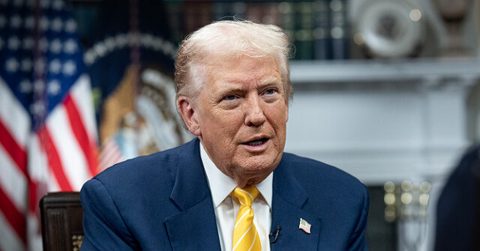
President Donald Trump gushed on Truth Social that “19 million barrels of oil flowed out of the Hormuz Strait” on Monday, setting what he called an “all time record.”
“Oil prices are tumbling down, and the World is a much safer place!!!” Trump exclaimed.
U.S. crude oil prices fell below $75 a barrel on Monday for the first time since early March, while the international Brent crude benchmark fell four percent to $77 a barrel, the lowest price since the beginning of Operation Epic Fury at the end of February. Both crude oil benchmarks remained over $10 per barrel higher than they were before the Iran conflict, however.
Kpler tracked 39 ships crossing the Strait of Hormuz on Monday, down slightly from a high of 42 crossings on Saturday. Maritime security experts said at least 30 of those ships were carrying Iranian crude oil, and five of the tankers were under sanctions from the United States before all sanctions were lifted as part of the MOU.
Ship tracking data showed 200 ships positioned at the entrance to the Strait of Hormuz, while another 250 tankers and 440 cargo ships remained trapped in the Persian Gulf. Most of them have not moved since the MOU was signed.
Iran’s terrorist Islamic Revolutionary Guard Corps (IRGC) nominally closed the strait again on Saturday, accusing Israel of violating the terms of the MOU by continuing to fight Hezbollah in Lebanon, but ship traffic continued with only a modest reduction.
On Tuesday, an IRGC source told Iran’s state-run Fars news agency that only a limited number of ships would be allowed through the Strait of Hormuz per day, a condition that would seem to directly contradict Iran’s commitments in the MOU.
The source did not specify how many ships would be permitted, saying only that the number would “vary daily depending on changing conditions.”
The Financial Times (FT) reported on Tuesday that ship owners “are in deep confusion over the safest route out of the Gulf amid conflicting instructions from Iran, the US and western insurers.”
Among other conflicting instructions, Iran has been ordering ships to hug the Iranian coast as they pass through the strait, while the U.S. government and insurance companies are advising captains to stay close to the coast of Oman. The Iranians are probably insisting on their side of the strait to make it easier for them to collect “fees” from shipping after their 60-day promise to refrain from doing so expires.
“The Iranians are insisting on ships using the Iran route and paying tolls. The U.S. is telling ships to go the Omani route and escorting them with close air support. It’s not very joined up and it’s all going to end in tears,” lamented a cargo insurance broker.
Iran is also insisting that all ships passing through the strait must register with the Persian Gulf Strait Authority (PGSA), the phony “maritime agency” Iran created in May. This is most likely also a prelude to collecting ransoms from international shipping in the future.
The multinational Joint Maritime Information Center (JMIC) is advising ships to avoid the middle of the Strait of Hormuz due to the threat from mines laid by Iran. JMIC recommends using the Oman coastal route because it has been “confirmed clear of mines.”
Read the full article here