

Aleksander Vucic has officially announced his departure months after saying he will leave
Serbian President Aleksandar Vucic resigned from office on Sunday ahead of snap parliamentary elections. The outgoing president is set to run for re-election as the candidate for the ruling Serbian Progressive Party (SNS), seeking the prime minister office instead.
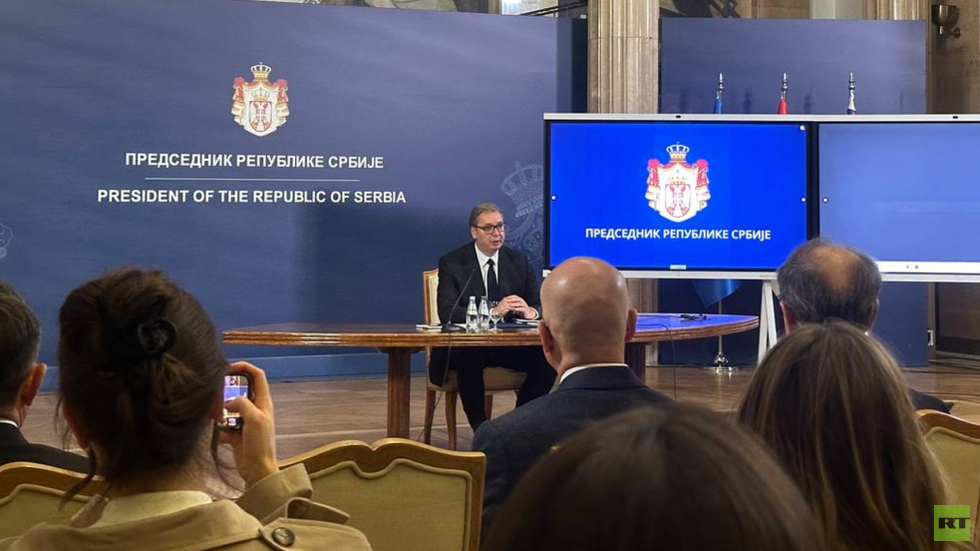
Vucic announced the move from the presidential palace, stating that his address would be the last in his current capacity. He is stepping down during his second presidential term and, under the Serbian constitution, cannot seek another one. A new election must be held within three months of the president’s resignation.
Vucic first announced his intent to leave his post at a rally in June.
The impending snap presidential vote means Serbs will have to go to the polls twice this year. The snap parliamentary election is set to be held on October 25, with Vucic expected to run as the head of his SNS party, potentially taking the prime minister post should it emerge victorious.


A large crowd of Vucic supporters gathered outside the presidential palace to bid him farewell. Some carried banners reading “Thank you,” as well as hailing Vucic as a “political genius.” The outgoing president joined his supporters in person after wrapping up his address and signing his resignation letter on camera, footage from the scene shows.
“This evening marks my last chance, the final time I am here in this beautiful building as president. I have held the office of president longer than anyone else in Serbia’s history since the establishment of multi-party democracy. I am proud to have achieved this thanks to your votes and support,” Vucic said in his address.
Vucic’s second term, originally set to run until May 2027, has been overshadowed over the past two years by recurring anti-government protests and sporadic clashes between demonstrators and police. The unrest was sparked by the 2024 railway station disaster in Novi Sad, where the collapse of a concrete canopy killed 16 people.
The tragedy gave rise to a broader anti-government movement that has accused the authorities of negligence and misuse of public funds, allegedly leaving Yugoslav-era infrastructure to deteriorate. Vucic has consistently denied the allegations, arguing instead that the unrest was incited by Brussels as part of a pressure campaign aimed at pushing Belgrade to align its foreign policy more closely with the EU.
You can share this story on social media:


Read the full article here