







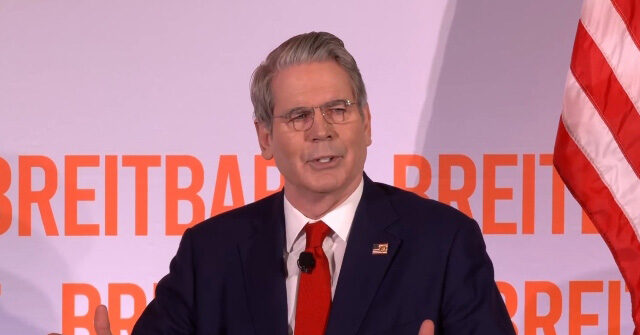
Treasury Secretary Scott Bessent called on artificial intelligence (AI) and data center companies to improve their messaging in comments at the G20 Finance Ministers meeting in Asheville, North Carolina, saying they, “Have done a horrendous job of explaining themselves to the American people.”
At the three-day meeting with world finance leaders, Bessent praised the promise of what AI and large language models (LLMs) can do, pointing to how small business startups are increasing on main street but offered warnings that the companies must do better to ensure the U.S. is the global AI superpower.
U.S. Treasury Secretary Scott Bessent at the 2026 G20 Finance Ministers meeting in Asheville, North Carolina. (U.S. Department of Treasury)
Bessent said other countries at the meeting were interested in what the United States was doing from the regulatory side. He said U.S. officials discussed how they have structured industry working groups and are working with them to increase resiliency.
He called on the AI and data center companies to reset their messaging.
“These models are powerful and moving very quickly, and we all have a responsibility to make sure we get to the productivity phase,” Bessent said.
Bessent made a point of noting how he did not invite AI companies, representatives, or professors to the G20 Finance meeting, instead bringing industries using the technology to talk about how they were integrating and using the products.
Inviting private sector leaders was a first for the G20. Bessent cited companies such as John Deere, which noted it is reshoring manufacturing back into the U.S. with a new plant in North Carolina.
WATCH — Substrate CEO: Trump Administration Is “Not Taking the Knee” — Fighting to Beat Chinese AI:

One of Bessent’s concerns was ensuring that benefits of AI adoption “will not accrue to a small group,” and did refer to misinformation campaigns from countries such as China affecting American sentiment.
“Some is Chinese agitprop that is being regurgitated … but I don’t blame the Chinese, because we’re ahead and we’re going to stay ahead. We’ve gone from 50 percent of global compute and by 2028 we’re going to be at 80 percent. We will be an AI superpower and all of those benefits will accrue to the American people.”
Bessent’s push to improve messaging and for companies to address concerns the American people have is part of a wider Trump administration effort.

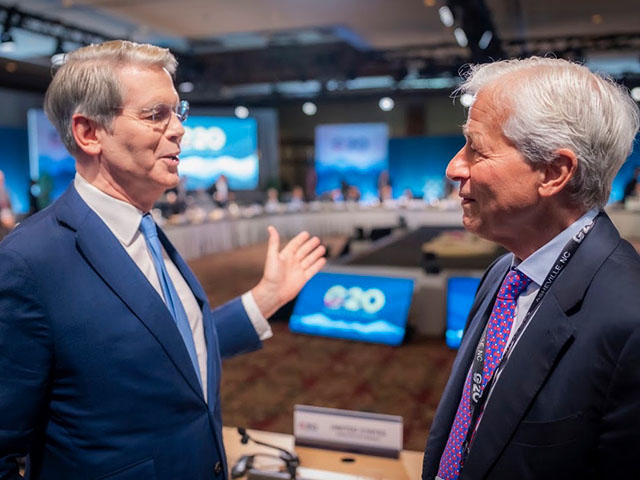
U.S. Treasury Secretary Scott Bessent (left) and JP Morgan Chase CEO Jamie Dimon speak at the 2026 G20 Finance Ministers meeting in Asheville, North Carolina. (U.S. Department of Treasury)
At a Breitbart News policy event at the end of August, Undersecretary of War for Research and Engineering Emil Michael said whoever wins the AI Race, the United States or China, will dominate economically and militarily.
Former Trump administration official Taylor Budowich, who founded Innovation Council Action, said at the event that electricity and water concerns were driving the conversation. “We should not be draining communities. We should be powering the communities,” said Budowich. “These investments, this work that’s being done, should go up to build and provide more opportunity, lower costs for people. And I think bad policy is informing a lot of the bad politics. I think good policy is the way to go, and there’s answers to these questions.”
WATCH — Innovation Council Action’s Taylor Budowich on AI Arm’s Race with China: Losing Is NOT an Option!:
While speaking to reporters at an event in August, President Trump continued to make the case for data centers, noting they must provide benefits to the communities in which they serve.
“The data center subject to me is a pretty simple one. If you pick the right location — not every location’s perfect for it, what it means for a community is jobs and lots of money and lower taxes. And the data centers now are mandated by me that they build their own electricity, so they’re not taking it from the grid,” the president said. “They’re going to build their own electric producing facility. And, that electricity that they have left over is going to the grid, it’s going to lower the cost of electricity.”
CNN recently called data centers “the unlikely midterm villain,” noting that $31 million in political ads criticizing the projects has already been spent across the country.
Read the full article here


