


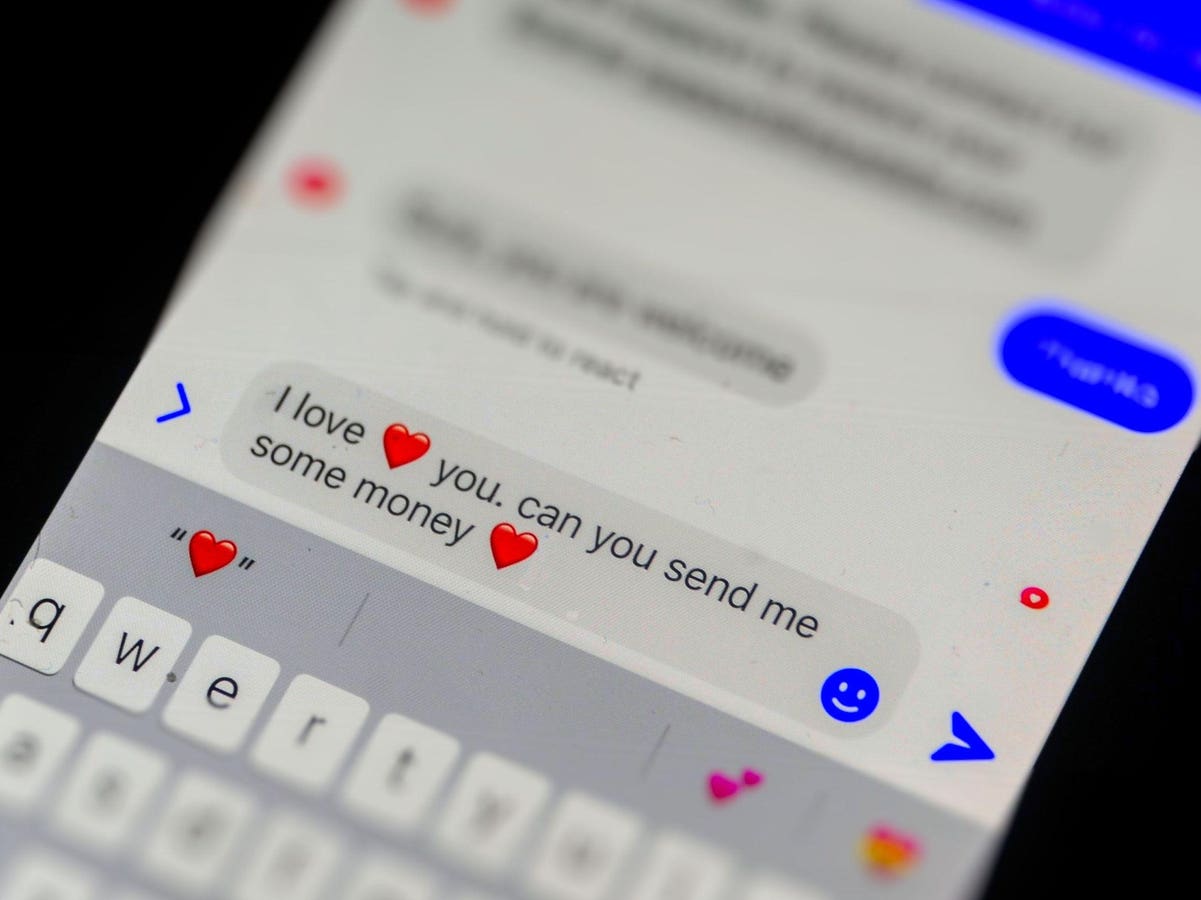
Romance scams remain very popular.
getty
Every year, the Federal Trade Commission (FTC), the agency tasked with protecting the public from deceptive or unfair business practices, receives millions of fraud reports from consumers. To help consumers identify potential scams, the agency then shares information about the top scams with the public. Their latest findings? Imposter scams ranked as the #1 scam for the ninth year in a row.
Imposter Scams
An imposter scam is a fraud in which fraudsters pretend to be a trusted entity, such as the IRS, a business, or a loved one, to steal money or personal information. The scamsters use high-pressure tactics, creating a sense of urgency to force potential victims to make payments, often via gift cards, wire transfers, or cryptocurrency. In 2025, the FTC received more than one million reports about imposter scams, with reported losses increasing by nearly 20% to $3.5 billion.
Reports of government imposter scams were up by 40%, thanks in part to messages about overdue tolls. You might have seen variations on these. The fake messages, which are often sent by text, look like real toll collection programs—such as EZ-Pass or SunPass—to appear more credible. They typically threaten late fees or suspension of your vehicle registration if you don’t pay right away.
The level of urgency is key. Scammers want you to react before you verify. If you get a text message demanding money for unpaid tolls, reach out to the state’s toll agency using an official phone number or website. Don’t use the information from the text.
The same is true for text messages that are allegedly from the IRS or the Social Security Administration. Scammers may send texts or emails claiming that you are due a refund or that there is a problem with your account. The goal is to get you to click on links or to otherwise engage, so that fraudsters can steal your money—and possibly, your identity.
Here’s an example of an imposter email from the Social Security Administration.
Kelly Phillips Erb
Fraud Is Getting Worse
If it feels like we’re talking about fraud more, you’re right. That’s because fraud is, by the numbers, getting worse. In 2025, consumers submitted three million fraud reports to the Consumer Sentinel Network, the FTC’s primary fraud-reporting hub. The CSN also aggregates reports from nearly 180 external data sources, including government agencies, consumer groups, and companies such as Microsoft, MoneyGram, Western Union, Apple, and Zelle. Their findings? Billions of dollars in reported losses.
In 2025, losses totaled $15.9 billion. That was up from 2024, when consumers submitted 2.6 million fraud reports and reported more than $12 billion in losses. Reported losses have risen every year for six years and are now nearly 430% higher than in 2020. And those are just the cases people reported. Since many victims never report scams because they feel embarrassed or powerless, the FTC estimates that the numbers are much higher. The agency suspects that the real cost of fraud in 2024 may have been as high as $195.9 billion.
How fraudsters work is also changing—the old “Nigerian prince fax scam” has evolved. In 2025, text messages were the most common way that consumers were contacted, but not the costliest. That distinction goes to social media platforms, with consumers reporting more than $2 billion in losses.
Text messages generate enormous volume, and can result in small hits (like those fake tolls). But on social media, a scammer can meet a victim on a platform, move the conversation to a messaging app, build trust, and then steer the victim toward a scam. The result? Bigger losses over time.
In 2025, consumers reported the highest total losses when sending money via bank transfers, followed by those when sending money via cryptocurrency. Credit cards were the most frequently reported payment method overall, but bank transfers and cryptocurrency can result in much larger losses because these payments may be fast, difficult to reverse, and useful to scammers moving money quickly across accounts, platforms, or borders.
Investment Scams
Imposter scams may top the charts by sheer volume of reports, but investment scams are where consumers lose the most money. Investment scams caused more than $7.9 billion in reported losses in 2025, with an average individual loss exceeding $10,000. That accounts for approximately half of all reported fraud losses for the year.
In an investment scam, scammers promise high, guaranteed returns with little to no risk, while hoping to steal money or personal information. These frauds often involve Ponzi schemes, pump-and-dump stock manipulation, or, increasingly, fake crypto opportunities. The common thread? High-pressure tactics to force quick decisions.
And, consumers may be willing to spend more if they think they’ll benefit. The FTC reports suggest that the total of reported losses is largely driven by individual consumers reporting losses of $100,000 or more.
Romance Scams
Romance scams were also on the rise, according to FTC reports. Reported romance-scam losses increased by 22%, with the average reported loss reaching $2,020 per person.
Romance scammers play the long game. They often friend you on social media or an app, and build a relationship. Artificial intelligence can make that easier by helping scammers refine backstories, mirror interests, generate convincing messages, and tailor narratives to the person they are targeting.
The fraudster’s objective is usually not immediate payment. It is trust. By the time a request for money arrives—for travel expenses, an emergency, or an investment opportunity—it may feel reasonable. Once the victim is asked to use cryptocurrency, wire transfers, gift cards, or bank transfers, the money can be nearly impossible to recover.
Romance scams also increasingly overlap with investment fraud and cryptocurrency schemes. If a new friend or love interest you met online asks for money, it could be a romance scam. Don’t send money to someone you’ve never met in person.
The Tax Treatment Of Scam Losses
Victims of scams often face an additional consequence: They may not be able to deduct their losses on their tax returns. Under the Tax Cuts and Jobs Act signed by President Donald Trump in 2017, personal casualty and theft losses are generally deductible only if attributable to a federally declared disaster—a limitation unchanged by the One Big Beautiful Bill Act he signed in July 2025. As a result, scam losses do not, in most cases, qualify for the deduction.
The IRS Office of Chief Counsel has clarified that tax relief may be available if a loss resulted from a transaction entered into for profit. Traditional investment scams and so-called pig-butchering schemes—where fraudsters encourage victims to invest in cryptocurrency or other ventures—may qualify under this standard. Some impersonation scams may also qualify when taxpayers transfer funds to “protect” accounts they believe have been compromised, because the intent is to preserve investment assets.
Unfortunately, personal romance scams generally do not meet the profit-motive requirement. If the motive was to support a relationship—even one that turned out to be fraudulent—the IRS’s position is that the loss does not qualify as a transaction entered into for profit. The exception may be where a romance scam evolves into an investment scheme, and the victim sends funds with the expectation of financial return.
The situation becomes even more complicated when victims withdraw funds from tax-deferred retirement accounts, such as IRAs or 401(k)s, to send to a scammer. Even if the funds were stolen through fraud, the withdrawal may still be taxable. And if the taxpayer is under age 59½, a 10% early withdrawal penalty may also apply. Current law provides no specific exception for scam-related withdrawals, meaning a victim can lose the money and still owe taxes and penalties on it.
Dirty Dozen Scams Tell Another Story
Scams may also target taxpayers, businesses and tax professionals. Each year, the IRS releases its Dirty Dozen, a list of common scams that are related to taxes. The list changes each year, but the tactics remain familiar: impersonation, urgency, inflated promises, and confusion about complex tax rules.
IRS impersonation—an imposter scam—made the list again. As with other imposter scams, these schemes use fake messages that appear to come from the IRS or another government agency to steal personal or financial information. The messages may claim that your account needs verification, that you owe more tax, or that you must confirm information to receive a refund. Scammers may also use caller ID spoofing or AI-generated voices to make phone calls sound more convincing.
The IRS generally contacts taxpayers first by U.S. mail—not by phone, text, or social media—and will not demand immediate payment or threaten arrest during an unexpected call.
How To Protect Yourself From Scams
There are practical steps you can take to avoid becoming a victim.
- Slow down when money is involved. Scammers rely on urgency—sending you a text about unpaid tolls, a call threatening arrest, a “limited time” investment opportunity, or a message from a new online friend who suddenly needs help. Pressure to act immediately is a red flag.
- Verify independently. If you receive a message claiming to be from the IRS, a toll agency, your bank, or a government program, do not use links, numbers, or QR codes from the message. Instead, look up the contact information yourself. Go directly to the official website or call the number on your statement.
- Be skeptical of anyone you have only met online asking for money. Whether it is a romantic interest or a new friend with an investment tip, financial guidance or requests for money from online-only contacts should raise immediate suspicion. Do not send money or move funds at someone else’s direction if you have never met them in person.
- Use payment methods with protections when possible. Bank transfers, wire payments, gift cards, and cryptocurrency are the payment methods scammers prefer because they are hard to reverse. Credit card transactions generally offer more consumer protection and a better paper trail.
- When it comes to taxes, stick to trusted sources. Do not take tax advice from social media, and make sure any paid preparer signs your return and provides a valid PTIN. If a credit or refund sounds too good to be true, it probably is. Check with a trusted tax professional or official IRS guidance before filing.
- If you have been victimized, tell your tax preparer. Even if no tax deduction is available, the financial activity associated with a scam—especially withdrawals from retirement accounts—can have tax consequences that must be handled correctly. Rely on a trusted professional to help you file the right paperwork or make the right calls to protect you in the future.
- Consider an IRS Identity Protection PIN. This six-digit number, issued by the IRS, is sometimes called an IP PIN. It helps prevent someone else from filing a tax return using your Social Security number. It is a simple step that can prevent a major mess if your personal information has been compromised.
- Report the scams. The FTC, IRS, and FBI rely on consumer reports to track and monitor emerging scams. Report fraud at ReportFraud.ftc.gov, file internet crime complaints with the FBI’s IC3.gov, and forward suspicious IRS-related emails or texts to [email protected]. Reporting may not undo the damage done by the scam, but it helps investigators spot patterns and protect future potential victims.
Read the full article here