





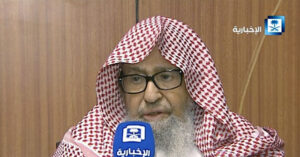


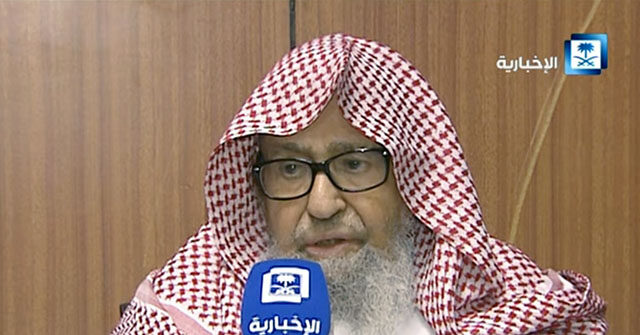
Grand Mufti Sheikh Saleh al-Fawzan, the normally apolitical top Muslim cleric in Saudi Arabia, issued a rare statement on Thursday urging Saudi troops to fight back against the Iran-backed Houthi insurgents of Yemen.
“Protecting this great nation and punishing anyone who seeks to lay a hand on even an inch of its territory are among the greatest duties and most virtuous acts of devotion, for which lives and souls may be sacrificed in seeking God’s pleasure,” al-Fawzan said in a statement carried by the state-run Saudi Press Agency (SPA).
“We ask God Almighty to grant you all his support, and to protect our countries and beloved Yemen from all harm. We also ask him to bring about the complete defeat of the Houthi group and those who assist and support them,” he wrote.
“It is incumbent upon you, brothers serving on the front lines, to remain constantly prepared to perform your duty, to obey the rulers and your field commanders, and to carry out orders with the utmost precision, as God Almighty commanded the companions of his Prophet to do,” the cleric admonished.
“You are following in the footsteps of the Prophet’s companions, defending the sacred sites of Muslims,” he concluded, presumably alluding to the Houthi drone attack on the Muslim holy city of Mecca last week that outraged much of the Islamic world. Saudi media has also broadcast footage of mosques in southern Saudi Arabia that were allegedly damaged by Houthi attacks.
The Grand Mufti had some choice words for the Houthis, denouncing them as “a group of evil” that was “founded on corruption in creed and methodology.” He urged Saudi soldiers to “stand united against this misguided faction and deviant group.”
Houthi supporters hold a rally in Sanaa, Yemen, July 17, 2026, against the Saudi-led coalition. Banner in Arabic reads, “All Saudi oil facilities are targets to our missiles and drones.” (AP Photo/Osamah Abdulrahman)
Al-Fawzan accused the Houthis of being poor Muslims at best, because the group “declares the Prophet’s Companions to be unbelievers, deems the blood of Muslims lawful, and destroys and demolishes their mosques.”
“Hold firmly to the rope of God, unite your ranks, cooperate with one another, and unite your word. Know that you are fighting an enemy, the Houthi group, which has caused corruption in the country, divided its people, turned against those in authority, and sought to harm the sacred sites of Muslims. But God is watching over them,” he said.
Al-Fawzan added that restoring the legitimate government of Yemen was “among the most pressing obligations,” because only then would the Yemeni people be able to live in security and prosperity alongside other Muslim nations.
The Grand Mufti is the highest religious authority in Saudi Arabia and is also regarded as an influential legal scholar, since Saudi Arabia’s legal system is largely based on Islamic sharia law. He heads up several important theocratic bodies, including the Council of Senior Scholars and the Permanent Committee for Scholarly Research and Ifta, which handles the kingdom’s research on matters of sharia law.
The office of Grand Mufti was created by the Saudi monarchy and, to this day, the king of Saudi Arabia appoints the Grand Mufti to a lifetime position. Al-Fawzan was appointed to the office by King Salman bin Abdulaziz in October 2025. The previous Grand Mufti held the office for over 25 years.
Unlike Iran’s Shiite Muslim theocracy, the Sunni Muslim clerics of Saudi Arabia are mostly seen as advisers rather than governing figures, since the monarchy holds all real power. Al-Fawzan has been relatively non-political by the standards of high-ranking Middle Eastern clerics, so observers found his fiery statement about the Houthis unusual – and probably a harbinger of major military operations to come because the Saudi monarchy would seek religious authority from the Grand Mufti for such an undertaking.
“They are preparing every single demographic they have in Saudi Arabia for a war,” Chatham House research fellow Farea al-Muslimi told the left-wing New York Times on Friday.
The Saudi military could use a bit of encouragement. When their renewed conflict with the Houthis broke out earlier this month, the Yemeni insurgents made lightning-fast gains all along the Red Sea coastline, while Saudi and Yemeni government troops melted away with little resistance. The Saudis have since launched heavy airstrikes against Houthi positions and attempted to rally their forces in Yemen for a counteroffensive.
Al-Fawzan’s statement came the day after Saudi Foreign Minister Prince Faisal bin Farhan met with the foreign ministers of Turkey and Pakistan on the sidelines of the U.N. General Assembly in New York City.
Saudi state media reported the foreign minister arranged an “urgent meeting of their military chiefs to explore ways to support Saudi Arabia” under the Mecca Agreement, the trilateral defense pact signed by Turkey, Pakistan, and Saudi Arabia in August 2026.
The Mecca Agreement has been the subject of some derision and mockery over the past few weeks because the Houthis are clearly attacking Saudi Arabia and the Saudis are having a lot of trouble fighting back – but all three members of the agreement have proven very reluctant to trigger the mutual defense clause that would oblige Pakistan and Turkey to intervene in the conflict.
The Pakistanis tried to throw their weight around two weeks ago by warning Iran that if it did not bring its Houthi proxies to heel, Pakistan might take action. Tehran ignored the warning, and the Pakistanis did not make good on their threats.
The Turkish Defense Ministry confirmed on Friday that the chief of its general staff, Gen. Selcuk Bayraktaroglu, would pay a visit to Saudi Arabia soon. Pakistan’s defense chief, Field Marshal Asim Munir, is also expected in Riyadh, and may already be en route, although the Pakistani military would not discuss the details of his travel plans.
The Saudi and Turkish foreign ministers took pains on Thursday to describe the trilateral meeting in New York as “technical negotiations” about “establishing institutional structures” for their defense agreement, rather than a war council. Turkish Foreign Minister Hakan Fidan hinted this week that his government might provide Saudi Arabia with technical support, rather than a direct military intervention.
Read the full article here


