




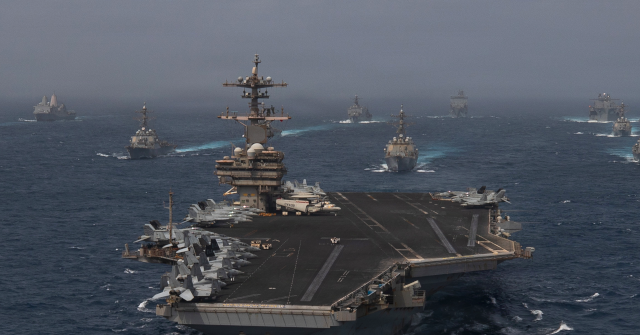
U.S. Central Command (CENTCOM), the wing of the military operating in the Middle East, revealed on Tuesday night that it had engaged in an airstrike campaign against Iranian proxies in Iraq that day with the aid of the Saudi Arabian Armed Forces.
CENTCOM described the targets as “Iran-aligned terrorists” and the airstrikes as necessary in response to attempted bombings of Saudi oil facilities and other high-value targets from Iraq. The Iranian terror regime has invested heavily in building a terrorist apparatus in Iraq, sending senior leaders of its Islamic Revolutionary Guard Corps (IRGC) into the country to help train members of the various militias known as the Popular Mobilization Forces (PMF), which include various Shiite terrorist organizations.
The PMF confirmed the strikes on Wednesday and claimed to have lost 20 terrorists to the operation. The strikes are likely to cause significant diplomatic controversy as the PMF, despite including jihadist terror organizations, are also a formal wing of the Iraqi armed forces, integrated into the nation’s military during the prolonged conflict against the Islamic State “caliphate” in the past decade. A PMF statement condemned the strikes and declared them a violation of Iraq’s sovereignty.
Both CENTCOM and the Saudi Ministry of Defense issued statements describing the strikes on Tuesday. The involvement of the Saudi military presents the potential of escalation, introducing Riyadh as a belligerent in the greater conflict between America and Iran that began with President Donald Trump’s Operation Epic Fury in February.
“U.S. and Saudi fighter aircraft struck multiple terrorist logistics and weapons sites across eastern Iraq in a strong response to over 30 IRGC-directed aerial drone attacks in the last 72 hours,” CENTCOM said in a statement on Tuesday, describing the actions as “precision strikes” against “Iran-aligned terrorists” organized by the IRGC.
CENTCOM separately accused the IRGC of launching ballistic missiles at American bases throughout the Middle East on Tuesday, an attack several headlines described as an attempted, and failed, “surprise” attacks. The American military command stated that “all Iranian missiles were successfully intercepted.”
The Saudi Defense Ministry confirmed its participation in the precision strikes on Tuesday, describing the targets as “belonging to those militias present on Iraqi territory that are linked to attacks on the Kingdom’s oil facilities.”
“The Kingdom also affirms that it does not seek escalation, but if subjected to any attacks, it will not hesitate to take all necessary measures to preserve the Kingdom’s sovereignty and protect its citizens and capabilities,” the Defense Ministry declared.
Separately, the Saudi Foreign Ministry defended the action, suggesting the airstrikes this week against Saudi oil facilities were especially egregious as the country was “exerting every effort to deescalate tensions in the region” when it was bombed.
“Nevertheless, these terrorist pro-Iran militias chose a reckless path of escalation,” the Saudi Foreign Ministry stated.
The PMF updated on Wednesday that it lost 20 troops to the airstrikes and 32 others were reportedly wounded, describing those numbers as “non-final.” The PMF specified that the strikes targeted the militias’ “official headquarters,” according to Iranian state media. The militants described a sprawling bombing campaign targeting their positions throughout Iraq in “Baghdad, Wasit, Nineveh, Basra, Kirkuk, Karbala, and Diyala” by Wednesday morning, complaining that targeting the PMF was a “violation of Iraq’s sovereignty.”
Iraq has largely avoided becoming involved in the ongoing conflict between Tehran and Washington, briefly interrupted by a “memorandum of understanding” signed in June that both parties appear to have largely forgotten. Saudi Arabia has endured several rounds of Iranian airstrikes since Operation Epic Fury began, but only became a target for Iran’s Iraqi proxies in the past week. The Saudi Defense Ministry revealed on Monday that it had identified and intercepted several drone attacks by Iran-linked militias in Iraq, presumably the PMF. Riyadh asserted that the attacks were targeting its oil fields and the country would “take all necessary measures to prevent its territories from being used as grounds from which acts of aggression are launched.”
The PMF as an entity responded to the airstrikes on Wednesday but, on Monday, the entity responding to the Saudi allegations was the “Islamic Resistance in Iraq,” (IRI), an unclear coalition of Iran-backed Shiite terrorist entities largely believed to consist of PMF members. the IRI denied that it had bombed Saudi Arabia but nonetheless threatened to make the Saudis “deeply regretful” for any retaliation.
Also targeting Saudi Arabia in the past month have been the Houthi terrorists of Yemen, another Iranian regime proxy organization. The Houthis, who falsely claim to be the government of Yemen, announced on July 20 that they would impose a “maritime ban” on Saudi ships attempting to navigate through the Bab el-Mandeb Strait out of the Red Sea, significantly hampering Saudi oil shipments to Asia.
“The Yemeni armed forces affirm their complete readiness for all options, and any foolish act committed by the reckless Saudi enemy through all escalation will be met with a comprehensive and decisive escalation, by Allah’s will and power,” Houthi terror spokesman Yahya Saree declared.
Iraqi Prime Minister Ali al-Zaidi ordered his security forces to investigate the drone attack in a statement released on Monday evening.
“The Iraqi government reaffirms its constitutional and unwavering commitment to the principles of good neighbourliness and to preventing Iraqi territory from being used as a route or launching point for any attack targeting brotherly or friendly countries,” said Iraqi military spokesman Sabah al-Numan.
“These fabrications are nothing but an attempt to justify the inability to respond to the painful Yemeni strikes that have targeted the heart of their infrastructure, out of fear of the nature of the impending Yemeni response,” the IRI jeered, referring to attacks on Saudi shipping in the Red Sea by another Iranian proxy, the Houthi insurgents of Yemen.
The Houthi blockade preceded reports last week that Saudi oil shipments had decreased dramatically out of the Red Sea and that Saudi oil companies were seeking to redirect some of those shipments through the Suez Canal. The Suez Canal cannot accommodate some of the world’s largest oil tankers, however, meaning the Saudis would have to pay much higher shipping costs for more ships to carry the same amount of oil.
Follow Frances Martel on Facebook and Twitter.
Read the full article here


