







President Vladimir Putin threatened retaliation against British and French ‘pirates’ over the seizure of Russian ‘shadow fleet’ oil tankers, saying his navy was ready to start capturing European ships in return.
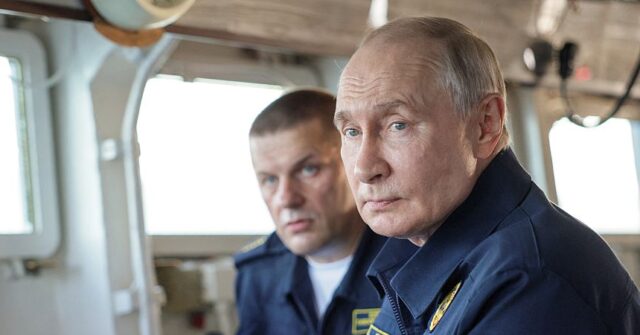
European states are engaged in “nothing less than piracy and robbery” when they seize Russian shadow fleet tankers moving sanctions-busting oil, President Vladimir Putin said on Wednesday. Speaking from the navy cruiser Varyag on a visit to observe the culmination of a major series of exercises off Russia’s east coast, Putin said his forces were ready to “respond in kind”. Several other Kremlin figures quickly followed their leaders’ remarks to add their own threats.
Russian state media reported that President Putin said: “I would like to draw attention to the EU’s recent decisions. We see that the authorities of some countries are attempting to restrict the movement of our economic operators’ ships in violation of international maritime law. I want to emphasise that these ships are peaceful. Recently, they’ve even considered seizing our ships and selling property stolen from us.”
President Putin called these acts “nothing less than piracy and robbery” and warned, “If this begins to happen in practice, we will be forced to respond in kind”, stating he’d already given such instructions to his Defence Ministry and that seizures could happen “wherever we deem it appropriate”, including the Pacific Ocean.
Admiral Viktor Liina, who commands the Russian Pacific Fleet and was hosting President Putin, specifically cited British and French ships as potential targets and said his forces were ready to commence operations.

Western powers, including the European Union, placed sanctions on Russian oil quickly after the commencement of its 2022 invasion of Ukraine, but the Russian Federation quickly found ways around those attempts to hamper its trade, including by shifting its oil exports into a large network of so-called “shadow” tankers. European critics say these ships, typically older vessels that would likely have otherwise been taken out of fleets permitted to transit around European coasts, attempt to defy sanctions by obscuring the origin of the oil cargoes they carry and the ownership of the vessels themselves through convoluted layers of ownership and obscure flagging.
Western states retaliated to this by sanctioning individual ships known to be carrying Russian oil as part of this shadow fleet, with over 630 vessels now listed. Still, much of this trade passes right under the nose of European navies, with hundreds of Russian shadow ships passing through the English Channel every year.
One of these ships was the oil tanker Smyrtos, a Chinese-owned, Indian-crewed vessel sailing under the flag of Cameroon. The Cameroon government came under pressure from European states to strike the Smyrtos off its national register, and when it finally did, the British government took this as a pretext to board and seize the ship for sailing under false or no colours under Article 110 of the United Nations Convention on the Law of the Sea. Royal Marines fast-roped onto the deck to capture the vessel and cargo, and then guided the tanker into the English harbour of Weymouth, where it remains, months later.
The Indian citizen captain Ajay Pant has been arrested and charged, and is due to appear in a British court in December for defying Western sanctions on Russian oil, the first such case in the world. The remainder of the non-officer crew has been repatriated.
Several other Russian ships have been seized by other Western nations, including France, Germany, Italy, and the United States. While the U.S. has recently gone so far as to sell off former shadow fleet ships for scrap value, Russia appears more wary of lashing out at Washington and has confided its criticism of European powers.
After President Putin’s remarks, Kremlin attack dog Dmitry Medvedev — who has spent much of the Ukraine War to date threatening to nuke Europe for daring to involve itself in the defence of Ukraine — added detail. Speaking on Thursday, the Russian Security Council Deputy Chairman said Russian shadow fleet ships do no more or less than Western-operated oil tankers that use obscure flags and ownership structures to minimise tax liabilities and staffing costs, and said Russia would soon attack European shipping in retaliation.
He said, “The vast majority of Western European ships also sail under flags of convenience. So what does that mean? It means that, guided by a fair, symmetrical approach, Russia has the right to attack any merchant vessel of an enemy country in our waters or neutral waters if there are sufficient grounds to suspect that it is carrying cargo for the enemy. That is, any cargo! There are many such vessels.”
Calling out European “lapdogs”, Medvedev said of Russia’s own ships: “European officials have no right to detain such vessels, neither under the 1982 United Nations Convention on the Law of the Sea nor under national legislation. This is blatantly arbitrary”.
A spokesman for the Russian Ministry of Foreign Affairs also commented, adding that European states are exposing themselves to “great danger” by impounding Russian oil, and that they “abuse international legal norms,” such as using flag-check boarding to “settle political scores”.
The British government denied the allegations. State broadcaster the BBC quoted a spokesman, who said of Putin’s remarks: “The UK is disrupting and deterring shadow fleet vessels and their harmful maritime activity which is fuelling Russia’s war with Ukraine.
“British Armed Forces and law enforcement officers boarded the Smyrtos in full accordance with international law. Unlike Russia’s shadow fleet, UK Armed Forces and commercial vessels operate firmly in line with international maritime law.”
The practice of so-called flags of convenience, around which much of the to-and-fro between Moscow and London revolves, is a long-standing practice in the maritime industry that allows operators to register ships in countries with the lowest regulatory and tax burden, sometimes even in landlocked countries. The upshot of this is that in 2026, a Russian warship would struggle to find a British-flagged oil tanker anywhere on earth.
During the Second World War, when flying the flag of a developed nation was the norm, around a third of all shipping on earth went beneath the ‘red duster’ flag of Britain, while today it is just half of one per cent. While the British Merchant Navy lost around 2,800 ships in the Second World War, there are now fewer than that flying the flag in total, with just 800 “trading vessels” left on the British register. Even once great British trading fleets — such as British Petroleum (BP) — have flown a tax haven flag and have been transitioning away from employing British officers to Indian crews for years.
Follow Breitbart London on Facebook: Breitbart London
Read the full article here


