




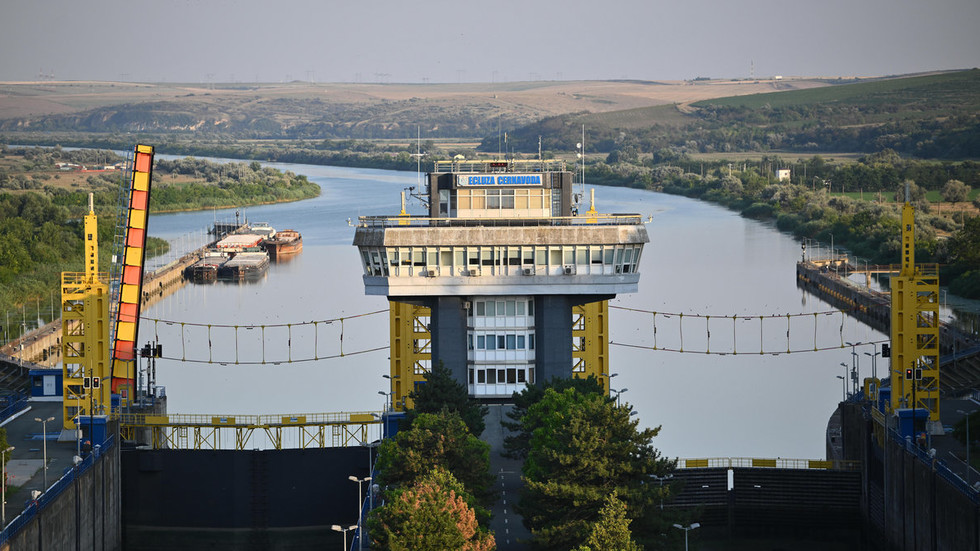
The reactor at the county’s Cernavoda facility has been disconnected as a severe drought left the Danube River at record lows
The only nuclear power plant in Romania has been completely shut down due to record-low Danube River levels, state-owned energy company Nuclearelectrica announced on Thursday.
River water is essential for cooling many European nuclear plants, making low levels an increasing constraint on power generation. The severe heatwave and drought across Europe have pushed the Danube and Rhine, two of the region’s most vital rivers, to historic lows, disrupting stable electricity generation in several countries while hampering industrial output and major trade routes.
Cernavoda, which accounts for about 20% of Romania’s power output, has two reactors, each with a capacity of 706 MW. In late July, Nuclearelectrica shut down one of them as water levels in the drought-hit river fell dramatically.
Last week, Romanian authorities sank four rock-filled barges near the Danube’s Bala Canal in an unprecedented effort to redirect water toward the Cernavoda plant after the military blasted a channel through the riverbed. Water levels, however, ultimately fell below the threshold needed to keep the reactor operating, forcing the management to disconnect it from the power grid.
At the same time, Bucharest declared a state of energy emergency for August, urging businesses and households to voluntarily reduce consumption during peak evening hours. The government has prepared a system to cut power for industrial consumers in stages and with prior notice if needed.


The Cernavoda shutdown has also raised concerns in neighboring Moldova, which is facing low water levels on the Dniester and relies on Romanian power to cover up to 60% of its electricity shortfall.
The energy strain has been felt across the region, with Hungary’s Paks nuclear plant forced to sharply cut output as the Danube fell to record lows.
France has also reduced nuclear generation amid high river temperatures and low water levels. Earlier this week, French state-run energy group EDF said a massive swarm of jellyfish had forced the operator to shut down three reactors at Gravelines, one of the largest nuclear power plants in the country.
The severe drought has hit hydropower generation in Italy, while Norway’s reservoirs have fallen to their lowest level in three decades.
Analysts warn the reactor cuts and outages could increase electricity import dependence among the bloc’s most vulnerable countries and drive up power prices across the EU. The disruption could further deepen the bloc’s energy crunch, which began with the loss of cheap Russian gas following Ukraine-related sanctions on Moscow. The strain has worsened this year amid the US war on Iran and the de facto closure of the Strait of Hormuz, a key global energy shipping route.
You can share this story on social media:



Read the full article here


