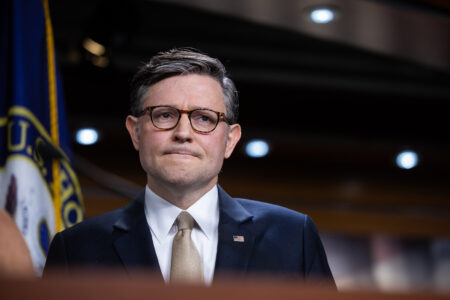




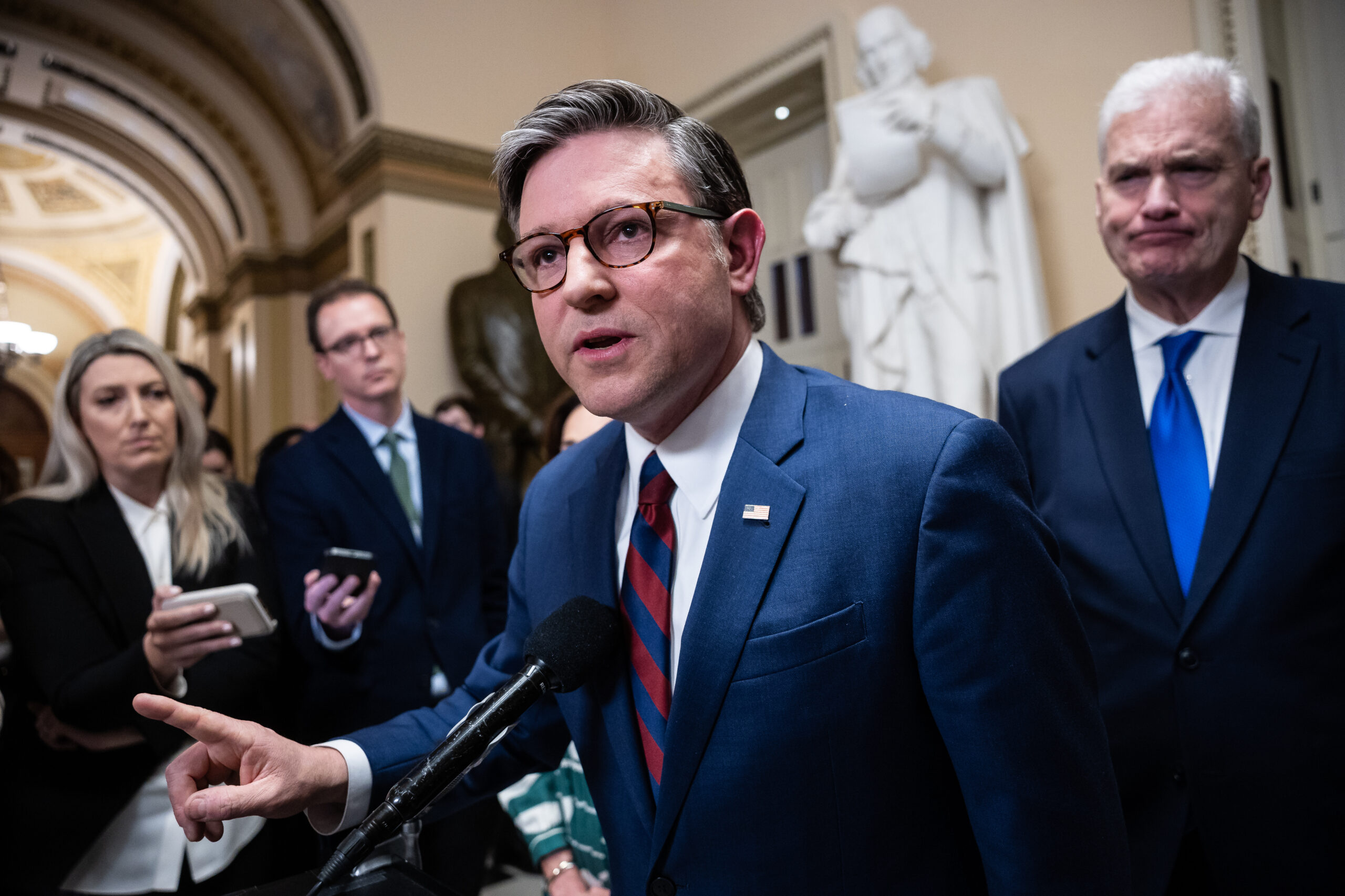
Speaker Mike Johnson canceled a vote scheduled for Wednesday evening on a clean reauthorization of a key spy power amid a hard-liner rebellion — a blow to President Donald Trump whose senior administration officials throughout the day tried to seal the deal ahead of the program’s expiration in five days.
Leaving the Capitol Wednesday night, Johnson said he believed negotiators needed “a few more hours” to wrap up discussions on proposed changes, and that the process could get back on track Thursday.“We’re working through some final details,” he added.
It comes as House GOP leaders and White House officials remain locked in talks over potentially including reforms to Trump’s desired 18-month extension of Section 702 of the Foreign Intelligence Surveillance Act.
In a bid to partially satisfy ultraconservative holdouts who are refusing to advance the legislation without policy changes, leaders and the White House are now in discussions to possibly allow a vote on a provision based on an amendment authored by Rep. Clay Higgins (R-La.).
The provision would require the government to obtain a warrant for “U.S. person queries” under Section 702, once there is probable cause that the individual is an agent of a foreign power or has committed a crime. While it would codify components of current surveillance law, it also would serve as a compromise by putting some restraints around many of the routine, warrantless surveillance practices now acceptable under existing statute.
Higgins was at the White House Tuesday night with other Republicans, and again Wednesday, to discuss his proposal and other ideas with White House officials, according to three people granted anonymity to share details of private conversations.
But White House officials are still trying to rein in the scope of this proposal even further given Trump’s demand for no policy changes or new guardrails on the government’s use of the spy powers authority.
And while Rep. Andrew Clyde (R-Ga.) said the Higgins amendment could satisfy some of his concerns regarding warrants, if it’s enacted in full, there are still other issues to tackle. Other House GOP holdouts note this proposal wouldn’t go far enough to convince ultraconservatives who have been battling warrantless surveillance activities for years.
Johnson on Wednesday didn’t rule out possibly adding amendments to the FISA reauthorization.
“Just wait and see,” he said. “I can’t really project all that yet.”
Hard-liners are also talking with the White House about the length of an extension, and about how leadership can make good on a promise to advance a ban on a central bank digital currency. They also want to tackle issues with third party data brokers. And if the White House allows reforms, officials are pushing for a longer extension than 18 months, complicating discussions further.
Intelligence Chair Rick Crawford (R-Ark.) said in a brief interview Wednesday evening that there was still a lot of conversation around warrants and potential reforms. When asked about the Higgins amendment in particular, Crawford said leadership has to consider the number of people they will gain on a final vote versus lose with any changes.
Crawford also suggested there might not be a resolution by Thursday but he was confident the House could move a FISA extension by the “end of the week.”
The eleventh hour talks are occurring even though the Trump administration has known for months about the April 20 deadline for extending Section 702, and that a clean reauthorization would not be acceptable to wide swaths of the House GOP Conference.
More than a dozen Republicans involved in the talks, from rank and file to more senior members and aides, privately complained that Trump officials have only started to engage over the details of possible policy compromises and reforms including negotiations over text in the last few days, once they discovered — too late — that their pressure campaign of a reform-free extension would not succeed.
White House officials in turn have been deeply frustrated by the holdouts, who some have argued are making Trump work harder for a FISA reauthorization during a war than they ever did during President Joe Biden’s tenure.
A White House official shared records of recent meetings on the topic to dispute the characterization of their engagement with members over FISA the last six months.
Changes to the deeply complex surveillance authority typically requires weeks, if not months, of negotiations. White House legislative affairs staff and other Trump officials are now trying to cram that into a “matter of hours,” said one Republican involved in the talks.
The result is that Republicans are now locked in another deeply toxic policy fight as they are already dealing with how to end the ongoing Department of Homeland Security shutdown. There’s also open conflict between Republicans in the House and Senate, with some lawmakers complaining they received conflicting advice from the Trump administration on the best path forward.
Any Section 702 extension the House passes also needs to clear the Senate on a very tight timetable, and Senate Majority Leader John Thune, in an interview Wednesday following a meeting with Johnson, said he was “still optimistic” and “hopeful” the other chamber would be able to make the first move.
As for whether senators would accept policy changes like the ones currently being discussed across the Capitol, Thune replied, “Depending on what it is. I assume the White House will have signed off on it.”
“I think we’re hopeful, but that doesn’t necessarily mean that every member agrees with that level of reform,” said Rep. Warren Davidson (R-Ohio), who had previously offered an amendment on the data broker issue, of the current state of talks over policy compromises. “That’s, I think, the challenge for leadership.”
Jordain Carney contributed to this report.
Read the full article here