
A report drafted by the International Atomic Energy Agency (IAEA) on the status of Iran’s nuclear program reportedly asserts that the U.N. agency has no way of verifying the status or location of the country’s illicit enriched uranium stockpile, multiple news outlets reported on Thursday.
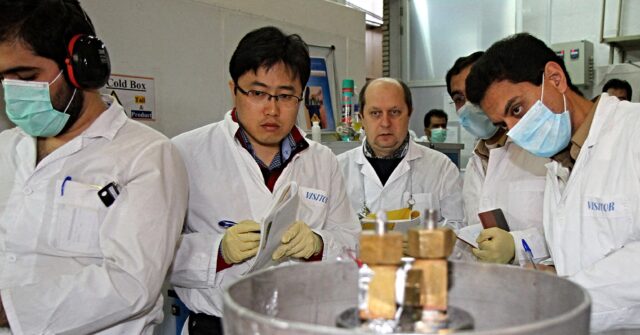
The IAEA has a global responsibility to inspect and approve the nuclear activities of countries that are parties to the nuclear Non-Proliferation Treaty (NPT), such as Iran. The Iranian terror regime has historically obstructed the IAEA’s ability to monitor its activities, however, particularly its high levels of uranium enrichment, which experts agree are not consistent with any known civilian use.
The U.N. agency, in the report, allegedly demanded that Tehran allow immediate access to its nuclear sites for its inspectors to assure that the material is safe and compliant with the NPT. The status of the enriched uranium stockpiles is of particular concern following American military activities in June 2025 targeting the enrichment facilities at Fordow, Natanz, and Isfahan, which may have destroyed the enrichment facilities. President Donald Trump announced the decision to conduct airstrikes on those sites after last year’s IAEA report on Iran’s status, which resulted in the agency passing a resolution condemning Iran for violating international law for the first time in two decades.
Reuters, the Associated Press, and the Agence France-Presse (AFP) all reported having seen a copy of the upcoming IAEA update on Iran on Thursday. Their reports widely coincided, sharing that the agency was demanding immediate access to Iranian nuclear sites and had no way of verifying if Iran was abiding by international law.
The agency “cannot provide any information on the current size, composition or whereabouts of the stockpile of enriched uranium in Iran or whether Iran has suspended all enrichment-related activities,” the report allegedly stated, citing a “loss of continuity of knowledge over all previously declared nuclear material at affected facilities in Iran.”
Obtaining that information, the report asserted, was of “utmost urgency.” IAEA chief Rafael Grossi emphasized that the agency could not “discharge its safeguards responsibilities” if Iran did not grant it access to critical uranium enrichment sites.
“The (IAEA) Director General has emphasized to Iran that it is indispensable and urgent to implement effectively the NPT Safeguards Agreement … and that its implementation cannot be suspended by Iran under any circumstances,” the report asserted, according to the mentioned news outlets.
The report also added that Grossi offered “full support” to ongoing negotiations between Iran and the United States to end their current war, which has been paused by an indefinite ceasefire that President Trump described as “shooting in a more moderate manner” to reporters on Wednesday. The current conflict began on February 28, when Trump announced the debut of “Operation Epic Fury” to erode Iran’s missile and drone capabilities and target warmongering Iranian regime leaders. President Trump announced that day that the “supreme leader” of Iran, Ali Khamenei, had been killed in an American strike.
“Operation Epic Freedom” was launched the day after the IAEA issued its last published report on the state of Iran’s nuclear program. As with the one reportedly circulating this week, the U.N. agency complained that it did not have sufficient access to nuclear sites to do its job and that it could not guarantee that Iran was not violating international law.
“During the current reporting period, Iran did not provide access to the Agency to any of Iran’s four declared nuclear enrichment facilities,” the report read. “The Agency does not know whether IFEP contains nuclear material or is operational. Iran has not provided the Agency with access to this facility since it was first declared by Iran over eight months ago.”
The report detailed that Iran repeatedly dismissed IAEA requests for access to sensitive sites, claiming that it was taking the requests “under consideration” but blaming the United States (“conditions resulting from acts of aggression”) for not being able to comply. Ultimately, by early February, Iranian officials declared that abiding by international law on inspections was “untenable.”
The Iranian state propaganda outlet Islamic Republic News Agency (IRNA) reported on Friday that Iranian officials, alongside allies from Russia and China, had met with IAEA director Grossi on Friday in preparation for next week’s Board of Governors meeting. Among Grossi’s responsibilities in that meeting is to update the Board of Governors on the status of Iran’s nuclear program and relationship with the agency. The group allegedly “discussed the issues on the agenda for the upcoming Board of Governors meeting with Grossi.”
Grossi is preparing for the Board of Governors in the context of his campaign to run the United Nations as its secretary-general. The Argentine diplomat is campaigning on moving the IAEA to sanction Iran, demanding that the U.N. as a whole take more action on international affairs. In remarks last week, he noted that, in the world’s major conflicts, “the U.N. is absent from the management or resolution” of them, demanding the status quo change.
Follow Frances Martel on Facebook and Twitter.
Read the full article here