






President Donald Trump has rejected Iran’s proposed seven-day plan to reopen the Strait of Hormuz and told aides he expects U.S. strikes against Iran to resume after the November midterm elections.
The Wall Street Journal reported Friday that Trump turned down Tehran’s proposal and has told aides he views another bombing campaign as likely, citing U.S. officials familiar with his thinking.
The United States has also told Tehran and regional mediators that Trump has no intention of lifting the maritime blockade of Iranian ports, according to the report, with Washington betting that mounting economic pressure will ultimately force Iran into an agreement on terms favorable to the United States and Persian Gulf Arab states.
Trump also posted an image on Truth Social Friday night showing the Strait of Hormuz circled in blue and labeled simply, “TRUMP STRAIT.”

Trump remains skeptical that Tehran will satisfy his demands on its nuclear program, the officials said.
The scale of any prospective strikes remains unclear, however, and Trump has not made an irrevocable decision to resume major combat operations. Officials said the president is reluctant to restart a major campaign in part because Washington wants to preserve munitions for other potential contingencies, while cautioning that his position could change in the coming weeks and could be affected by the midterm results.
Diplomacy has not stopped despite Trump’s rejection of the current proposal.
A U.S. official told the outlet that Washington and Tehran continue to negotiate through mediators, including over Iran’s nuclear program, while an American-led effort to move oil tankers through the Strait of Hormuz despite Iranian threats has reduced Washington’s urgency to reach an agreement.
Earlier Friday, a U.S. official familiar with the indirect discussions described them as “positive” and “constructive.”
Iranian Foreign Minister Abbas Araghchi, meanwhile, publicly detailed what he called a “concrete seven-day plan” Friday that Tehran had conveyed to Washington through Qatar.
Under the proposal, Washington would lift its naval blockade of Iran, waive sanctions on Iranian oil sales, release frozen Iranian assets and observe a ceasefire covering all fronts, including Lebanon. Iran, in turn, would reopen the Strait of Hormuz and begin negotiations with Washington over its nuclear program.
Iran first broached the idea of a seven-day pause during a meeting in Qatar on Sunday, according to the report, with regional mediators subsequently working around the United Nations General Assembly in New York to reinvigorate negotiations.
Araghchi made clear Friday that the seven-day clock would begin only after Washington accepted the plan.
“If they accept this plan tomorrow, the seven days will start from tomorrow,” he said.
Araghchi said the steps required of the United States could be completed in roughly four to five days, allowing Iran to reopen the strait on the sixth day and begin negotiations with Washington over a final agreement on day seven.
“If there is seriousness on the US side to come to a deal and reopen the Strait of Hormuz, everything is now prepared,” he said.
“The choice now rests with the United States.”
The proposal seeks to revive and accelerate the framework of the Islamabad Memorandum of Understanding reached between Washington and Tehran in June. That arrangement subsequently collapsed after Iran resumed attacks on commercial shipping in the strait, prompting renewed U.S. military action. Tehran has accused Washington of violating the agreement and is demanding a return to its terms.
Iranian diplomats have presented several proposals to end the war and acknowledged to Arab mediators the deepening economic crisis inside Iran, according to the report.
Iran’s Islamic Revolutionary Guard Corps, however, has resisted new formulas for an agreement and is prepared for a prolonged conflict, the outlet reported. The IRGC instead favors terms closer to the preliminary June agreement, which included sanctions relief, access to frozen Iranian assets and a role for Tehran in administering the Strait of Hormuz in exchange for reopening the waterway.
Washington, meanwhile, has increasingly signaled that it sees little reason to surrender its economic and maritime leverage first.
State Department spokesman Tommy Pigott said Friday that the United States was “severing” the Iranian government’s financial lifelines through its economic campaign and said Trump “holds all the cards.”
Pigott said more oil was moving through Hormuz each day and stressed that any agreement with Tehran would have to be “actions-based.”
A U.S. official said around 40 million barrels of oil had transited the Strait of Hormuz over the previous 48 hours.
U.S. Central Command separately said Friday that American forces had redirected 122 commercial vessels to ensure compliance with Washington’s blockade, up from 115 two days earlier.
The U.S.-led effort to keep tankers moving through Hormuz has reduced Washington’s urgency to reach an agreement with Tehran, according to the report.
The diplomatic gap extends beyond the blockade.
A senior Iranian official told Reuters Friday that Tehran would show “no flexibility” over its nuclear program even if Washington accepted the Hormuz proposal, saying Iran would neither surrender what it considers its right to enrich uranium domestically nor agree to Washington’s demand that its highly enriched uranium be shipped out of the country.
Iran has separately indicated that it could dilute its most highly enriched uranium.
Iranian President Masoud Pezeshkian told Fox News’s Bret Baier on Thursday that Tehran was prepared to dilute the material and allow verification of its nuclear activities.
“We said we’re willing to dilute them. It’s not a big deal. We are willing to submit ourselves to verification,” Pezeshkian said.
The distinction leaves a fundamental disagreement intact: Iran has offered measures addressing the concentration and verification of its uranium while refusing to abandon domestic enrichment or export its highly enriched stockpile.
Tehran has also continued to apply military pressure as its diplomats pursue an agreement.
IRGC spokesman Hossein Mohebbi said Friday that the Revolutionary Guard would continue military action against the United States until Tehran’s conditions were met, according to Iran’s semi-official ISNA news agency.
“Our missiles are capable of destroying US multilayered air defense systems,” he said.
Mohebbi also claimed Washington was portraying Hormuz as open to prevent oil prices from rising but was unable to keep the waterway open consistently despite possessing the world’s largest navy.
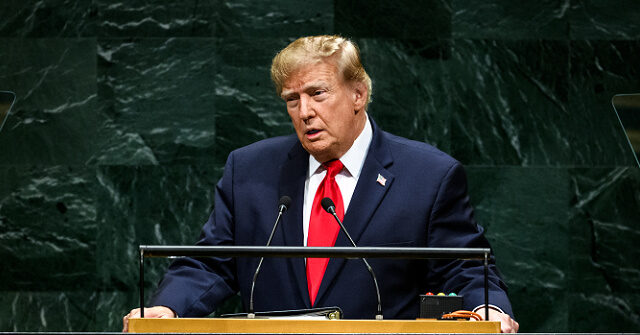
Trump, for his part, warned Iran during his address to the United Nations General Assembly on Tuesday that it needed to move quickly toward an agreement while reiterating that the United States would not permit Tehran to acquire a nuclear weapon.
The president also called for Iran’s complete economic isolation while holding out the possibility of an agreement if Tehran changed course.
Trump insisted that the approaching midterm elections would not determine his Iran policy.
“The Republican Party is running, and I’ll be helping them, but I am not running,” Trump told world leaders. “I gave absolutely no credence and will not give credence through the election when it comes to Iran.”
“The only thing that does is that Iran will never have a nuclear weapon,” Trump added.
Araghchi on Friday placed responsibility for the next move squarely on Washington.
“The choice now rests with the United States,” he said.
By Friday night, Trump had rejected Tehran’s current proposal and told aides he expects American strikes to resume after the midterms, according to the report — though officials cautioned that the scope of any prospective strikes remains undecided and the president’s position could still change.
Joshua Klein is a reporter for Breitbart News. Email him at jklein@breitbart.com. Follow him on Twitter @JoshuaKlein.
Read the full article here


