

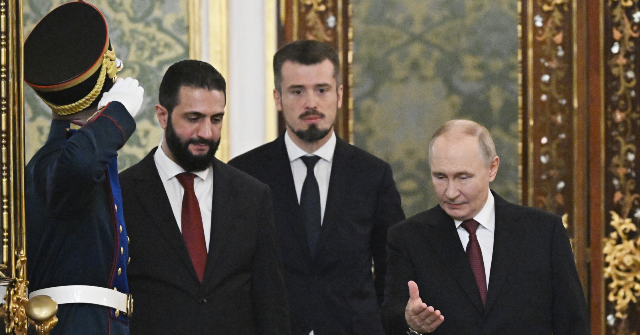
The government of Syria announced this week that it had signed a memorandum of understanding with Russia that would result in Moscow handing over control of a critical airport and part of a seaport to Damascus.
Russian officials celebrated the agreement on Tuesday as an “important step” in building a foundation for a functional relationship between their government and the rulers of Syria, who came to power defeating close Russian ally Bashar Assad in the Syrian Civil War.
The government of Russia, under strongman Vladimir Putin, developed a close and long-term relationship with the Assad regime that resulted in significant Russian intervention in the civil war. Assad found refuge in Moscow and is believed to have been living there since December 2024, when Hayat Tahrir al-Sham (HTS), an al-Qaeda offshoot led by “Abu Mohammad al-Jolani,” toppled the ruling Assad dynasty and ended the civil war. Abu Mohammad al-Jolani has since shed his jihadi nom de guerre and now goes by his legal name, President Ahmed al-Sharaa.
Sharaa has met with Putin twice since becoming president of the country and the state-run Syrian Arab News Agency (SANA) described the new agreement with Russia as 18 months in the making, the product of intense and sometimes difficult negotiations. The agreement will reportedly affect most prominently the Tartous Port that Russia has for years been using as its only access port to the Mediterranean and the Hmeimim Air Base, both in western Syria. Under the deal, Hmeimim will become a civilian airport managed by the government of Syria, according to SANA. Russia also reportedly agreed to hand over control of the fourth commercial berth at Tartous Port.
“The two sides also agreed to redefine the role of facilities currently used for military purposes, with Russian military bases to be transformed into joint training and qualification centers under new arrangements aimed at safeguarding the interests of both countries,” SANA added. The changes announced in the agreement will reportedly take place within the next three months.
Declaring the agreement a victory for Sharaa’s government, SANA emphasized in an analysis of the diplomatic efforts that preceded it the HTS leadership’s efforts to keep some functional Syria-Russia relationship despite Russia being an active belligerent against HTS and other anti-Assad forces during the civil war.
“The agreement goes beyond arrangements governing Russia’s presence on the Syrian coast,” SANA explained. “It represents a broader effort by Damascus to reshape a relationship that, for years, has been closely tied to the political and military circumstances of the ousted regime and establish new terms that place Syrian sovereignty and national interests at the center of bilateral ties.”
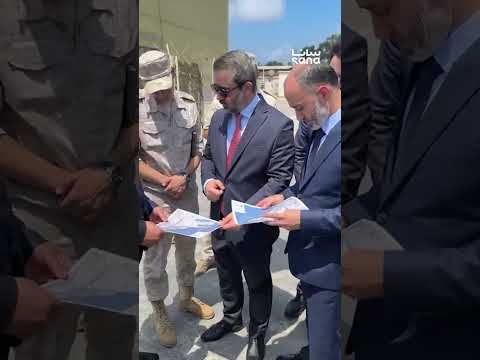
Syrian Foreign Minister Asaad al-Shaibani visited the Tartous Port on Sunday to inspect the area and bring back to Damascus a report on its status and what needs to be updated to outfit it for its new use, as well as bring it out of Russian control.
The Russian Foreign Ministry weighed in on the restructuring of its presence in Syria on Tuesday, insisting that it was not a diminishing of Russian influence in the region, but rather a positive evolution in bilateral ties. Moscow also announced on Tuesday that the Syrian government would allow the reopening of a cultural and educational institution known as the Russian House in Damascus, suggesting a refocus on soft power.
“We regard the signing on 9 August of the memorandum… as an important step aimed at further improving bilateral cooperation in the military sphere,” the Foreign Ministry declared. “We believe that reaching this agreement will give further impetus to the development of the full range of relations between our countries, which are based on a long history of friendship and partnership.”
Neither country has offered at press time any clarifying information on what the “joint training and qualification centers” would look like, or what kind of military activities would take place there.
The Russian news agency Tass reported the return of the Russian House to Damascus on Tuesday as a separate but related development that would ensure the expansion of the country’s influence in the Middle East. Tass cited an official with Rossotrudnichestvo, Putin’s “humanitarian cooperation” agency, confirming the restoration of the location, specifying that Russia will be pursuing scientific and educational endeavors there.
“One of the key areas of the Russian House’s work will be education. Since the beginning of 2026, more than 4,500 applications have been received from Syrian citizens to study at Russian universities, and the competition has reached 23 people per place,” the official stated. “During the negotiations, interuniversity exchange educational programs in artificial intelligence, robotics, mathematics, and engineering disciplines were discussed, along with the resumption of Russian language courses.”
The new agreements revealed this week reflect reports earlier in the summer stating that Damascus and Moscow were progressing towards a situation that allowed Russia to retain influence while limiting its military presence in the country, a demand that Sharaa’s followers, many of whom fought against Russian soldiers in the civil war, have elevated. Russian Foreign Ministry spokeswoman Maria Zakharova told reporters in June that talks with Syria were “developing very actively” and that they included a “reformatting of the functionality of Russian military facilities.” She suggested that Tartous could remain a Russian port repurposed to import Russian goods rather than as a strictly military facility.
Follow Frances Martel on Facebook and Twitter.
Read the full article here