




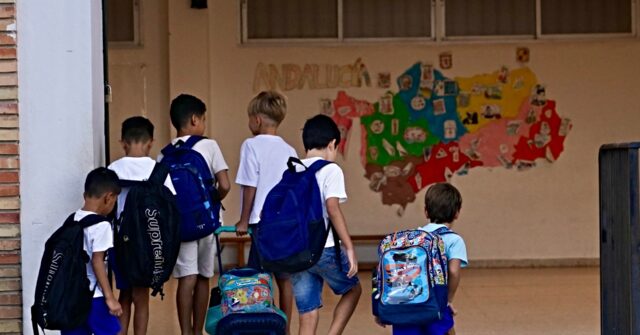
Nearly 20-percent of all students enrolled in elementary and secondary school in Spain come from migrant families living in the country, official data from the Spanish Education Minister cited by local outlets revealed.
The Ministry’s statistical data indicates that migrant enrollment in Spain’s elementary and high schools have experienced a significant growth and demographic shift over the past decade, with local outlets characterizing the data as a “thermometer” to measure how migration patterns are changing in the European nation.
According to the data, there were 1,151,694 million migrant students enrolled across Spanish schools during the 2024-2025 academic period — 427,059 more than the 724,635 that were enrolled during the 2014–2015 period. Most of Spain’s migrant student population is more heavily concentrated at the Balearic Islands, the Valencian Community, La Rioja, Aragon, Catalonia, Murcia, and Madrid — all regions that exceed the national 12.9 percent migrant student average.
The online newspaper El Español, citing the data, noted that the changes in Spain’s student demographics are largely driven by a highly significant, nearly 115 percent surge of migrant students of Hispanic origin. The growth is majorly driven by Colombian students, who have increased their numbers fourfold in ten years.

Per the outlet, the number of South American students enrolled in Spain has risen from 164,465 to 352,677 over the past ten years — increase of 188,212 students, or 30.6 percent of all migrant students. Colombian students, which El Español characterized as a “particularly striking” case among the group, have grown by 310 percent over the past decade, going from 27,957 students during the 2014-2015 period to 114,723 as of the 2024-2025 period.
On the other hand, enrollment from African students, the “historically dominant source of migrants in Spain,” is slowing down. Per the outlet, the number of migrant students of African origin rose from 219,048 in 2014–2015 to 260,139 in 2024–2025 — representing a 18.8 percent increase that, while still significant, pales in comparison to the 115 percent surge in Hispanic migrant students.
Morocco, the largest group of foreign nationals in the Spanish education system, is instead exhibiting a downward trend. After reaching 205,418 students during the 2019–2020 academic period, the number slightly dropped down to 200,487 during the 2024-2025 period.
“A comparison between regions highlights the scale of the change. While South America gained 188,212 students over the course of a decade, Africa gained 41,091,” El Español explained. “In percentage terms, South America’s growth was six times that of Africa’s, and if we focus specifically on Colombia, its growth exceeded Africa’s by more than 16 times.”
El Español further attributed the changes in Spain’s migrant student enrollment data to changes in U.S. migration policies enacted over the past two decades following the September 11, 2001 terrorist attacks, noting that, up until the year 2000, 72 percent of all Hispanic migrants lived in America.
Studies published in 2018 cited by El Español found that, by that year, Spain housed 47.4 percent of all of Europe’s Hispanic migrant population — a result attributed to the lack of Spanish language barriers between Latin America and Spain, Spain’s historical links to Latin America, and Spain’s lax regularization processes for migrants, among other factors.
Read the full article here


