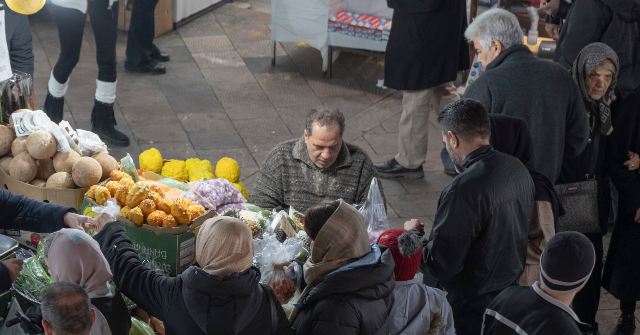
Iranian citizens are telling foreign media outlets that survival is growing difficult as the price of food and other basic commodities soars by 400 percent under pressure from the U.S. blockade, even as the regime in Tehran insists the food situation is under control.
“I’m in survival mode,” a 33-year-old cryptocurrency trader from western Iran using the alias “Nima” told The National on Monday.
Nima said his grocery bills have tripled from prices that were already painfully high before the conflict with the United States began and some items have quadrupled. He said this is forcing him to “choose between the essentials and everything else,” even though his crypto trading gave him better foreign currency reserves than most Iranians.
The annual rate of general inflation in Iran is now over 80 percent and unemployment reached a four-year high of 9.1 percent in June. Iran’s currency, the rial, is down to an astounding 1.88 million against the U.S. dollar, which is an especially severe problem for the many Iranians who prefer to do business using dollars instead of Iran’s nearly-worthless currency.
Unemployment rates soared after the uprising in January because the regime blacked out the Internet for about three months, dealing a crushing blow to many Iranian businesses.
“Every tomorrow has been worse than the day before. If you can’t save, can’t buy what you want and don’t have a predictable future, then what’s the point of working any more?” Nima said in despair.
Other Iranians who lacked Nima’s access to foreign currency were in even worse shape, as they can almost feel the regime scrip in their pockets losing its value with every passing day. Blue-collar Iranians told The National they had to work two or three jobs to make ends meet and there are not enough jobs to go around.
Perhaps understandably, given the horrifying bloodbath the regime unleashed against protesters in January, few Iranians harbored realistic hopes of improving their country. Most of them simply dreamed of leaving.
“This isn’t life, to worry every day if you can feed your family,” one of them said.
“You take one look at the condition of job postings you can find online or in person, and you will understand why some young people feel like it’s not even worth it going out for work. But the expenses don’t go away,” a 26-year-old Tehran resident named “Saeed” told Al Jazeera News on Sunday.
“A lot of employers don’t offer insurance and are asking for 12 hours of work per day, sometimes six days a week. They also come up with all sorts of excuses to deduct pay whenever they can, knowing you have limited options,” Saeed added. He said he holds a master’s degree in Persian literature, but is currently looking for menial labor just to put food on the table.
Iranian agriculture minister Gholamreza Nouri-Ghezeljeh insisted on Monday that Iran’s food security remains “intact” despite the U.S. blockade.
Iran’s state-run Islamic Republic News Agency (IRNA) quoted Gholamreza telling a press conference that “85 percent of Iran’s food production is supplied domestically, while measures have been taken to secure the remaining imports.”
Gholamreza claimed enormous increases in agricultural output this year — 19 percent in poultry and eggs, 18 percent from greenhouses, and 62 percent in seedlings — that were difficult to square with the accounts of Iranian civilians, or with the painful drought Iran experienced last year. He also claimed Iran has received three million metric tons of imported food, despite the blockade.
Al Jazeera quoted some less confident remarks from Iranian President Masoud Pezeshkian last week, as the head of Iran’s secular government considers imposing fuel quotas and price hikes that could decimate what remains of the Iranian commercial sector.
“We could sell oil, and now we can’t. They have also struck and destroyed some of our factories, so we can’t levy taxes in the same way either. We must also pay them so they can stay up and running and the wheels of the economy can spin,” Pezeshkian said.
The National Council of Resistance of Iran (NCRI), the London-based opposition group, said on Monday that “economic mismanagement, hyperinflation, and public outrage” are converging, forcing regime officials to make “unprecedented admissions of failure.”
Vice President Mohammad-Reaz Aref, for example, said on Sunday that inflation has become “painful,” and the government must prepare for “worst case-scenarios.” Other officials have warned that fuel production is running far behind consumption, and if the government tries to address the deficit with quotas or price hikes, the results could be catastrophic.
Executive Vice President Mohammad Ja’far warned on Sunday that much of Iran’s economy is slipping into a “shadow market,” and “we do not know whose pockets it goes into.” The chief of Iran’s Food and Drug Organization, Mehdi Pirsalehi, said on the same day that many essential medicines have doubled in price.
NCRI noted that the regime appears to be returning to its January playbook to tamp down public unrest by throttling Internet traffic, a measure that is once again disrupting business transactions and employment in the rickety Iranian economy. The regime’s latest brainstorm is a new security law that could punish “unauthorized contact, interviews, or transmission of footage to foreign media outlets” with lengthy prison sentences.
“These draconian measures reflect an establishment trapped in a terminal spiral, attempting to mask structural failure with state coercion,” NCRI said. “With basic food costs doubling, acute fuel deficits looming, medical supply lines collapsing, and localized protests continuing… the clerical leadership’s reliance on censorship and IRGC enforcement reveals profound vulnerability.”
Read the full article here