






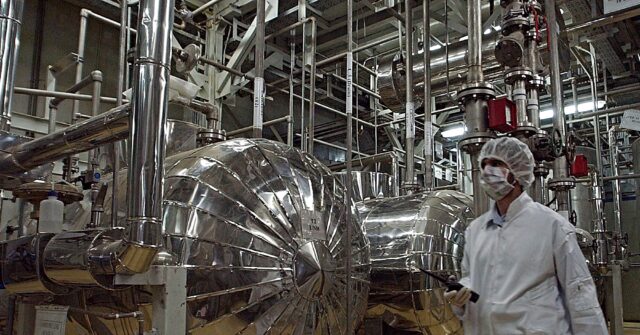
Iran has reportedly collapsed access tunnels and planted explosive mines around a key nuclear facility believed to contain much of the regime’s highly enriched uranium stockpile, potentially complicating a central component of the emerging U.S.-Iran agreement aimed at ending the months-long conflict in the Middle East.
The new fortifications were carried out in recent weeks at Iran’s Isfahan nuclear complex, where much of the regime’s near-weapons-grade uranium is believed to be buried underground. The move comes as President Donald Trump has repeatedly insisted that any final agreement with Tehran must ultimately result in the removal, destruction, or downblending of the enriched material.
The reported effort to seal off the uranium stockpile adds a new layer of uncertainty to negotiations that Trump said Saturday are expected to culminate in the signing of a memorandum of understanding as soon as Sunday. Under the framework currently under discussion, Iran would commit to reopening the Strait of Hormuz and entering technical negotiations over dismantling its nuclear program, while the United States would eventually oversee the disposal of Tehran’s highly enriched uranium.
CNN reported Saturday, citing five sources familiar with U.S. intelligence, that Iran deliberately collapsed tunnels and booby-trapped entrances with explosive mines in an apparent effort to prevent access to the uranium cache.
According to the report, retrieving the material is now significantly more difficult, dangerous, and time-consuming than it was only weeks ago, when Trump was publicly discussing the possibility of using military force to secure the stockpile.
The international community believes much of Iran’s highly enriched uranium remains buried within tunnel networks at the Isfahan facility following last year’s U.S. and Israeli strikes on the regime’s nuclear infrastructure. Additional material is believed to be stored at other nuclear sites.
The fate of that uranium has emerged as one of the most consequential unresolved issues in the ongoing negotiations.
Trump reiterated its importance on Saturday while announcing that an agreement with Iran is expected to be signed on Sunday.
“At the appropriate time, when all is calm, we will go in and get the Nuclear Dust, buried deep under the powerful sunken granite mountains, thanks to our beautiful B-2 Bombers and their brilliant pilots, and downblend and destroy it, whether in Iran, or the United States,” Trump wrote on Truth Social.

The president added that the agreement would prevent Iran from obtaining a nuclear weapon and reopen the Strait of Hormuz immediately after its signing.
A senior Trump administration official similarly told reporters Friday that the emerging agreement ultimately “leads to” the United States obtaining Iran’s stockpile of highly enriched uranium.
“We provide in the agreement that this material would be destroyed on site, and then taken out of the country,” the official said.
The same official acknowledged, however, that the technical details remain unresolved.
“The Iranians commit to destroying and removing the enriched material, but how do you do that? It’s going to take a little bit of time to figure it out,” the official said. “This is very combustible stuff, very volatile stuff. We’re not just going to, like, go down there with a backhoe and a guy with a backpack and start taking it out.”
Experts cited in the report warned that Iran’s new fortifications could create additional verification challenges.
Scott Roecker, who headed the National Nuclear Security Administration’s Office of Nuclear Material Removal from 2017 to 2021, said the reported measures could provide Tehran with an opportunity to claim that portions of its uranium stockpile are inaccessible.
“If this reporting is true, it would definitely complicate retrieving the HEU,” Roecker said.
He warned that if negotiators require Iran to gather the entire stockpile for verification and removal, Tehran could later argue that some of the material is irretrievable.
“We wouldn’t have full confidence that Iran couldn’t retain access to it at some point in the future,” Roecker said.
The report comes one day after CNN revealed that senior U.S. military officials had previously prepared plans for a possible ground operation to seize Iran’s uranium stockpile by force.
According to that report, Chairman of the Joint Chiefs of Staff Gen. Dan Caine made a rushed trip to U.S. Central Command headquarters in Tampa, Florida, in May to review operational plans involving American ground forces entering Iran and securing the material.
RELATED: President Trump: “We’ve Been Pushed Around by Iran for 47 Years, but Not Anymore”

President Trump ultimately declined to authorize the operation after being warned it could trigger severe Iranian retaliation, prolong the conflict, damage the global economy, and result in significant U.S. casualties, according to the report.
Officials familiar with the planning told CNN that physically securing the uranium would likely require hundreds of special operations personnel and a substantial American military presence on the ground.
“It would be insanely difficult to fish through those tunnels and all the barrels,” one source told the outlet. “We’d have to set up a massive presence. Essentially, we’d have to invade.”
Despite the challenges, administration officials have continued to maintain that removing or destroying Iran’s enriched uranium remains a central objective of any final agreement.
Pakistani Prime Minister Shehbaz Sharif said Saturday that negotiators are preparing for an electronic signing of the memorandum of understanding, while Iranian officials have suggested the agreement could still require additional time to finalize.
Even if the memorandum is signed, both sides are expected to enter a subsequent phase of technical negotiations focused on implementing the agreement’s nuclear provisions, including the disposition of Iran’s enriched uranium stockpile.
The newly reported fortifications at Isfahan suggest that process could prove considerably more complicated than negotiators anticipated.
Joshua Klein is a reporter for Breitbart News. Email him at jklein@breitbart.com. Follow him on Twitter @JoshuaKlein.
Read the full article here


