




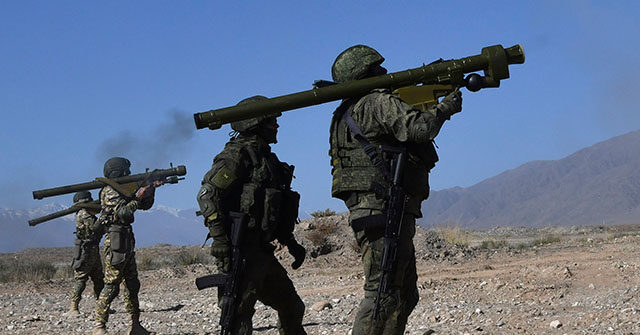
Iran is reportedly anticipating the first delivery installment of 400 Chinese-made shoulder-fired surface-to-air missiles within a matter of weeks, the fruit of a deal worth over $60 million arranged by a Hong Kong-based intermediary.

The missile shipment was reported by Reuters on Wednesday, based on information from three sources who “spoke on condition of anonymity because of the sensitivity of the matter.”

Houthi supporters hold a rally in Sanaa, Yemen, Friday, July 17, 2026, against the Saudi-led coalition. Banner in Arabic reads, “All Saudi oil facilities are targets to our missiles and drones.” (AP Photo/Osamah Abdulrahman)

These sources said a Hong Kong company called Zhongqing Baoshang International Investment acted as the intermediary between Beijing and Tehran for the missile shipment, which seems intended to fill the gaps in Iran’s air defenses exposed by U.S. and Israeli strikes during Operation Epic Fury.

The Iranians learned they could not defend their most sensitive and exposed military sites against state-of-the-art airpower, so China is reportedly stepping in to provide the terrorist state with between 300 and 400 Man-Portable Air Defense Systems (MANPADS), including the advanced QW-12 model, which has extended range and can defeat infrared jamming defenses from the targeted aircraft.

The deal was also said to include one of China’s most powerful MANPADS, the fourth-generation FN-16, which was designed to kill low-flying planes. The FN-16 is believed to be highly resistant to electronic countermeasures (ECM) and can be used to attack aircraft from almost any angle. Variants of this weapon can be mounted on helicopters and used as air-to-air missiles.

In short, the QW-12 is most useful against helicopters, transport planes, and other relatively slow targets, while the FN-16 can quickly engage fast-moving warplanes and drones at low altitudes. If Iran can quickly acquire and deploy such weapons in substantial numbers, U.S. pilots might be forced to adjust their attack patterns to remain at longer distances and higher altitudes from their targets.

According to the Reuters report, Iran was desperate to acquire cash-and-carry weapons that could be delivered quickly. China worked out a scheme for shipping the weapons covertly from the western Chinese city of Urumqi through Pakistan to reach Iran. The sources for the report were uncertain whether the missiles would be shipped by air or ground during each leg of their voyage.

The report was corroborated by European and Middle Eastern security officials who said Iran has been looking to buy Chinese MANPADS for some time and has also expressed interest in Chinese anti-ship cruise missiles. The Reuters report on Wednesday offered the first confirmation that a deal had been reached and products were out for delivery.

Chinese and Pakistani officials indignantly denounced the report. China called it “completely groundless,” while Pakistan said the details of its involvement were “absolutely concocted and false.”

China has simultaneously cultivated a relationship with Iran as a junior partner in the Chinese-Russian axis of tyranny, and insisted that Beijing is a completely neutral party that seeks only peace in the region.

China is Iran’s largest trading partner and buys over 85 percent of its oil exports. In 2021, Beijing and Tehran signed a 25-year “comprehensive strategic partnership agreement” that included defense cooperation. Some intelligence analysts believe China has been secretly giving Iran access to its BeiDou satellite navigation system, greatly improving the accuracy of Iran’s drone and missile attacks.

China has reportedly taken steps to ensure its oil tankers will not be harassed by Iran or its terrorist proxy in Yemen, the Houthis, who are once again menacing ships in the Red Sea. 

Reuters reported on Wednesday that the Houthis are planning to extract ransoms from ships sailing through the Bab el-Mandeb Strait from the Red Sea to the Gulf of Aden, much as their patrons in Iran are scheming to extort money from international shipping through the Strait of Hormuz. 

According to this report, China has already engaged in “direct talks” with the Houthis to ensure its ships will not be attacked or forced to pay extortionate “fees” to use the Bab el-Mandeb Strait.

Read the full article here

Share.
Leave A Reply

Exit mobile version