
A report released this week by researchers at Conflict Armament Research (CAR) revealed that the Houthis, an Iran-backed Yemeni terrorist organization, have been rapidly rebuilding their weapons arsenal through shipments of components, including for missiles and underwater weapons.
The components found to be entering Yemen reportedly bore marks linking them to defense companies in a variety of unexpected countries, including America, Switzerland, and South Korea. CAR warned, however, that many of the parts may be counterfeit and their greater concern with the influx of components is that it indicates the Houthis have improved their ability to build their own weapons and the sophistication of their technical expertise.
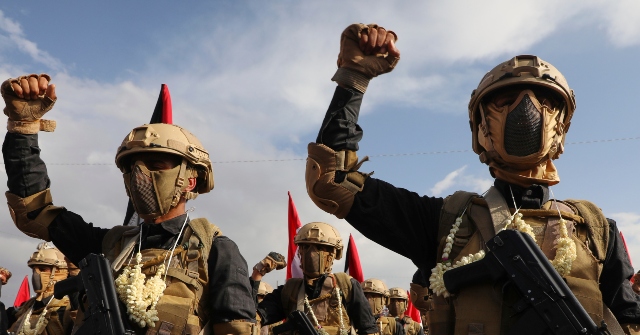
The Houthis, formally “Ansar Allah,” are a Shiite jihadist terrorist organization that has controlled the capital of Yemen, Sana’a, for over a decade. They are believed to rely heavily on Iranian support and elevated their international terror profile in the aftermath of the October 7, 2023, massacres in Israel by Hamas, a fellow Iranian proxy terror group. Falsely asserting themselves as the government of Yemen, the Houthis “declared war” on Israel shortly after October 7 and announced a blockade of commercial shipping in Bab el-Mandeb Strait, sabotaging commerce traversing the Red Sea.
The Houthis ultimately concluded their disruptions of civilian ship travel following the resolution of the Gaza war and have not resumed an active role in the current conflict between Iran and its enemies, America and Israel. While the terrorists have claimed to launch some missiles at Israel, most reports indicate they have chosen a “reserved” stance that raised questions of whether Iran was still supplying their members.
The CAR investigation indicated that the Iranian supplies were, in fact, still entering Yemen.
“The group’s arsenal now includes an array of advanced missiles and uncrewed aerial vehicles (UAVs) that pose a direct threat to shipping, critical infrastructure, and populated areas in the wider region,” the study revealed, describing a far more advanced threat in Ansar Allah than a decade ago. “CAR investigators have documented more than 800 missile and UAV components recovered in recent maritime seizures in the Red Sea. Collectively, these items provide critical insight into the composition and nature of advanced conventional weapon systems — like missiles and UAVs — in Houthi possession.”
The Houthis appear to be avoiding the global weapons sale ban on their organization and sanctions by procuring “dual-use” technology “commercially available and widely found on the open market,” the report suggested.
The study is based on interdictions of shipments intended for the Houthis by the Yemeni National Resistance Forces. While the Houthis have controlled Sana’a since about 2015 and claim to be the government of Yemen, the country is technically in a decade-long state of civil war between the Houthis and its legitimate government headquartered in the southern port city of Aden. The lack of control of actual territory in Yemen has significantly weakened what remains of that government and, in the ensuing struggle, a separate group known as the “National Resistance Forces” (NRF), led by Gen. Tareq Saleh, has become a viable force in Yemen.
The NRF has focused on weakening Houthi forces, particularly through intercepting weapons shipments. In July 2025, for example, the Pentagon congratulated the NRF for seizing a shipment, allegedly from Iran, of over “750 tons of munitions and hardware.” According to the Pentagon’s Central Command (CENTCOM), the shipment included “advanced cruise, anti-ship, and anti-aircraft missiles, warheads and seekers, components as well as hundreds of drone engines, air defense equipment, radar systems, and communications equipment.”
Those shipments, CAR relayed in its report, suggested that the munitions Iran is sending the Houthis have become more advanced. Authorities and experts believe the shipments are from Iran because the interdicted components contained names in Farsi or component references used only in Iran. Only a reported five percent of interdicted components appeared to have been manufactured in Iran, however, presenting a separate problem from the fully constructed weapons.
CAR concluded that the Houthis’ reliance on Iranian support — and, in turn, Iran’s reliance on components manufactured abroad — represent a vulnerability for the terrorist organization.
“While the Houthis have declared these missiles to be locally produced, the identification of Iranian missile designations on the shipped components implies that Houthi domestic production of those systems is limited,” the report asserted. “Moreover, as much as the Houthis depend on external supply of Iranian-origin weapons, Iran itself clearly depends on critical foreign technology to sustain its production of missiles and UAVs.”
“This reliance underscores a clear supply chain vulnerability that can only be elaborated through systematic and sustained field documentation,” it concluded.
The Houthis have maintained only an occasional presence in the ongoing conflict between Iran and its proxies versus America and Israel, but could potentially at any time choose to use its weapons arsenals to support its patrons in Tehran. Houthi leaders claimed in April, for example, to have shot a “barrage of ballistic missiles” at Tel Aviv, which the Israel Defense Forces (IDF) reported they intercepted. Some reports have also identified Houthi terrorists fighting alongside Hezbollah, another Iranian proxy, in Lebanon, where Israel launched a ground invasion following America’s strikes on Iran in March.
The Times of Israel reported on Tuesday, citing the IDF, that Israel intercepted a drone seemingly launched from Yemen targeting the Red Sea port city of Eilat, the first such attack since the Iran conflict began.
Follow Frances Martel on Facebook and Twitter.
Read the full article here